Chevrolet
Home charging for Chevrolet EVs: the 2027 switch to NACS, GM's home adapters, onboard charger limits and the GM Energy charger lineup.

Your car's onboard charger and charge port set the right home charger and circuit. Start with the car, then size everything else to it.
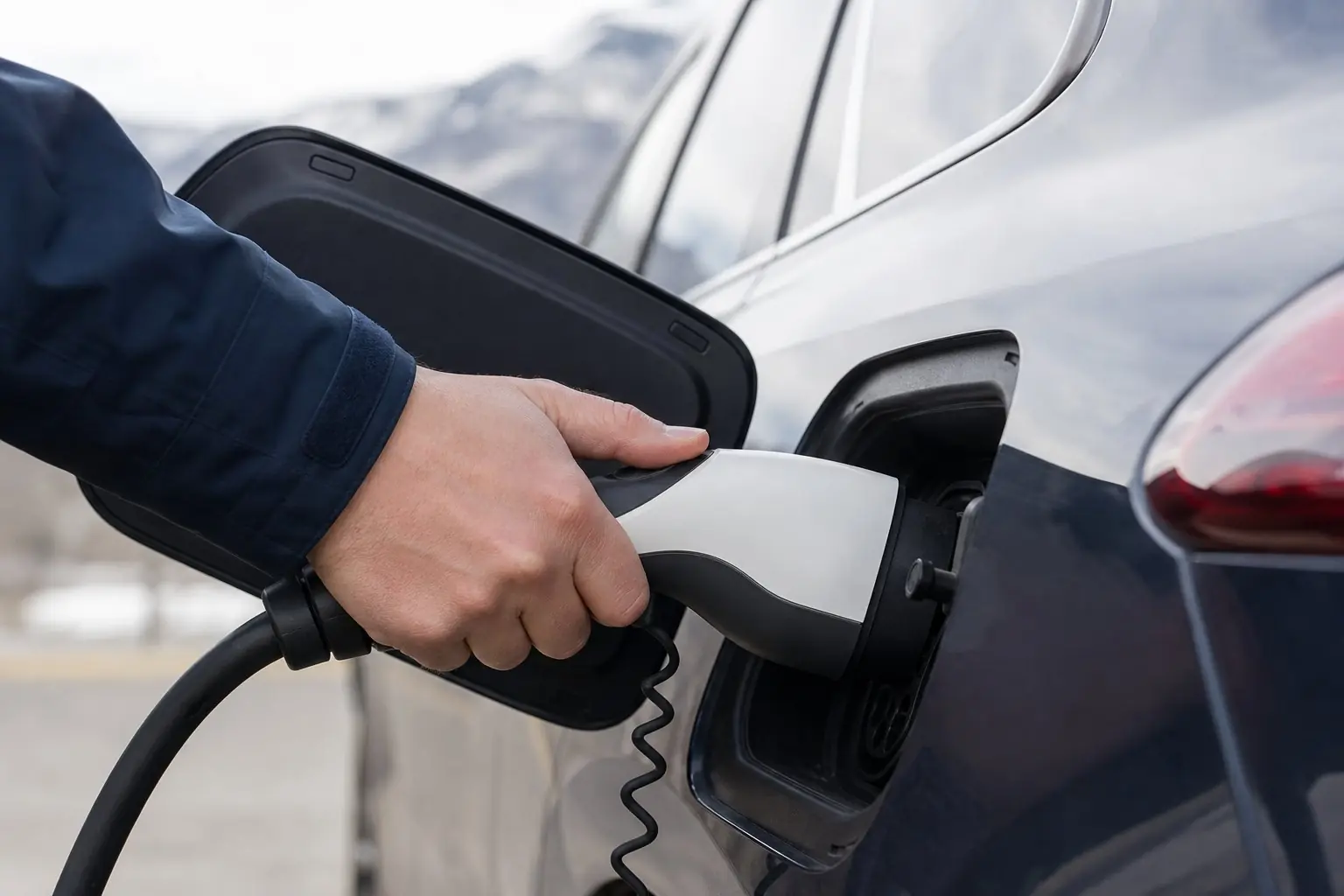
A Level 2 charger supplies AC power, and the car's onboard charger converts it to charge the battery. The onboard charger sets the ceiling: if your car accepts 48 amps, a 48 amp charger on a 60 amp circuit is full speed, and anything larger adds wire and breaker cost without adding speed. The charge port decides which plug the charger needs.
Short on time? The EV charger finder shows the port, circuit and chargers for your car in one step.
Ford puts it plainly in a footnote to its charger table: the "Vehicle onboard charger may limit the rate of charging." That is true of every EV. It is why we ask what you drive before talking about breakers, and why two neighbors on the same street in Ogden or North Ogden can need very different circuits.
The second thing the car decides is the connector. A car with a J1772 or CCS1 port takes a J1772 charger. A car with a NACS port takes a NACS charger. Mixed households need a charger that offers both. Circuit sizing itself is covered on our Level 2 EV charger installation page.
Check the owner's manual charging section first, then the window sticker or order paperwork, then the manufacturer's spec sheet for your exact model year and trim. Do not assume one number for a model name. Ratings change between years, batteries and trims, and some fleet versions carry options retail buyers could not order.
The F-150 Lightning shows how much this matters. Ford lists 80 amps (19.2 kW) for 2022 and 2023 Extended Range trucks, but 48 amps for Standard Range trucks and for all 2024 and 2025 retail trucks. Ford's 2024 order guide lists a dual onboard charger as a fleet-only option. Same truck name, two very different circuits. The full breakdown is in our F-150 Lightning home charging guide.
Look for the rating in amps or kilowatts for AC or Level 2 charging, not the DC fast-charging figure, which is far higher and irrelevant at home. If the paperwork is gone, the make guides below collect the ratings we have verified from manufacturer sources.
Automakers are moving from the J1772 and CCS1 port to Tesla's NACS port, standardized by SAE as J3400. Kia's 2025 EV6 and Hyundai's 2025 IONIQ 5 adopted NACS, while most cars already on the road use J1772 or CCS1. At home, match the charger's cable to your port, or choose a unit with both connectors for a mixed garage.
The transition is gradual and uneven. Ford announced in 2023 that it would move to NACS on next-generation EVs, yet its 2022 to 2025 Lightning and Mach-E use CCS1 with an adapter for Tesla Superchargers. Check your own car rather than the brand's announcements.
Adapters are not interchangeable either. Ford says its NACS adapter is "Not compatible with Level 1 or Level 2 AC chargers," so a Ford cannot use it on a NACS-only home charger. Tesla's Universal Wall Connector solves the mixed-garage problem with a NACS handle and a docked J1772 adapter, at up to 48 amps. See our home EV charger guides and the Tesla Wall Connector guide.
Home charging for Chevrolet EVs: the 2027 switch to NACS, GM's home adapters, onboard charger limits and the GM Energy charger lineup.
Home charging for Ford EVs: J1772 at home, onboard charger limits, Ford's own charging equipment and what changed.
Hyundai's port change to NACS, the shared 10.9 kW onboard charger on IONIQ 5 and 6, and what Hyundai offers for home charging.
Home charging for Kia EVs: onboard charger ratings, the CCS1 to NACS port change, adapters and what Kia supplies.
Home charging for Rivians: the 2026 switch to NACS, the 48 amp setup, Rivian's own chargers and which adapters work at home.
What each Tesla accepts at home, the NACS port, Tesla's home charging equipment and garages with two cars.
Only up to your car's onboard charger rating. The car decides how much AC current it accepts, and the charger and circuit only need to match it. Ford's own charger table notes that the vehicle's onboard charger may limit the charging rate. Paying for a larger circuit than your car can use buys nothing today, though it can make sense if a second EV is coming.
Start with the owner's manual charging section, then the window sticker or order paperwork, then the manufacturer's published spec sheet for your exact model year and trim. Ratings can differ by battery, trim and year. Ford's F-150 Lightning, for example, ranges from 48 amps to 80 amps depending on those details.
A charger with a NACS cable is the simplest match for a NACS-port car. Older cars with a J1772 or CCS1 port need a J1772 charger. If your household has both, a charger with both connectors, such as Tesla's Universal Wall Connector with its docked J1772 adapter, covers each car without loose adapters.
Not always. Ford's NACS adapter, for example, is for Tesla Superchargers and Ford says it is not compatible with Level 1 or Level 2 AC chargers, including home chargers with NACS connectors. Check your adapter's documentation before planning a home setup around it.