
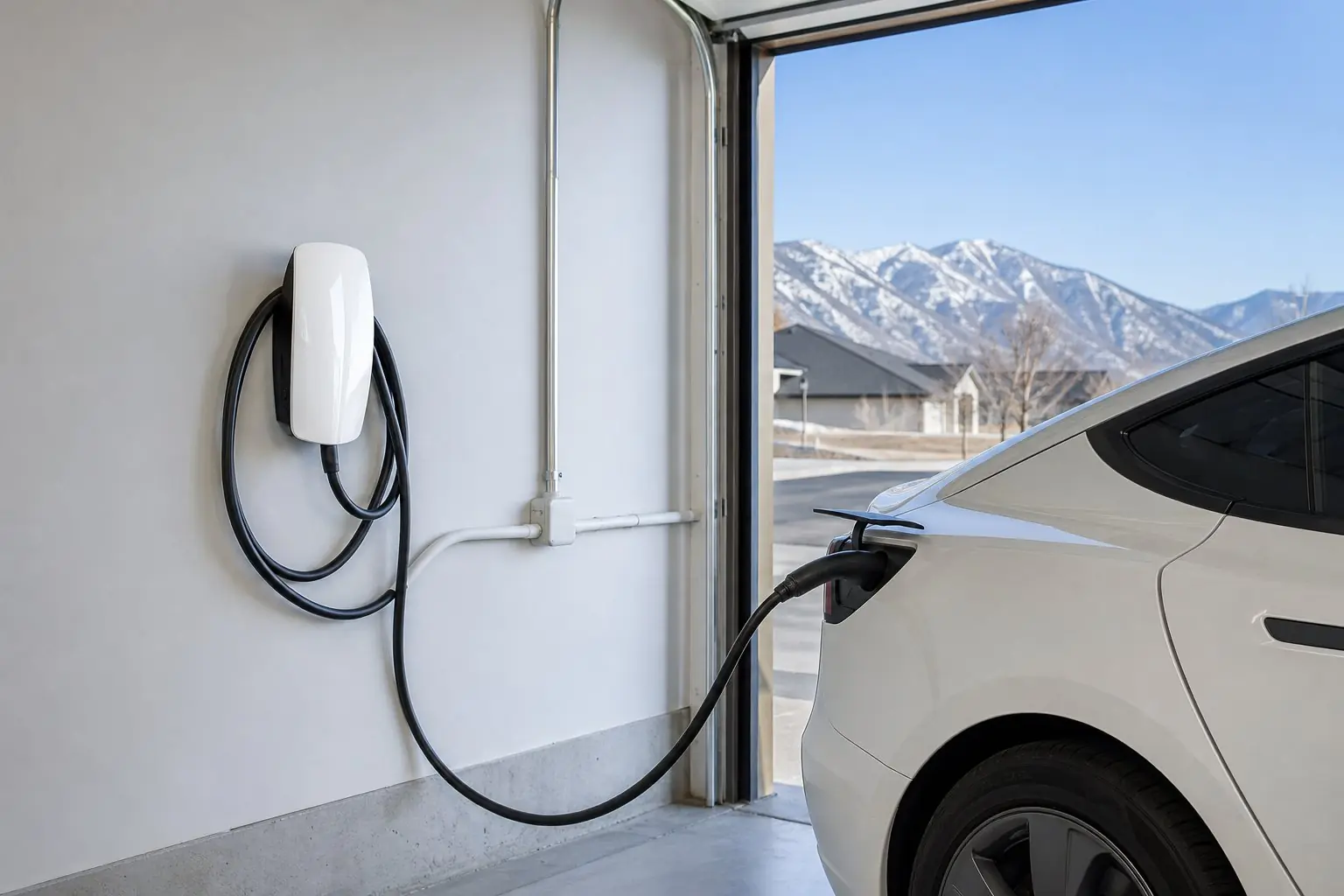
What a home EV charger installation includes
A home installation is a new 240-volt circuit from your electrical panel to a wall-mounted charger or a NEMA 14-50 outlet. It includes the breaker, correctly sized wire, conduit or cable, mounting, testing under load, and the permit and inspection your city requires. The charger itself may be one you already own or one we help you choose.
Want numbers for your car? The EV charging time calculator compares setups side by side.
Most of the work, and most of the cost, sits between the panel and the parking spot. The charger is the visible part; the circuit behind it decides how fast you can charge and how safely it runs every night for the next decade.
- Breaker and circuit: a dedicated two-pole breaker sized at 125 percent of the charger's output.
- Wire and route: copper conductors sized for the circuit, run through walls, attics, crawlspaces, surface conduit or underground.
- The charging point: a hardwired charger, or a NEMA 14-50 receptacle with GFCI protection for a plug-in charger.
- Setup: the charger's amperage set to match the breaker, Wi-Fi and app setup if it has them, and a test charge.
- Permit and inspection: through Ogden City, South Ogden, North Ogden or Ogden Valley City.
Choosing the right amperage for your car
Match the charger to your car's onboard charger, then to what your panel can spare. Many EVs accept around 32 to 48 amps on Level 2. A 40 or 48 amp setup charges almost any EV overnight, and a 32 amp circuit is often plenty for daily driving when panel capacity is tight.
A Level 2 circuit running all night delivers a lot of energy. A 32 amp charger at 240 volts supplies about 7.7 kW, so eight overnight hours put roughly 60 kWh into the battery before charging losses. For most Ogden commutes, even a trip down to Salt Lake and back, that refills what you used in a day with time to spare.
| Setup | Breaker | Power | Energy in 8 hours |
|---|---|---|---|
| Standard 120 V outlet (Level 1) | 15 or 20 amp | about 1.4 kW | about 11 kWh |
| 32 amp Level 2 | 40 amp | 7.7 kW | about 61 kWh |
| 40 amp Level 2 | 50 amp | 9.6 kW | about 77 kWh |
| 48 amp Level 2 (hardwired) | 60 amp | 11.5 kW | about 92 kWh |
Energy figures are the circuit's output before charging losses, and assume the car's onboard charger can accept that rate. Check your vehicle's rating in our vehicle charging guides.
Bigger is not automatically better. If your car tops out at 32 amps, a 60 amp circuit buys nothing but larger wire. If you expect a second EV or a truck with a larger onboard charger, it can make sense to pull wire sized for the future and set the charger lower today.
Attached garage, detached garage or driveway
An attached garage with the panel nearby is the simplest install. Detached garages usually need an underground run and sometimes a subpanel, and outdoor chargers need weather-rated equipment placed away from snow and plows. The location decides more of the price than the charger does.
Attached garages
When the panel is in the garage or on the other side of a garage wall, the run can be a few feet. Finished drywall, a panel in a basement on the opposite side of the house, or a run through an attic all add labor.
Detached garages and older Ogden homes
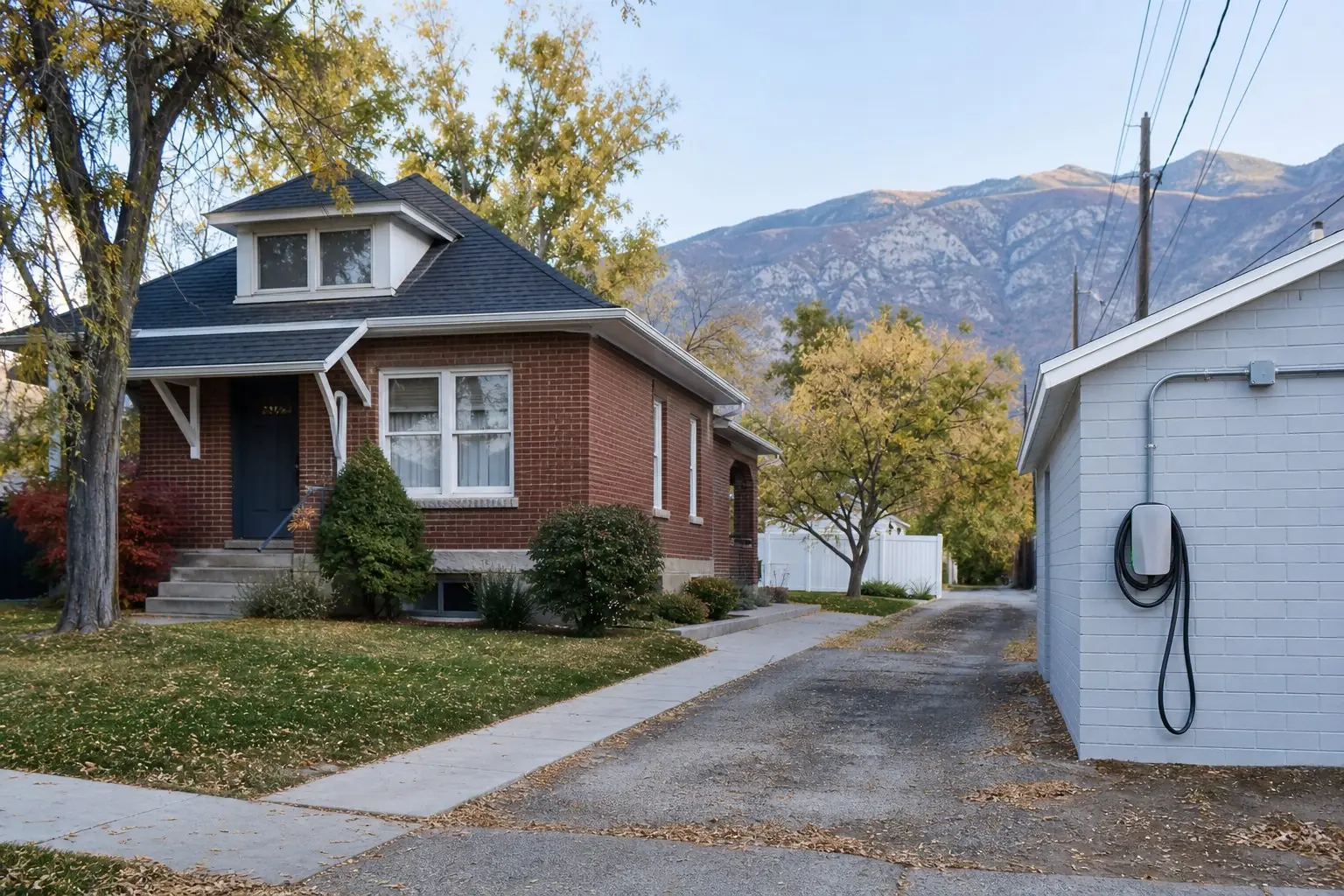
Ogden City's plans for older neighborhoods such as Hillcrest/Bonneville and Horace Mann describe garages set at the back of the lot, often detached. Reaching them usually means trenching from the house, conduit rated for burial, and sometimes a small subpanel in the garage so the charger and the garage lights do not share one feeder. See garage EV charger installation for the details.
Outdoor and driveway chargers
Outdoor installs need a charger and fittings rated for weather, a holster that keeps the connector off the ground, and a spot plows and shovels will not hit. In Eden and Ogden Valley, NOAA's 1991 to 2020 normals at Pineview Dam show a January average low near 9.5°F and roughly 108 inches of snow a year, so cable length and placement matter. More on outdoor EV charger installation.
Hardwired charger or NEMA 14-50 outlet
Choose hardwired for the highest charging rate, outdoor locations and the fewest wear points. Choose a NEMA 14-50 outlet if you want to use a portable charger or take it with you when you move. In Utah, a receptacle installed for EV charging still needs GFCI protection, which adds a GFCI breaker to the cost.
Utah adopted the 2023 National Electrical Code and removed 240-volt receptacles from the general GFCI rule, but the EV article's GFCI requirement for charging receptacles still applies. A hardwired charger has ground-fault protection built in. The full comparison is on the NEMA 14-50 installation page.
Will your electrical panel handle it?
Often, yes, but it takes a load calculation to know. The calculation adds up your home's existing loads and shows how much capacity is left for a charger. When capacity is short, options include a smaller charger setting, a load management device that throttles charging when the house is busy, or a panel or service upgrade.
A photo of the open panel door, with the breaker labels visible, tells an electrician a lot before a visit: the panel's rating, whether there is room for a two-pole breaker, and which large loads are already on it. That is why the quote form asks for one. The load calculation comes first; a panel upgrade only if load management can't do the job.
Related: EV charger load management and panel upgrades for EV charging.
Permits and inspection
A new EV charging circuit is permitted electrical work in Ogden. Ogden City requires a permit to install, alter, change, extend, repair or replace an electrical system. South Ogden and North Ogden issue their own electrical permits, and Eden addresses now go through Ogden Valley City, not Weber County.
Owner-occupants in Ogden may pull their own permit; rentals need a Utah-licensed contractor. We handle the permit application and schedule the city inspection. The Ogden EV charging guide keeps the current process for each city.
Charging off-peak with Rocky Mountain Power
Rocky Mountain Power's optional residential time-of-use schedule sets on-peak hours at 6 to 10 p.m. on weekdays. Its tariff lists on-peak energy at about 33.6 cents per kWh in summer and 29.7 cents in winter, against about 7.5 and 6.6 cents off-peak. Charging after 10 p.m. keeps nearly all of it off-peak.
Rates are from Rocky Mountain Power's Utah Schedule 1 tariff effective August 10, 2026, and they change. The option carries a one-year commitment, so compare it with your current bill before switching. Most EVs and smart chargers can start charging at a set time, which is the simplest way to use it.
Ended Rocky Mountain Power's residential charger rebate was removed effective January 1, 2026, and the federal 30C credit does not apply to chargers placed in service after June 30, 2026.
What to expect on install day
The power is off for part of the visit while the breaker goes in. The charger is mounted where the cable reaches your charge port comfortably with the car parked normally, the circuit is tested, and the charger is set to the breaker's amperage. If the charger has an app, it gets connected to your Wi-Fi and you get a walkthrough of scheduling. The inspection follows on the city's schedule.
Home EV charger installation questions
How long does a home EV charger installation take?
The electrical work for a straightforward attached-garage install is usually a single visit. Longer runs, detached garages that need trenching, subpanels and panel upgrades take more time, and the city inspection is scheduled separately after the work is done.
Can I install an EV charger myself in Ogden?
Ogden City lets homeowners who live in the home pull their own electrical permit, so it is legal for an owner-occupant to do the work and have it inspected. A 240-volt, 40 to 60 amp circuit is not beginner work, though, and rentals require a Utah-licensed contractor.
Do I need a smart charger?
Not strictly. Many EVs can schedule charging from the car's own app. A smart charger adds scheduling at the charger, energy tracking and, on some models, power sharing or load management. It is most useful when you want to stay inside off-peak hours or share one circuit between two cars.
What if I have two EVs?
Two cars rarely need two full-size circuits. Chargers with power sharing, such as two Tesla Wall Connectors on one circuit, split the available current and give each car a full charge overnight. A second dedicated circuit is an option when the panel has capacity to spare.
Will a home charger raise my electric bill much?
It depends on how far you drive and when you charge. Rocky Mountain Power's optional residential time-of-use schedule prices off-peak energy far below its 6 to 10 p.m. weekday peak, so most home charging can be scheduled into the cheapest hours.
Ready for a number? Your car model and a panel photo are the best place to start.
Get a home charger quote