
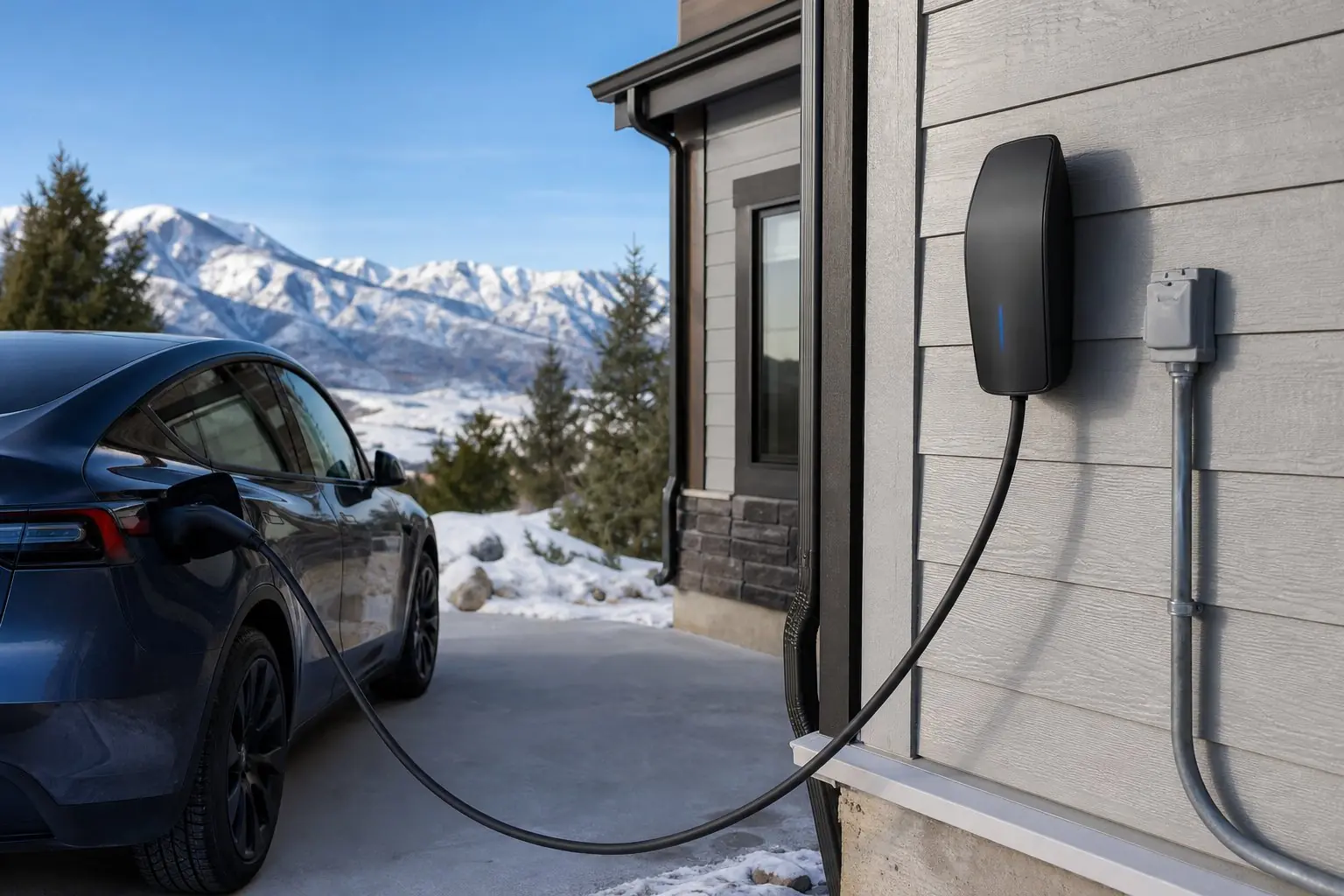
What makes an outdoor EV charger installation different?
Everything has to be rated for weather: the charger enclosure, the conduit fittings and, for a plug-in charger, the outlet cover. Placement matters more too, because snow, roof shed, plows and a cable left on the ground cause most outdoor problems. In most cases a hardwired charger is the simpler outdoor choice.
ChargePoint recommends hardwiring "for outdoor use," and Tesla's manual calls for "watertight fittings when securing feeder wires to the wirebox" on outdoor installs. Why hardwired beats a plug outdoors is laid out in hardwired vs NEMA 14-50; the install itself is on hardwired EV charger installation.
What do NEMA 3R, Type 4 and IP ratings mean?
They describe what the enclosure keeps out. NEMA Type 3R protects against rain, sleet and snow and is undamaged by ice forming on it. Type 4 adds windblown dust and splashing or hose-directed water. Type 4X adds corrosion resistance. An IP rating's first digit covers solids and its second digit water.
| Rating | Protects against (per NEMA) |
|---|---|
| Type 3R | Falling dirt; rain, sleet, snow; undamaged by external ice |
| Type 4 | Falling dirt and windblown dust; rain, sleet, snow, splashing and hose-directed water; undamaged by external ice |
| Type 4X | Type 4 plus "an additional level of protection against corrosion" |
NEMA warns that IP codes "cannot be exactly equated" with its Type numbers, partly because NEMA tests for things IEC 60529 does not, such as icing and corrosion. So a charger listed as both Type 3R and IP54, like Tesla's Wall Connector, is described two ways, not twice protected.
Which chargers are rated for Utah cold?
Most popular home chargers are rated to operate down to -22°F. That covers normal winters even in the Ogden Valley, where NOAA's 1991 to 2020 normals for Pineview Dam show a January average low of 9.5°F and about 16 nights a year at or below 0°F. Check the top of the range too for a sun-facing wall.
| Charger | Enclosure | Operating range | Cable |
|---|---|---|---|
| Tesla Wall Connector (Gen 3) | Type 3R, IP54 | -22°F to 122°F | 24 ft |
| ChargePoint Home Flex | Type 3R | -22°F to 122°F | 23 ft |
| Emporia Pro | Type 4 | -22°F to 122°F | 25 ft |
| Wallbox Pulsar Plus | Type 4 | -22°F to 104°F | 25 ft |
From each manufacturer's install manual or datasheet, checked October 2026. More models are compared on home EV chargers.
Ogden itself is milder: its Pioneer station averages 21.9°F in January with almost no sub-zero nights. How cold affects the car itself while charging is covered in EV charging in Utah winters.
Where should an outdoor charger go so snow and plows do not hit it?
On a wall or pedestal out of the roof's snow-shed line, above where the snowbank builds, and away from where a plow or blower throws snow. It should still sit within easy cable reach of the charge port. Tesla sets a 24 inch minimum height outdoors and 60 inches maximum.
- Gable ends and covered walls are better than under an eave that dumps sliding snow.
- Mount above a full winter's shoveled pile, not just the 24 inch minimum, in Eden and on the upper benches.
- Keep the charger and conduit out of the plow's path at the edge of the driveway.
- Put it on the side of the parking spot where the charge port faces, so the cable never crosses the driveway.
Valley-specific advice for Eden, Liberty and Wolf Creek, including second homes, is on the Eden EV charger installation page.
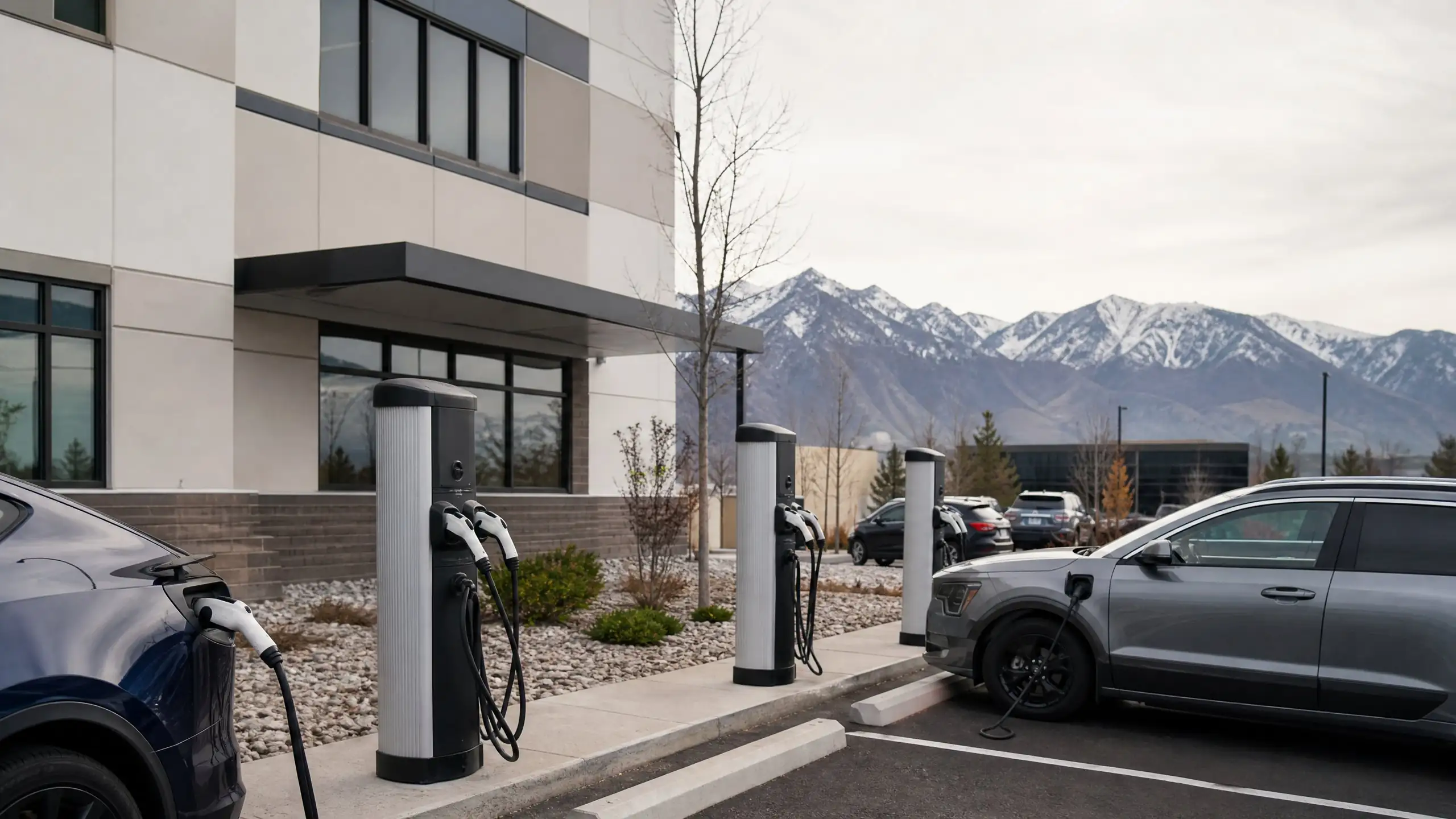
When does a pedestal make sense?
When there is no wall within cable reach of where you park, such as a detached parking pad, a long driveway or a shared lot. A pedestal is fed by an underground circuit. Tesla's manual allows mounting on a pedestal, with sealing washers to keep the Type 3R rating.
Tesla's exact note: "Type 3R rating is only possible when washers have sealing gaskets. If mounting to alternate surface (such as a prefabricated pedestal), use alternate fasteners with sealing washers." Its Universal Wall Connector manual also shows two units on one pedestal for side-by-side spaces. The underground run to a pedestal follows the same burial rules as a run to a detached garage; see garage EV charger installation.
In Ogden Valley City, ask the city whether a charger with indicator lights or a lit pedestal needs an outdoor lighting review.
How should the cable be managed outdoors?
Holster the connector after every session and keep the cable off the ground. A connector left lying in the driveway fills with snow, freezes and gets driven over. Tesla says to coil the cable in loose loops at least 2 feet across and never hang its weight from the handle.
- Tesla suggests a cable organizer near the charger when space is tight.
- A shorter path from charger to port means less cable on the ground; choose the wall nearest the port.
- Tesla's Mobile Connector should not be used in "severe rain, snow, electrical storm or other inclement weather," or stored "in a recessed area or below floor level."
What are the rules for an outdoor 14-50 outlet?
A 30 amp or larger receptacle in a wet location feeding an unattended load, such as a charging car, needs an enclosure that stays weatherproof "with the attachment plug cap inserted or removed," as Mike Holt explains the NEC rule in EC&M. That means an in-use cover, on top of the GFCI breaker every EV receptacle needs.
That EC&M Q&A was written against an earlier NEC edition, so confirm the current text with your inspector. Leviton's 1450W is the weather-resistant version of its EV-rated 14-50. Full details are on NEMA 14-50 outlet installation.
What we look at for an outdoor install
Photos of the wall or parking spot, the roofline above it and your panel let us plan the route and placement before a visit. We look at the charge port side, snow shed and plow paths, conduit route and fittings, and whether a pedestal is needed. We pull the permit with Ogden, South Ogden, North Ogden or Ogden Valley City and schedule the inspection. See the EV charger permit guide.
Outdoor EV charger questions
Is NEMA 3R good enough for an outdoor EV charger in Utah?
For a wall-mounted home charger, generally yes. NEMA defines Type 3R as protecting against rain, sleet and snow and being undamaged by ice forming on the enclosure. Type 4 adds windblown dust and splashing or hose-directed water, which helps where the charger may be sprayed or splashed.
Will an outdoor charger work in Eden's winters?
The common home chargers are rated to operate down to -22°F, and NOAA's normals for Pineview Dam show a January average low of 9.5°F. Cold is rarely the limit. Snow, ice, roof shed and plows cause more trouble, so placement matters more than the temperature spec.
Can I leave a portable charging cord plugged in outside?
Only into an outlet with a cover that stays weatherproof with the plug inserted. Tesla also warns against using its Mobile Connector in severe rain, snow or storms, or storing it in a recessed area or below floor level. For permanent outdoor charging, a hardwired charger is usually the better fit.
Do I need a pedestal for an outdoor charger?
Only if there is no suitable wall within cable reach of where you park. A pedestal puts the charger beside the parking spot and is fed underground. Tesla's manual allows mounting on a pedestal but says to use fasteners with sealing washers to keep its Type 3R rating.
Charging in the driveway? Send a photo of the wall or spot and your panel.
Get an outdoor charger quote