Autel MaxiCharger
The six current AC Elite Home models, the rotary current selector and breaker sizes up to 70 amps, cold rating, connectivity and GFCI notes.

Connector, amps, hardwired or plug-in, outdoor rating and app features, with a spec table checked against manufacturer documents.
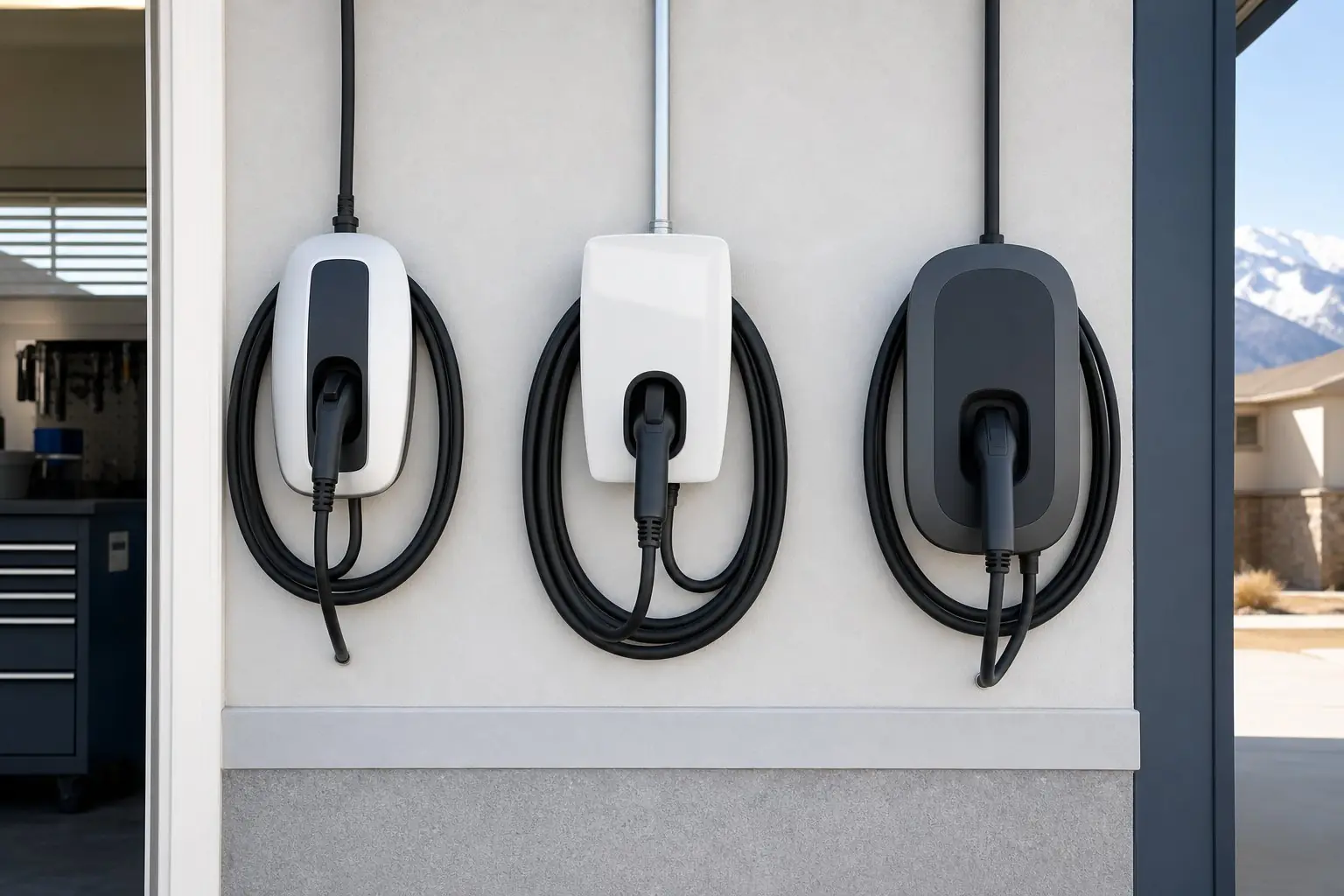
Five things: a connector that fits your car, an output that matches your car's onboard charger and your panel, hardwired or plug-in, an enclosure rated for where it will hang, and app features you will use. Most home Level 2 chargers top out at 40 to 50 amps, so the circuit behind the charger usually matters more than the brand.
Older non-Tesla EVs use the J1772 connector for Level 2. Teslas use NACS, now standardized as SAE J3400, and more automakers are moving to it: Kia's 2025 EV6, for example, adopted a NACS port. Most chargers in the table below are sold in both versions, so buy the one that matches the car you will plug in most. In a mixed garage, a unit with both connectors, such as Tesla's Universal Wall Connector, saves an adapter.
If you plan to use an adapter, check its rating. Ford's Fast Charging Adapter (NACS) for the F-150 Lightning is listed by Ford as "not compatible with Level 1 or Level 2 AC chargers," so it will not let a Lightning charge from a NACS-only home unit.
A charger cannot push more current than your car's onboard charger accepts. A 48 amp charger on a car limited to 32 amps charges at 32 amps. The charger also needs a breaker at 125 percent of its output: 40 amps on a 50 amp breaker, 48 amps on a 60 amp breaker. Our vehicle charging guides list onboard charger ratings, and panel upgrades for EV charging covers what happens when capacity is short.
Plug-in versions use a NEMA 14-50 (sometimes 6-50) outlet and are usually capped at 40 amps. ChargePoint's datasheet, for example, limits its NEMA models to 32 or 40 amps, and Emporia's to 40 amps, while their hardwired versions reach 50 and 48 amps. In Utah, a receptacle installed for EV charging needs GFCI protection, which can conflict with the charger's own ground-fault protection. Emporia recommends its hardwire version when code requires a GFCI breaker on a 14-50 circuit, and ChargePoint says to use a non-GFCI breaker for hardwired installs. The trade-offs are on our NEMA 14-50 installation page.
For a driveway or carport, look for a NEMA Type 3R or Type 4 enclosure and an operating range that covers your winters. Most units below are rated down to -22°F. That matters more in Eden and Ogden Valley than on the Ogden bench; see outdoor EV charger installation.
Rocky Mountain Power's optional residential time-of-use schedule puts on-peak hours at 6 to 10 p.m. on weekdays, with off-peak energy priced far lower. Either the car or the charger can hold a start time of 10 p.m. or later. A Wi-Fi charger adds scheduling at the wall, energy history and firmware updates, which helps when the car's own scheduler is weak.
Some chargers can share one circuit. Tesla's manuals say up to six Wall Connectors at one site can share the available power over Wi-Fi. That can avoid a second full-size circuit. Load management that watches the whole house is a related option, covered on our EV charger load management page.
Specs below come from each manufacturer's datasheet, manual or product page, checked October 4, 2026. Where a manufacturer's page did not state a spec, the cell says so rather than guessing. Prices are left out because they change often.
| Charger | Max output | Connector | Hardwired or plug-in | Enclosure and temperature |
|---|---|---|---|---|
| Tesla Wall Connector (Gen 3) | 48 A | NACS | Hardwired only | Type 3R, IP54; -22°F to 122°F |
| Tesla Universal Wall Connector | 48 A | NACS plus built-in J1772 adapter | Hardwired only | Type 3R, IP54; -22°F to 122°F |
| ChargePoint Home Flex (CPH50) | 50 A hardwired; 32 or 40 A plug-in | J1772 or NACS versions | Hardwired, NEMA 14-50 or NEMA 6-50 | Type 3R; -22°F to 122°F |
| Emporia Pro | 48 A hardwired; 40 A plug-in | J1772 or NACS versions | Hardwired or NEMA 14-50 | Type 4; -22°F to 122°F |
| Wallbox Pulsar Plus | 48 A (hardwired model); 40 A model | J1772 or NACS versions | 48 A: hardwired. 40 A: NEMA 14-50 or hardwired | NEMA Type 4; -22°F to 104°F |
| Grizzl-E Classic Connect | 40 A | J1772 or NACS | NEMA 14-50 plug-in | UL Type 4; -22°F to 122°F |
| Grizzl-E Ultimate 48A | 48 A | J1772 or NACS | Hardwired only | UL Type 4; -22°F to 122°F |
| Autel MaxiCharger AC Elite Home | 50 A hardwired; 40 A plug-in | J1772 | Hardwired, NEMA 14-50 or NEMA 6-50 | NEMA 4; -40°F to 131°F (Autel spec sheet) |
| Rivian Wall Charger | 48 A | J1772 (2022 to 2025 R1) or NACS (2026 and later) | Hardwired only, per Rivian's install guide | NEMA 3R, -22°F to 122°F (J1772 version install guide) |
Plug-in amperage is the manufacturer's limit for its NEMA versions. Actual charging speed is the lowest of the charger setting, the circuit and the car's onboard charger.
Not listed JuiceBox chargers are left out of this table.
Model-by-model notes on specs, circuit sizing and installation details.
The six current AC Elite Home models, the rotary current selector and breaker sizes up to 70 amps, cold rating, connectivity and GFCI notes.
Home Flex amp settings and breaker sizes, hardwired vs plug-in limits, ChargePoint's GFCI breaker guidance and the NACS version.
Emporia Pro specs and breaker settings, the Vue 3 monitor that goes in your panel, and how PowerSmart load management is configured.
Ford no longer sells the Charge Station Pro: what existing owners and used F-150 Lightning buyers need to know about its 80 amp circuit, backup power and replacements.
The current Grizzl-E lineup from Classic to Ultimate 80A: plug-in or hardwired, amp settings, the aluminum Type 4 enclosure and what an 80 amp install needs.
J1772 vs NACS versions, the 60 amp hardwired circuit, dip switch output settings, mounting rules and what Rivian's warranty asks of the installer.
Gen 3 vs Universal Wall Connector: breaker sizes, cable, cold ratings, power sharing, app setup and what Tesla's manuals say about installers.
Pulsar Plus 40A vs 48A, the rotary current selector, Power Boost with Wallbox's meter, and the 104°F upper temperature limit.
The one whose connector matches your charge port and whose output meets your car's onboard charger rating without exceeding what your panel can spare. The current models in our table are rated 40 to 50 amps. Beyond that, choose on cable length, outdoor rating, and if you need them, app scheduling or power sharing.
Only if your car accepts 48 amps and your panel can support the 60 amp circuit it needs. A 40 amp charger on a 50 amp circuit adds about 77 kWh in eight hours, which covers a typical day of driving with room to spare. If panel capacity is tight, the smaller setting can be the better choice.
Yes, with an adapter rated for Level 2 AC charging, and a unit with both connectors avoids the question. Check that the adapter is rated for Level 2 AC charging: Ford's Fast Charging Adapter for the F-150 Lightning, for example, is DC only and will not work on a home charger.
Not if your car can schedule charging on its own, which most can. Wi-Fi and an app add scheduling at the charger, energy tracking, firmware updates and, on some models, power sharing between units. It is most useful in a two-EV household or when a car lacks good scheduling.
Hardwired for the highest output, outdoor spots and no outlet to wear out. Plug-in if you want to take the charger with you or swap it later. Plug-in versions are usually capped at 40 amps, and in Utah the outlet needs GFCI protection, which some chargers' manufacturers warn can cause nuisance tripping.
Picked a charger, or still deciding? Send your car model and a photo of your panel.
Get a charger installation quote