Cybertruck Home Charging
The 60 amp Universal Wall Connector circuit, why Tesla discourages 120 V charging, and the equipment and rules behind Powershare home backup.

Every Tesla plugs into the same NACS port, but not every Tesla takes the same current. Here is how to size a home setup to the car you actually own.
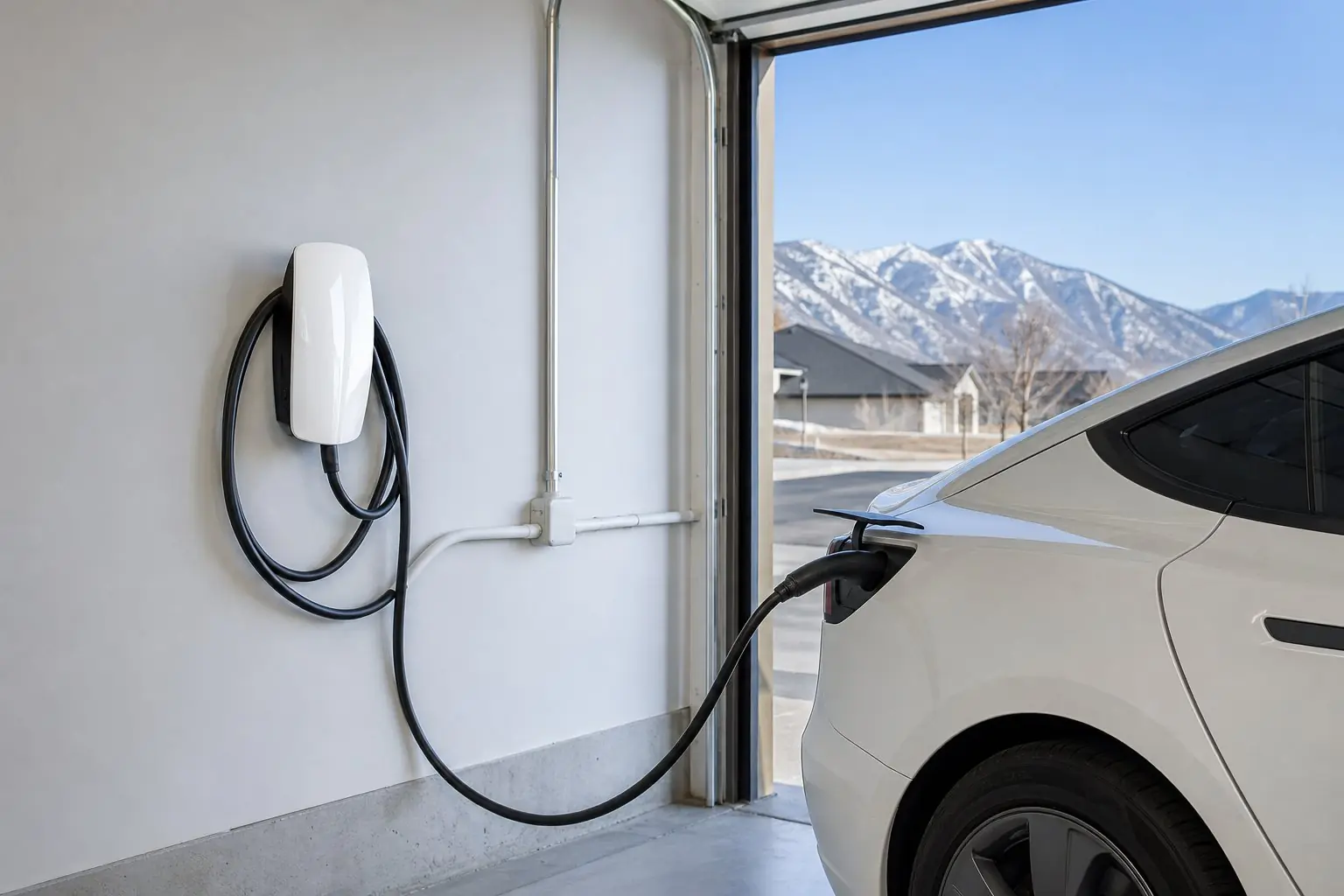
Most Teslas accept 48 amps (11.5 kW), which a Wall Connector delivers on a 60 amp breaker. The exception is the rear-wheel-drive base model: Tesla lists Model 3 Rear-Wheel Drive at 32 amps (7.7 kW) on a 40 amp breaker, and its home charging FAQ says the same for Model Y Rear-Wheel Drive. A larger circuit than the car accepts adds cost, not speed.
| Model (Tesla's naming) | Onboard charger | Breaker Tesla recommends for a Wall Connector |
|---|---|---|
| Model S, Model X | 48 A (11.5 kW) | 60 A |
| Model 3 Long Range, Model 3 Performance | 48 A (11.5 kW) | 60 A |
| Model 3 Rear-Wheel Drive | 32 A (7.7 kW) | 40 A |
| Model Y | 48 A (11.5 kW) | 60 A |
| Model Y Rear-Wheel Drive (home charging FAQ) | 32 A | 40 A |
From Tesla's Onboard Charger and Home Charging support pages. Tesla's website blocks automated checks, so we read both through Internet Archive captures from April and May 2026. The onboard charger table lists "Model Y" without a trim split, while the FAQ singles out Model Y Rear-Wheel Drive at 32 amps. Cybertruck is not in the table.
Tesla's own tie-breaker is the simplest: "Tap the lightning bolt icon on the touchscreen to view the max amperage of your vehicle." Tesla's current sales names (Standard, Premium, Performance) do not line up neatly with the names in its charging table, so check the car itself before choosing between a 40 amp and a 60 amp circuit.
One guide per model. The Model 3 home charging guide covers the 32 amp versus 48 amp split. The Model Y home charging guide covers Tesla's conflicting Model Y figures. The Model S, Model X and Cybertruck guides cover the larger cars.
Tesla's table is a snapshot of its lineup, not a history. For an older or used Tesla, read the maximum from the car's charging screen rather than assume it matches.
The NACS port. Tesla's owner's manual says all Tesla vehicles have a North American Charging Standard (NACS) charge port and can charge on Tesla's Supercharger, Wall Connector and Mobile Connector. Any Tesla home charger fits any Tesla, so the only sizing question is current.
On adapters, the manual says only that "the most commonly used adapter(s) for each market region are provided." Confirm what came with your car if you plan to use a J1772 charger. The reverse direction is the bigger trap: Ford's Supercharger adapter, for example, is not compatible with Level 2 AC chargers, so a NACS-only Wall Connector will not charge a CCS1-port Ford.
Three products. The Mobile Connector is a 20 foot portable cable with plug adapters, up to 32 amps on a NEMA 14-50. The Wall Connector is a hardwired 48 amp unit with a NACS cable. The Universal Wall Connector adds a docked J1772 adapter for other EVs. Tesla's home charging page says a Wall Connector is not required.
Which one fits depends on the car's onboard charger and where you park. For a 48 amp Tesla, only a hardwired charger on a 60 amp circuit uses the car's full rate; for a 32 amp car, a NEMA 14-50 outlet with the Mobile Connector reaches the same 32 amps. Our Tesla charger installation page walks through that choice, Tesla Wall Connector installation covers mounting and commissioning, and the Tesla Wall Connector guide has the full specs.
Tesla runs a certified installer finder on its site. Ogden EV Charger Pros does not claim Tesla Certified Installer status; Tesla's Wall Connector manuals ask for an installer trained and qualified to work on electrical systems.
Tesla recommends two Wall Connectors configured for Group Power Management. Its manuals say up to six units at one site share the available power over Wi-Fi, each on its own branch circuit. The pair shares one limit instead of each drawing 48 amps at the same moment, which can avoid a panel upgrade.
If one of the cars is not a Tesla and has a J1772 port, make one of the units a Universal Wall Connector. The sharing logic is the same. Whether your panel can carry the shared limit is a load calculation; see EV charger load management for how the 2023 NEC treats it.
The 60 amp Universal Wall Connector circuit, why Tesla discourages 120 V charging, and the equipment and rules behind Powershare home backup.
Rear-Wheel Drive vs Long Range and Performance onboard chargers, the circuit each one needs, NEMA 14-50 and scheduling.
The 48 amp onboard charger, a 60 amp Wall Connector circuit, NEMA 14-50 as a fallback, and how to check an older Model S before sizing anything.
Why the heaviest Tesla SUV benefits most from a full 60 amp Wall Connector circuit, plus older 2015 to 2020 cars and two-EV garages.
Tesla's two Model Y amp figures, how to check your car, which circuit to install, where to mount the charger and winter tips.
No. Tesla's onboard charger table lists Model S, Model X, Model Y, Model 3 Long Range and Model 3 Performance at 48 amps (11.5 kW) on a 60 amp breaker, and Model 3 Rear-Wheel Drive at 32 amps (7.7 kW) on a 40 amp breaker. Tesla's home charging FAQ also puts Model Y Rear-Wheel Drive at 32 amps. Tap the lightning bolt on the touchscreen to see your car's maximum.
No. Tesla's home charging page says a Wall Connector is not required. A Mobile Connector on a 120 volt outlet adds 2 to 3 miles of range per hour, and on an approved 240 volt outlet up to 30. Tesla still recommends the Wall Connector as the main home charger because it is faster on 48 amp cars and adds scheduling and charging statistics.
The standard Wall Connector and Mobile Connector have NACS plugs, which Tesla says only work with Tesla vehicles. A car with a J1772 port needs Tesla's Universal Wall Connector, which has a docked J1772 adapter, or a separate J1772 charger. Newer non-Tesla cars with a native NACS port are a different case; check the automaker's guidance.
Tesla's answer is two Wall Connectors configured for Group Power Management. Tesla's manuals say up to six units at one site can share the available power over Wi-Fi, so both cars charge overnight without each circuit needing the house's full spare capacity at once.