
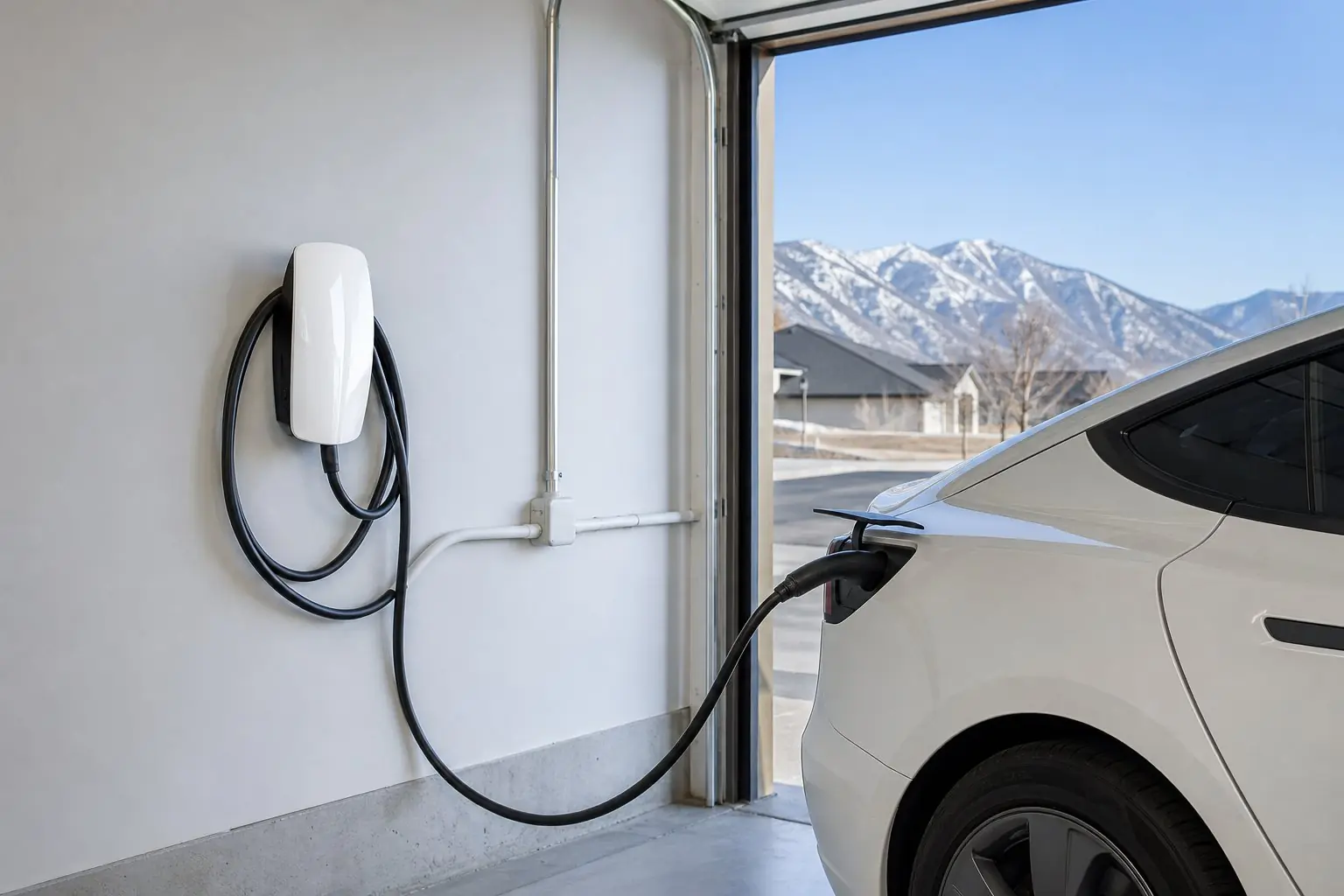
What is the difference between the Gen 3 and Universal Wall Connector?
Both deliver up to 48 amps (11.5 kW at 240 volts), use a 24 foot cable, and are hardwired only. The Gen 3 Wall Connector has a NACS handle for Teslas and other NACS-port cars. The Universal Wall Connector adds a J1772 adapter docked on the unit, so it also charges J1772-port EVs without a separate adapter.
The figures below are from Tesla's current North American installation manuals for each unit. Tesla's website blocks automated checks, so prices and availability are not listed here; confirm them with Tesla before you buy.
| Spec | Gen 3 Wall Connector | Universal Wall Connector |
|---|---|---|
| Connector | NACS | NACS plus docked J1772 adapter |
| Output | 12 to 48 A, up to 11.5 kW | 12 to 48 A, up to 11.5 kW |
| Voltage | 200 to 240 V AC, single phase | 200 to 240 V AC, single phase |
| Cable | 24 ft (7.3 m) | 24 ft (7.3 m) |
| Enclosure | Type 3R, IP54 | Type 3R, IP54 |
| Operating temperature | -22°F to 122°F | -22°F to 122°F |
| Wi-Fi | 2.4 GHz | 2.4 GHz |
| Weight | 10 lb | about 13 lb |
| Connection | Hardwired only | Hardwired only |
Older Gen 3 units may have a shorter cable: Tesla's 2020 manual listed 8.5 or 18 feet. If you are replacing an older unit, check the label before planning where it mounts. For other brands, see our home EV charger comparison.
What breaker size does a Tesla Wall Connector need?
A 60 amp two-pole breaker for the full 48 amps. Tesla's manuals allow smaller breakers at lower outputs, down to 15 amps for 12 amps of charging. The output is always 80 percent of the breaker rating, because EV charging is a continuous load. The breaker size is set in software during commissioning, not with a switch inside the unit.
| Breaker | Max output | Power at 240 V | Energy in 8 hours |
|---|---|---|---|
| 60 A | 48 A | 11.5 kW | about 92 kWh |
| 50 A | 40 A | 9.6 kW | about 77 kWh |
| 40 A | 32 A | 7.6 kW | about 61 kWh |
| 30 A | 24 A | 5.7 kW | about 46 kWh |
| 20 A | 16 A | 3.8 kW | about 31 kWh |
| 15 A | 12 A | 2.8 kW | about 23 kWh |
Breaker, output and kW are from Tesla's Gen 3 and Universal manuals. Energy is the circuit's output before charging losses and assumes the car can accept that rate.
Tesla's wire guidance at full power is minimum 6 AWG copper (90°C THWN-2) with a 75°C rated breaker, or 4 AWG with a 60°C rated breaker. The terminals take 12 to 4 AWG copper only. The manuals also say external disconnect switches are "neither required nor recommended," and warn against Eaton BR branch breakers when the panelboard is aluminum, recommending Eaton BRH breakers instead. Check what your car accepts in our Tesla home charging guide before paying for a larger circuit.
Is the Wall Connector hardwired only?
Yes. Both current manuals say "Hardwire branch circuits to disconnects or circuit breakers. Do NOT install cord-and-plug type connections." A Wall Connector should not be fitted with a plug and run from a NEMA 14-50 outlet. If you want a plug-in setup, Tesla's Mobile Connector with its NEMA 14-50 adapter charges at up to 32 amps.
The Gen 3 has ground-fault protection built in (Tesla lists a CCID20 device), and Tesla's 2020 Gen 3 manual says not to install a GFCI circuit breaker ahead of it. Hardwiring also sidesteps the GFCI requirement that applies to EV charging receptacles under the 2023 NEC that Utah has adopted.
Can two Wall Connectors share power?
Yes. Tesla's manuals say up to six Wall Connectors at one site can share the site's available power over unit-to-unit Wi-Fi, each on its own branch circuit of up to 60 amps. Two Teslas can share one site limit instead of each drawing a full 48 amps at once. Daisy chaining on a single 60 amp circuit is currently supported only on the Universal Wall Connector.
Tesla describes two other limits an installer can set. Static power management caps the unit at a fixed current in the Tesla One app. Dynamic power management uses Tesla's Remote Meter with current transformers on the service to throttle charging when the house is busy; the Gen 3 manual says it is compatible with split-phase service where a single Wall Connector is installed. Both are forms of load management, explained on our EV charger load management page.
What about a garage with a Tesla and another EV?
Choose the Universal Wall Connector if any car in the garage has a J1772 port, such as an F-150 Lightning or a 2022 to 2025 Rivian R1. Ford's NACS adapter is DC only: Ford lists it as not compatible with Level 1 or Level 2 AC chargers, including home chargers with NACS connectors, so a Lightning cannot use a Gen 3 unit through it.
Rivian likewise lists its J1772 wall charger for 2022 to 2025 R1T and R1S trucks with CCS1 ports. Newer cars with native NACS ports can use the Gen 3 directly. Weighing a Tesla unit against a J1772 or NACS alternative from another brand? See Tesla Wall Connector vs ChargePoint Home Flex.
How is a Wall Connector set up?
The installer commissions it with Tesla One, Tesla's installer app, by scanning the QR code on the quick start guide. During setup the installer enters the breaker size, which sets the maximum output, connects the unit to 2.4 GHz Wi-Fi and configures power sharing if there is more than one unit. Owners can then add vehicles in the Tesla app.
The output ceiling is whatever breaker size the installer enters, so commissioning is part of the install, not an optional extra. Gen 2 units were different: they used an internal rotary switch. Wi-Fi also delivers firmware updates, so plan for a signal that reaches the garage.
Do you need a Tesla Certified Installer?
Tesla's documentation we reviewed does not say a Tesla Certified Installer is required for the warranty. The manuals ask for personnel "trained and qualified to work on electrical systems," and Tesla One tells installers who are not Certified Installers to select "Unknown" for the company name. Tesla's web support pages blocked our checks, so that wording was not reviewed.
Tesla's manuals give the Wall Connector a 48 month warranty for normal personal use and 12 months for commercial use, which includes multifamily and shared-access sites. They exclude damage from "lack of or improper installation" and from repairs, alterations or modifications "made by a person or facility not authorized or certified to do so." The Gen 3 manual also warns that incorrect installation and testing could damage the vehicle's battery and that such damage is excluded from both the vehicle and charging equipment warranties.
The practical reading: have a qualified electrician install it to Tesla's manual, commission it in Tesla One, and keep your invoice. Read Tesla's current warranty terms yourself before buying. Ogden EV Charger Pros does not claim Tesla Certified Installer status. More on the process is on our Tesla Wall Connector installation and Tesla charger installation pages.
Indoors, outdoors and Eden winters
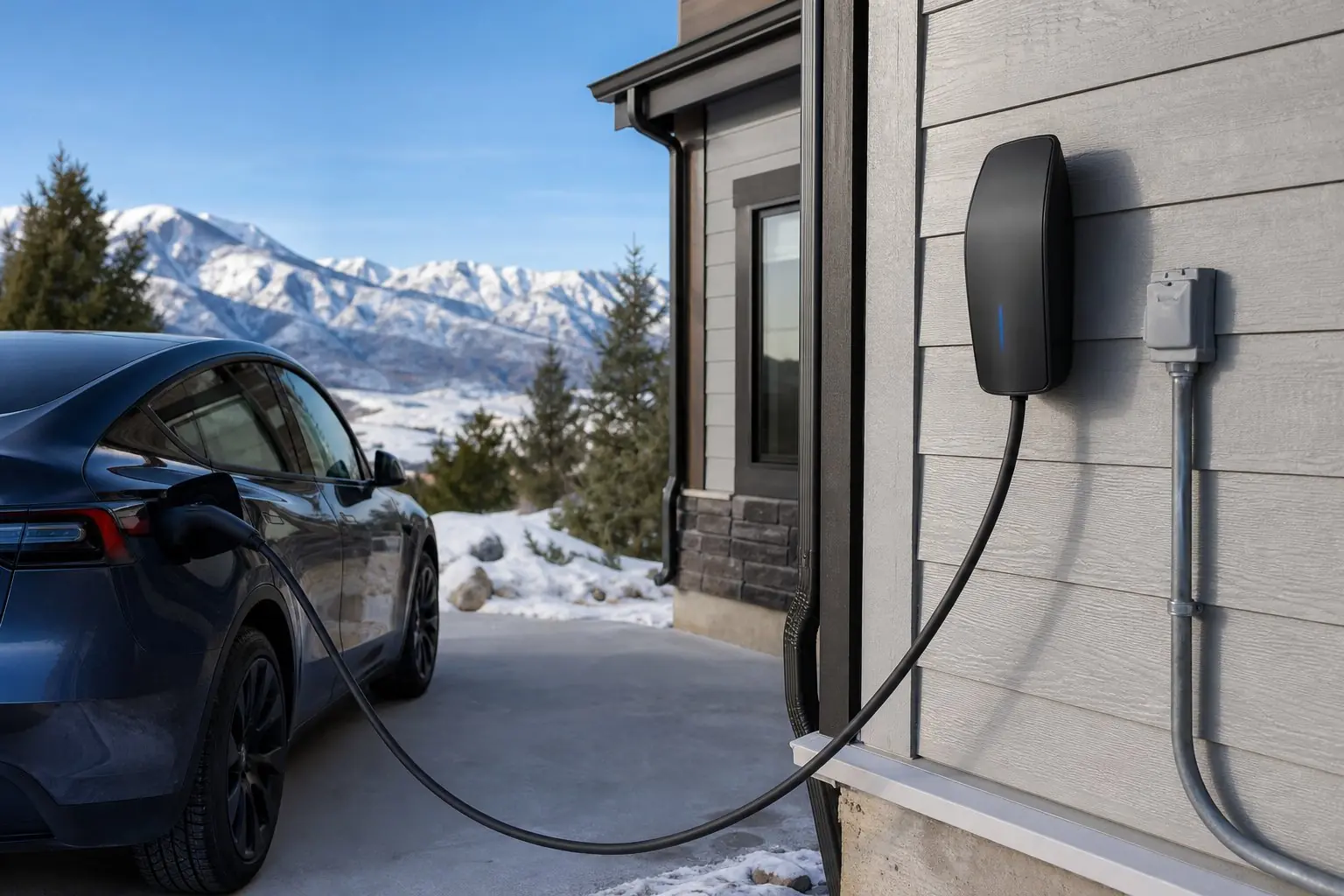
Both units carry a Type 3R, IP54 enclosure and an operating range of -22°F to 122°F, so they are rated for outdoor mounting. NOAA's 1991 to 2020 normals at Pineview Dam, near Eden, show a January average low of about 9.5°F, well inside that range. Normals are averages, though, not record lows.
The same station averages about 16 nights a year at or below 0°F and roughly 108 inches of snow. For an Eden or Ogden Valley driveway, mount the unit where roof snow will not slide onto it and plows will not pile against it, and keep the handle holstered off the ground. The 24 foot cable gives room to mount on a protected wall and still reach the charge port. A garage mount avoids most of this. See outdoor EV charger installation.
Panel and load notes
Under the 2023 NEC, which Utah adopted, a load calculation counts an EV charger at 7,200 watts or its nameplate rating, whichever is larger. A Wall Connector at 48 amps is about 11.5 kW, so on a crowded panel the answer may be a lower breaker setting, power sharing, or an energy management system, which NEC 220.70 lets the calculation count at its maximum setpoint. A panel upgrade is one option, not the default. The cost side is covered in Tesla charger installation cost.
Tesla Wall Connector questions
Can a Tesla Wall Connector plug into a NEMA 14-50 outlet?
No. Tesla's current Gen 3 and Universal Wall Connector manuals say to hardwire the branch circuit and not to install cord-and-plug connections. If you want a plug-in setup, Tesla's Mobile Connector with its NEMA 14-50 adapter charges at up to 32 amps, or you can choose a different plug-in charger.
Will a Universal Wall Connector charge a Ford F-150 Lightning?
Yes. The Universal Wall Connector has a J1772 adapter docked on the unit, and the Lightning has a J1772/CCS1 charge port. A NACS-only Gen 3 Wall Connector will not work with Ford's NACS adapter, which Ford lists as not compatible with Level 1 or Level 2 AC chargers.
What breaker does a Tesla Wall Connector need?
For full 48 amp output, a 60 amp two-pole breaker. Smaller breakers work at lower outputs: 50 amps gives 40 amps, 40 gives 32, 30 gives 24, 20 gives 16 and 15 gives 12. The breaker size is programmed into the Wall Connector in the Tesla One app during commissioning.
Does a Tesla Wall Connector have to be installed by a Tesla Certified Installer?
The Tesla manuals we reviewed ask for installers who are trained and qualified to work on electrical systems, and tell installers who are not Tesla Certified Installers to select Unknown when registering the unit. We found no line in them making the warranty depend on a Certified Installer. Tesla's web support pages could not be checked.
Can two Wall Connectors share one circuit?
Tesla's manuals describe power sharing for up to six Wall Connectors at one site over Wi-Fi, each on a branch circuit of up to 60 amps. They also say daisy chaining units on one 60 amp circuit is currently supported only on the Universal Wall Connector, with all units limited to 48 amps combined.
Planning a Wall Connector? Tell us your car and send a photo of your panel.
Get a Wall Connector quote