
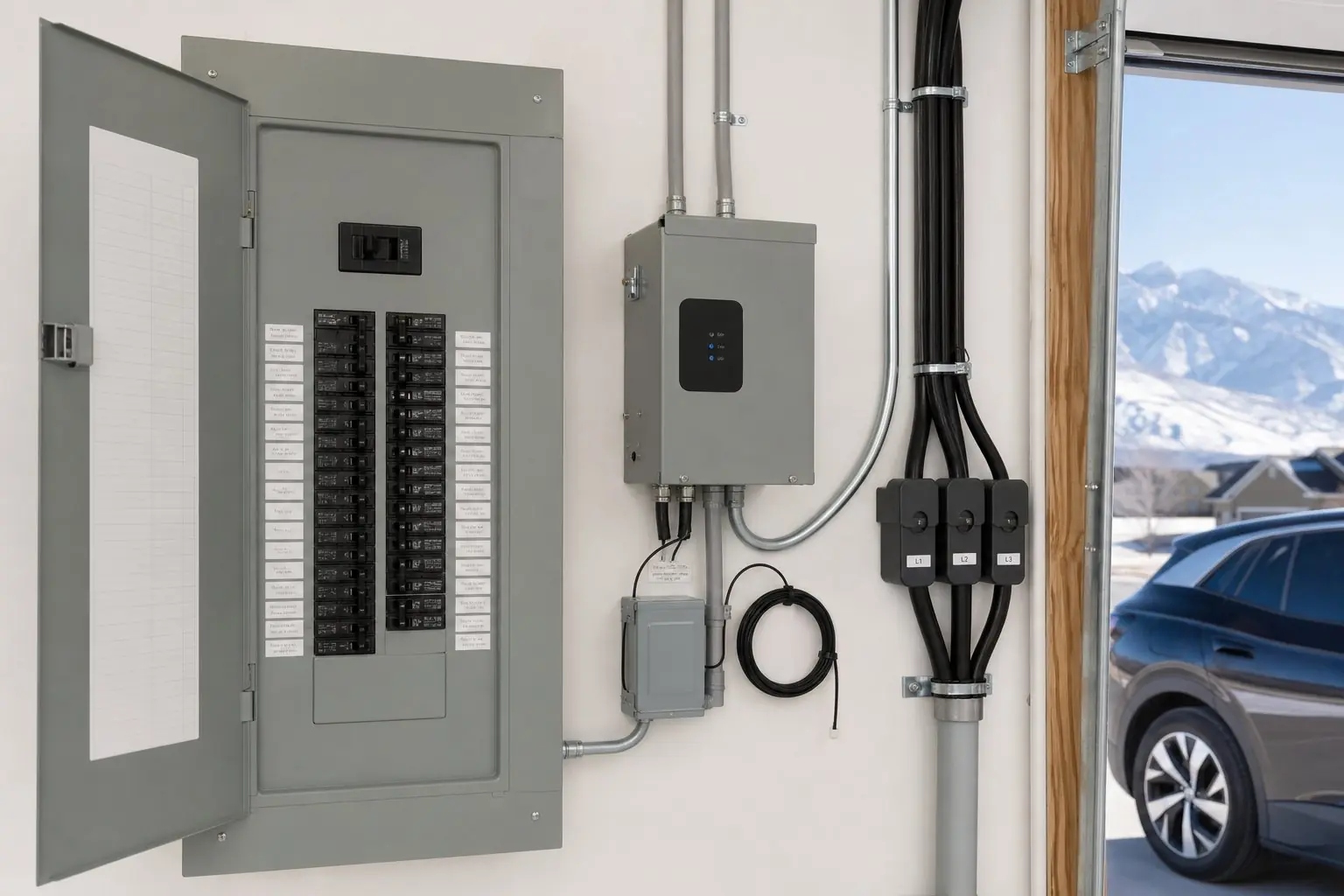
How does EV charger load management work?
Current sensors on your service conductors measure what the whole house is drawing. When the total nears a limit the installer sets, the system lowers the charger's current or pauses it, then restores it when the load drops. Because the service is never asked for more than its limit, the load calculation can count the managed value instead of the charger's full rating.
The code calls this an energy management system, and for EV charging an EVEMS. It is the main alternative to a panel or service upgrade. We check load management before we recommend a panel upgrade.
What does the 2023 NEC allow?
Utah adopted the 2023 NEC. Section 220.70 lets an energy management system's "maximum ampere setpoint" stand in for the managed loads in the service calculation. Section 625.42 lets a charger with an adjustable setting be counted at the setting marked on its label. Both turn a charger that would not fit into one that does.
Without management, NEC 220.57 counts a 48 amp charger at its full 11,520 watt nameplate. Two approaches bring that down:
- Static limit (625.42). The charger is set and labeled at a lower maximum, such as 32 amps, and never draws more.
- Dynamic limit (220.70). The system gives the charger whatever is left under a setpoint, and the calculation uses that setpoint as a continuous load.
The system must meet the energy management rules in 750.30 and pass your city's inspection.
What kinds of load management devices are there?
Four main kinds: chargers paired with their own home energy meter, standalone controllers that switch the charger off when the panel is busy, smart panels that manage many circuits, and chargers that share power with each other. Which fits depends on your charger, your panel and if you want to keep the charger you own.
| Type | Examples verified on maker sites | How it limits charging |
|---|---|---|
| Charger plus meter | Emporia charger with Vue 3 monitor; Wallbox chargers with a Wallbox energy meter; Tesla Wall Connector with Tesla Remote Meter | Turns charging current up or down in real time |
| Standalone controller | RVE DCC-12 | Switches the charger off above a threshold, back on later |
| Smart panel | SPAN Panel with PowerUp | Throttles selected circuits, including the charger |
| Power sharing | Tesla Wall Connector power sharing | Splits a fixed limit among several chargers |
Charger plus meter
Emporia pairs its charger with a Vue 3 energy monitor and two 200 amp current sensors, and says its software "allocates only the available panel capacity to your EV charger." Wallbox's dynamic load management "requires an energy meter sold by Wallbox," set to the main breaker rating. Tesla's Wall Connector supports dynamic power management through the Tesla Remote Meter, for a single Wall Connector on split-phase service.
Standalone controller
RVE's DCC-12 is built for single-family homes with a full panel. When use passes 80 percent of the main breaker, it cuts power to the charger, and it restores power only after use stays below that level for more than 15 minutes. RVE's page lists Canadian certifications, so confirm a US listing before choosing it.
Smart panel
SPAN replaces your main panel. Its PowerUp software adjusts loads "to safely and comfortably stay within lower utility service sizes," and SPAN says it is the first smart panel to meet UL 3141 for power control systems. SPAN's own charger, SPAN Drive, works only with a SPAN Panel. It is a bigger project than a sensor kit.
Can two chargers share one circuit or one limit?
Yes. Tesla's manuals say up to six Wall Connectors at one site can share the available power over Wi-Fi, each on its own branch circuit of up to 60 amps. The Universal Wall Connector also supports daisy chaining on a single 60 amp circuit, with all units limited to 48 amps combined. Two cars charge overnight without two full-size circuits.
The electrician sets one total limit the service can support, and the chargers divide it among the cars plugged in. For other brands, check the manual for a sharing feature before buying two.
What about smart splitters on a dryer outlet?
A smart splitter plugs into an existing 240 volt outlet, often the dryer's, and switches power between the appliance and the charger so both never run at full draw together. It avoids a new circuit, but it charges at the outlet's limits, usually about 24 amps on a 30 amp dryer circuit, and is rated for indoor use.
NeoCharge's spec sheet lists its Smart Splitter as UL and cUL listed, in 24 amp models for 30 amp circuits and 40 amp models for 50 amp circuits. The appliance version gives the dryer priority and resumes charging when it finishes. Splitvolt describes its Splitter Switch as cETLus certified for 30 amp dryer outlets, charging at about 24 amps. Avoid unlisted splitters.
A splitter is only as sound as the outlet it plugs into. Ask how your inspector applies the EV article, including its GFCI rule for EV receptacles, before relying on one nightly.
What are the limits and tradeoffs?
Charging slows or stops when the house is busy, so a car plugged in during dinner may start slowly. Switch-off controllers can wait 15 minutes or more before restarting. Systems with sensors in the panel are wired-in work that needs a permit. Load management cannot fix a panel that is damaged, has no spaces left, or is too small for planned loads.
Emporia also warns its charger "could cause nuisance tripping" on a GFCI breaker and recommends hardwiring there. If you plan a heat pump or a second EV, compare load management with an upgrade.
Why does this matter for older Ogden homes?
Ogden has the oldest housing of the four cities we serve. Census estimates for 2020 to 2024 put its median build year at 1966, with about 44 percent of homes built before 1960 and about one in five built in 1939 or earlier. Older houses may have smaller services, which is exactly where load management helps most.
Ogden City plans also describe detached rear garages behind bungalows and 1950s ranches, which already means a longer feeder or a subpanel. Pairing that run with load management can keep the project on the existing service. See garage EV charger installation and what size breaker for an EV charger.
EV charger load management questions
Will load management make my car charge slower?
Only when the house is busy. The device lowers or pauses charging while large loads such as an electric range, dryer or heat pump run, then returns to full speed. Most charging happens overnight when household load is low, so many owners rarely notice. Homes with electric heat in an Ogden winter may see more throttling on cold nights.
Is EV load management allowed by code in Utah?
Yes. Utah adopted the 2023 NEC. Its section 220.70 lets the load calculation use the maximum setpoint of an energy management system instead of the full charger load, and 625.42 lets a charger with an adjustable setting be sized at the setting on its label. The system must meet the code's energy management rules and pass inspection.
Are smart splitters safe?
Choose one with a recognized safety listing. NeoCharge states its Smart Splitter is UL and cUL listed, and Splitvolt describes its Splitter Switch as cETLus certified. Both are indoor products that plug into an existing 240 volt outlet, so the outlet and its wiring need to be in good condition. Ask an electrician to check them first.
Does load management need a permit?
A device wired into the panel, such as a current sensor kit, a standalone controller or a smart panel, is electrical work that needs a permit and inspection in Ogden, South Ogden, North Ogden and Ogden Valley City. A plug-in splitter on an existing outlet is not wired in, but the outlet it uses should be checked.
Think your panel is too small? Send a photo of the open panel and tell us your car.
Get a load management quote