
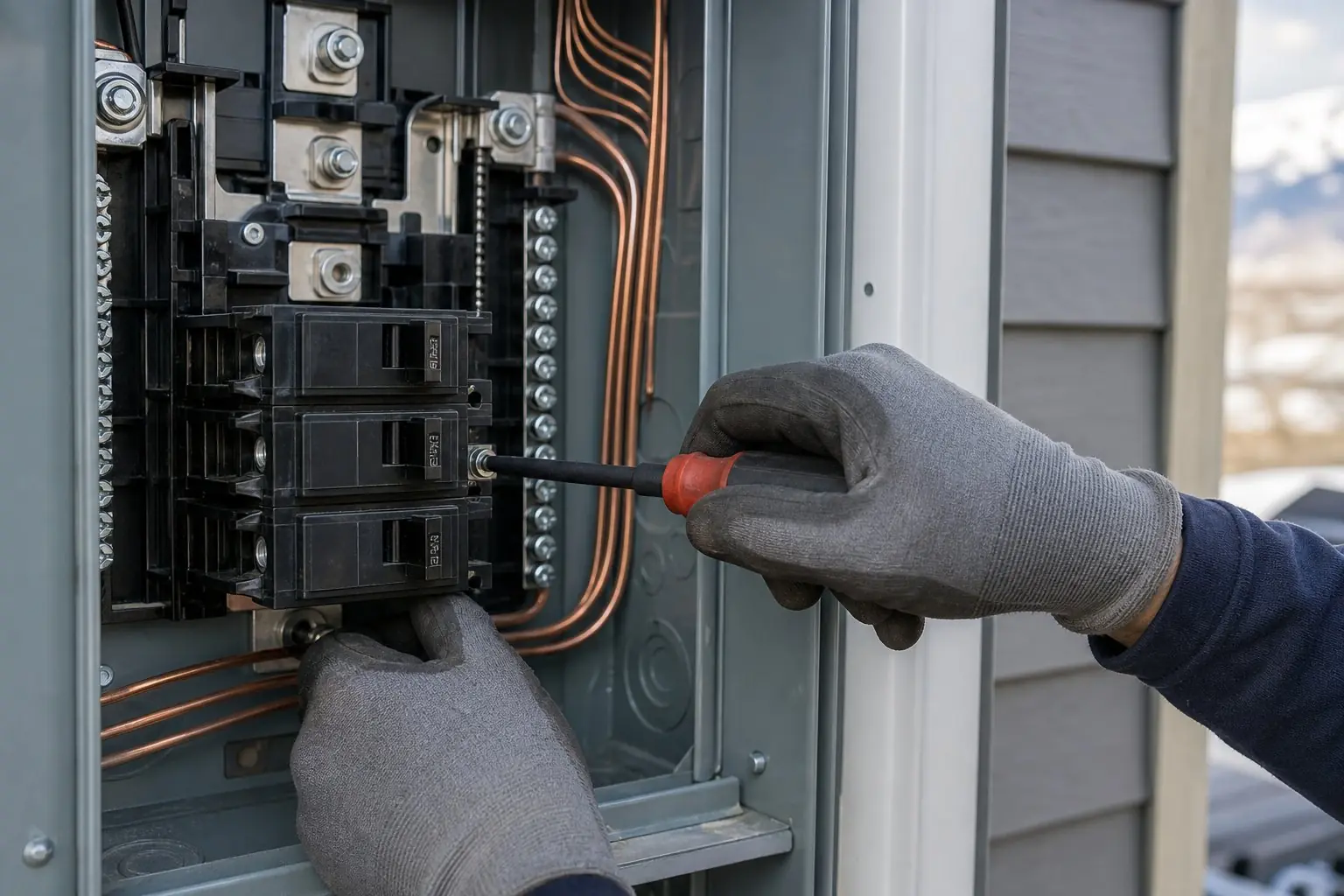
What size breaker does an EV charger need?
A breaker rated at least 125 percent of the charger's output. A 32 amp charger needs a 40 amp breaker, a 40 amp charger needs 50 amps, and a 48 amp charger needs 60 amps. The wire must be rated for the breaker, and the charger must be set to match it. Most home Level 2 installs land on a 40, 50 or 60 amp two-pole breaker.
Pick the charger output your car can use, multiply by 1.25, round to a standard breaker size, then size the wire for that breaker.
Why the 125 percent rule?
The electrical code treats EV charging as a continuous load, meaning maximum current for three hours or more. NEC 625.42 says EV charging is continuous, and 625.41 requires overcurrent protection of at least 125 percent of the charger's rating. Put the other way, a charger may draw no more than 80 percent of its breaker's rating.
The general continuous load rule is in NEC 210.20(A): the breaker rating "shall not be less than the noncontinuous load plus 125 percent of the continuous load." The IAEI explains the reason: a standard breaker in an enclosure runs warmer than the open-air conditions it was tested in, so it is applied at 80 percent of its rating for long, steady loads. 125 percent and 80 percent are the same rule seen from opposite ends (1 divided by 1.25 is 0.8).
Utah has used the 2023 NEC statewide since July 1, 2025. Single-family homes and townhouses fall under the residential (IRC) electrical chapters as Utah amended them, which follow the NEC. Your city inspector applies the version in force for your address.
Breaker size and charger output table
Tesla's Wall Connector manuals give a clean version of the table: 60 amp breaker for 48 amps of output, 50 for 40, 40 for 32, 30 for 24, 20 for 16 and 15 for 12. The same math applies to any Level 2 charger with an adjustable output.
| Breaker | Max charger output | Power at 240 V | Copper in conduit (75°C) | NM-B cable (60°C) |
|---|---|---|---|---|
| 15 A | 12 A | 2.8 kW | Per manual and code | |
| 20 A | 16 A | 3.8 kW | Per manual and code | |
| 30 A | 24 A | 5.7 kW | 10 AWG | 10 AWG |
| 40 A | 32 A | 7.6 kW | 8 AWG | 8 AWG |
| 50 A | 40 A | 9.6 kW | 8 AWG | 6 AWG |
| 60 A | 48 A | 11.5 kW | 6 AWG | 4 AWG |
| 100 A | 80 A | 19.2 kW | Per the charger manual; few cars can use it | |
Breaker, output and power from Tesla's Gen 3 and Universal Wall Connector manuals (100 A row from Ford's Charge Station Pro footnote). Wire sizes are copper, from the NEC 310.16 ampacity values published by Cerrowire, checked against the breaker each circuit is on. Long runs can need larger wire for voltage drop.
Reading the wire columns
NM-B cable, the sheathed cable run through stud walls and attics, is limited to its 60°C ampacity. Individual THHN or THWN-2 conductors in conduit can use the 75°C column when the breaker and charger terminals are rated for it. That is why a 50 amp circuit can be 8 AWG in conduit but needs 6 AWG in NM-B, and why 6 AWG NM-B (55 amps) is too small for a 60 amp breaker.
Tesla's Wall Connector manual states it directly for a 60 amp circuit: with a 60°C rated breaker, use minimum 4 AWG, 90°C THWN-2 copper; with a 75°C rated breaker, minimum 6 AWG, 90°C THWN-2 copper. Its terminals accept 12 to 4 AWG copper only.
Do you have to set the charger to match the breaker?
Yes. Most hardwired Level 2 chargers can run at several output levels, and the installer sets the one that matches the breaker. If the charger is set higher than 80 percent of the breaker, it can draw more than the circuit allows and trip after a long session. Check the setting any time a breaker or charger is replaced.
On Tesla's Gen 3 and Universal Wall Connectors the breaker size is programmed in software during commissioning, through the Tesla One installer app, under Installation Settings and Breaker Size. There is no rotary switch on these units; the older Gen 2 used one. Other brands use an app, a dial or a DIP switch. ChargePoint's Home Flex FAQ puts it plainly: "Incorrect amperage settings during installation can cause circuit breaker tripping during charging sessions."
A mismatch is one of the first things to check when a charger trips its breaker. Our EV charger troubleshooting guides walk through the rest.
Does a bigger breaker charge faster?
Only until you hit your car's onboard charger limit. The car decides how much AC current it accepts, so a 48 amp charger on a car that accepts 32 amps charges at 32 amps. Size the circuit for the car you have and the one you expect next, not for the biggest charger sold.
The F-150 Lightning shows how this works. Ford lists a 48 amp onboard charger for 2024 and 2025 retail trucks and 2022 to 2023 Standard Range trucks, while 2022 to 2023 Extended Range trucks have an 80 amp onboard charger. Ford's Charge Station Pro could deliver 80 amps, and Ford's footnote says that was "only available when installed with a 100Amp wire and breaker." Ford now says the Charge Station Pro "is no longer for sale." For a 48 amp truck, anything beyond a 60 amp circuit adds nothing. A charger rated over 60 amps also needs a readily accessible, lockable disconnect under NEC 625.43.
Look up your car's rating in our vehicle charging guides before choosing a breaker. If a second EV or a bigger truck is likely, it can make sense to pull wire sized for a 60 amp circuit now and run the charger at a lower setting until then.
What about a NEMA 14-50 outlet?
A NEMA 14-50 outlet goes on a 50 amp breaker, so a plug-in charger on it can draw at most 40 amps continuously. Many portable chargers draw less: Tesla's Mobile Connector draws 32 amps on its 14-50 adapter. In Utah the outlet must also have GFCI protection, which usually means a 50 amp two-pole GFCI breaker.
Utah removed most 240-volt receptacles from the general GFCI rule, but it did not amend NEC 625.54, which requires GFCI protection on "all receptacles installed for the connection of electric vehicle charging." Hardwired chargers are not covered by 625.54 and have ground-fault protection built in.
Some charger makers warn that a GFCI breaker plus the charger's own protection can cause nuisance trips. ChargePoint's answer is that "if local codes require a GFCI breaker for plug-in installation, ChargePoint recommends a hardwire installation." Removing the GFCI breaker from an EV receptacle is not a legal fix. More detail in EV charger GFCI requirements and on our NEMA 14-50 installation page.
What if your panel can't take another 60 amp breaker?
You have choices short of a new panel. A lower setting on a smaller breaker often still fills the battery overnight. A load management device can cap charging when the house is busy, and the 2023 NEC lets the load calculation count that capped value. A panel or service upgrade is for when neither fits.
Two separate questions hide here. One is physical space: is there room in the panel for a two-pole breaker? The other is capacity: does a load calculation show enough spare amperage for a continuous charging load? The 2023 NEC counts EV charging at 7,200 watts or the charger's nameplate, whichever is larger, in that calculation.
Where an energy management system limits current, NEC 220.70 allows "a single value equal to the maximum ampere setpoint" in the service or feeder calculation, and 625.42 lets a charger with an adjustable setting be sized at the setting marked on its label. Tesla's Wall Connector supports a fixed static limit and, with Tesla's Remote Meter, dynamic power management. See EV charger load management, can my panel handle an EV charger and panel upgrades for EV charging.
Changing breakers, opening a panel or resizing a circuit is electrician work. In Ogden, South Ogden, North Ogden and Ogden Valley City, a new or altered charging circuit needs an electrical permit and inspection. Never swap in a larger breaker on existing wire.
EV charger breaker size questions
What size breaker do I need for a 48 amp EV charger?
A 60 amp two-pole breaker. EV charging is a continuous load, so the breaker must be rated at least 125 percent of the charger's output, and 48 times 1.25 is 60. The wire has to be rated for the 60 amp breaker too, which typically means 6 AWG copper in conduit or 4 AWG NM-B cable.
Can I put a 40 amp charger on a 40 amp breaker?
No. A charger drawing 40 amps for hours needs at least a 50 amp breaker. On a 40 amp breaker, set the charger to 32 amps. A charger set above 80 percent of its breaker rating can trip the breaker after a long session and runs the circuit hotter than the code allows.
What breaker does a NEMA 14-50 outlet use for EV charging?
A 50 amp two-pole breaker, and in Utah it must be a GFCI type because NEC 625.54 requires ground-fault protection on receptacles installed for EV charging. A plug-in charger on that outlet can draw at most 40 amps continuously. Tesla's Mobile Connector draws 32 amps on its 14-50 adapter.
Will a bigger breaker make my car charge faster?
Only up to your car's onboard charger limit. A car whose onboard charger accepts 48 amps gains nothing from a circuit sized for 80 amps. Charging speed is the lowest of three numbers: the car's onboard charger, the charger's setting and the circuit's rating.
What if my panel has no room for a 60 amp breaker?
There are options short of a panel upgrade: a lower charger setting on a smaller breaker, or a load management device that limits charging when the house is busy, which the 2023 NEC recognizes in its load calculation rules. A panel or service upgrade is the answer only when those do not fit.
Not sure which breaker fits your panel? Send your car model and a photo of the open panel.
Get a charger circuit quote