
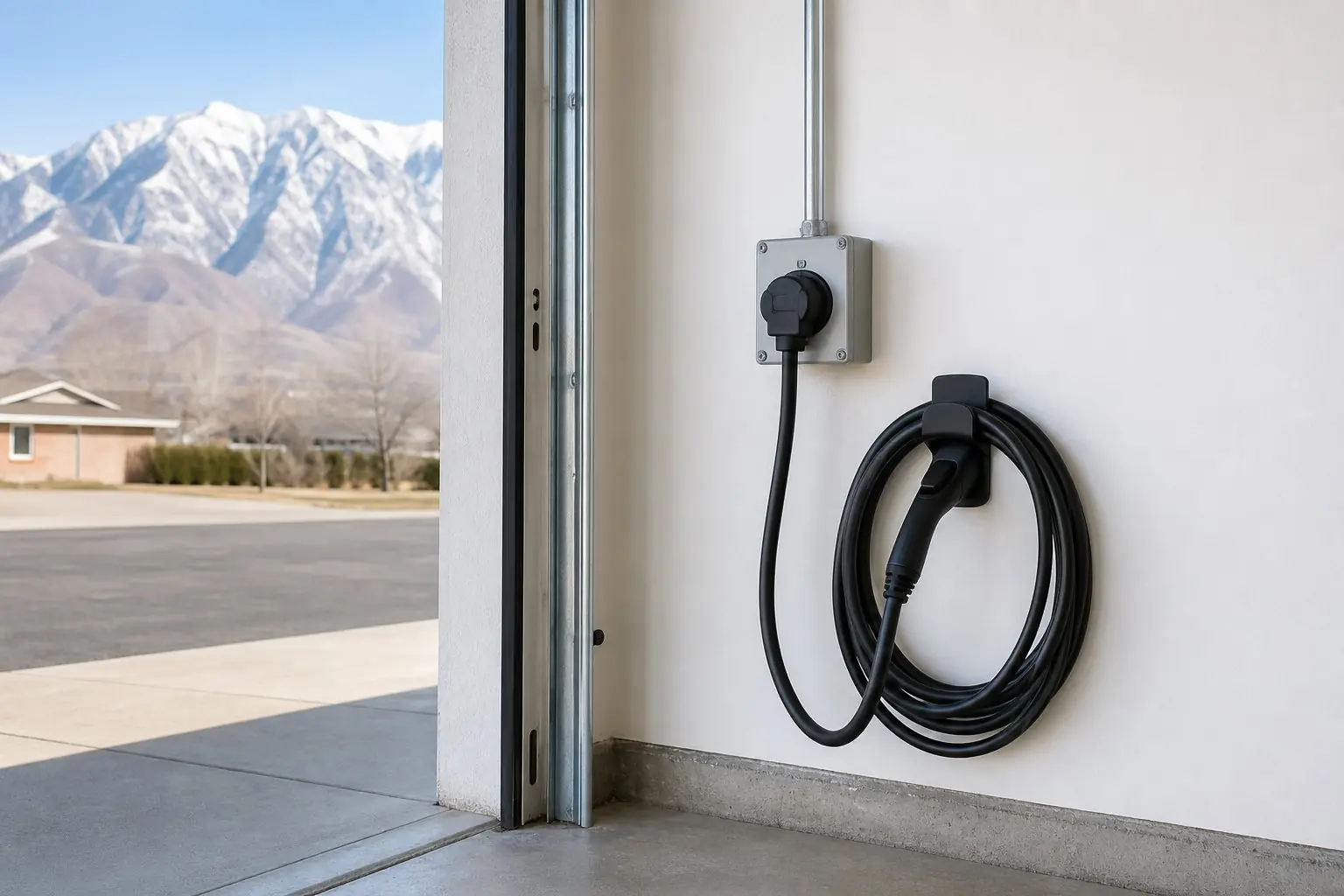
What does a NEMA 14-50 installation for an EV include?
A dedicated 50 amp, 240 volt circuit from your panel to a four-wire 14-50 receptacle: two hots, a neutral and a ground. For EV use it also means a two-pole GFCI breaker, wire sized for 50 amps, a receptacle built for daily charging, and a weatherproof in-use cover if the outlet is outside.
The 14-50 is popular because almost every portable EV cord and many wall chargers come with a 14-50 plug. Typical wire for the circuit is 8 AWG copper in conduit or 6 AWG NM-B cable, per the NEC ampacity table published by Cerrowire.
If you are still deciding whether to plug in or hardwire, the hardwired vs NEMA 14-50 comparison lays out the trade-offs. In short, a 14-50 wins on portability and choice of charger; hardwired wins on top speed, fewer wear points and outdoor use.
Why does an EV outlet need a GFCI breaker?
Because the code says so. NEC 625.54 requires GFCI protection for receptacles installed for EV charging, and Utah did not amend that section. Utah removed 240 volt receptacles from the general GFCI rule, but an outlet installed for a car still falls under 625.54, so the circuit gets a 50 amp two-pole GFCI breaker.
Here is the catch: most Level 2 chargers and portable cords already have ground-fault protection inside. Two layers of protection can interfere with each other. ChargePoint says a GFCI breaker "especially with a plug-in installation, can cause nuisance breaker tripping," and Emporia says "redundant GFCI protection will cause nuisance tripping."
Do not swap the GFCI breaker for a standard one to stop trips. On an EV receptacle that removes required protection. If trips keep happening, the fix the manufacturers point to is hardwiring the charger on a standard breaker. See EV charger keeps tripping the breaker.
Not every plug-in setup trips. Plenty of portable cords run on a GFCI-protected 14-50 without trouble, which is why it remains a reasonable choice when you value the flexibility.
Which 14-50 receptacle should be installed?
One designed for EV charging. A charging outlet carries a heavy load for hours and may be plugged in and out often. Hubbell and Leviton both sell 14-50 receptacles made for that duty, and the terminals must be torqued to the stated value. A loose or worn receptacle is a heat risk.
| Receptacle | What the maker says | Install details |
|---|---|---|
| Hubbell HBL9450A, industrial grade | "Designed for plug-in EV charging applications"; 50 percent greater contact force | Maximum continuous 75°C; accepts #12 to #4 AWG |
| Leviton 1450R, heavy duty | "Can sustain the necessary extended charge time and high frequency of insertions EV chargers require" | 75 in-lb terminal torque; #4, #6 or #8 AWG copper only |
| Leviton 1450W | Weather-resistant version of the 1450R | For damp and outdoor locations |
Torque matters as much as the brand. NEC 110.14(D) requires a calibrated torque tool where the maker lists a value, and Hubbell notes under-torqued terminals can lead to "arcing, overheating, and potential electrical fires." Tesla's Mobile Connector manual adds: "Do not plug the Mobile Connector into a damaged, loose or worn power outlet." A plug that feels loose or warm is a reason to call someone; see NEMA 14-50 outlet getting hot.
How fast can you charge from a 14-50?
No more than 40 amps, or about 9.6 kW at 240 volts. The breaker and receptacle are rated 50 amps, and EV charging is a continuous load, so the charger must stay at 80 percent of that. Many portable cords draw less, which is often fine for overnight charging.
| Equipment on a 14-50 | Draw |
|---|---|
| Tesla Mobile Connector (14-50 adapter) | 32 A |
| Ford Mobile Power Cord | 30 A |
| ChargePoint Home Flex, plug-in | 32 or 40 A |
| Emporia Pro, plug-in | up to 40 A |
From each maker's manual, support page or sell sheet. Your car's onboard charger may cap the rate lower.
If your car can take 48 amps and you want all of it, that takes a hardwired charger on a 60 amp circuit. See hardwired EV charger installation.
Where should the outlet go?
Where the charger's short input cord reaches it without strain, and where the charging cable reaches your port. Wall chargers come with short plug cords, so the outlet location is set by the charger you choose. Pick the charger first, then place the outlet from its install guide.
- ChargePoint Home Flex: the input power cord is 12 inches, which ChargePoint calls the maximum allowed under the NEC.
- Wallbox Pulsar Plus: the outlet sits to the left of the charger on a 12 inch cord, and Wallbox recommends the 14-50's ground pin face down.
- Emporia Pro: the plug-in version has a 28 inch cord.
For a portable cord, place the outlet so the cord hangs without the plug carrying its weight and the charging cable reaches the port with the car parked normally. Placement relative to the car is covered on garage EV charger installation.
Can a 14-50 go outside?
Yes, with the right cover. As Mike Holt explains the NEC wet-location rule, a 30 amp or larger receptacle in a wet location feeding an unattended load, such as a charging car, needs an enclosure that is weatherproof "with the attachment plug cap inserted or removed." That means an in-use, or bubble, cover.
That EC&M explanation was written against an earlier NEC edition, so confirm the current wording with your inspector. Tesla also warns not to use its Mobile Connector "in a recessed area or below floor level," or in severe rain, snow or storms. For a driveway or carport, many people end up hardwiring; the outdoor EV charger installation page explains why.
What goes into our 14-50 installs
An EV-grade receptacle torqued to spec, a two-pole GFCI breaker, wire sized for 50 amps and, outside, an in-use cover. When the run is long or the panel is tight, it is worth sizing the wire so the circuit can be hardwired later without pulling new conductors. We handle the permit and inspection with your city. Dryer outlets and 6-50 receptacles are covered on 240V EV charger outlet installation.
NEMA 14-50 outlet questions
Does a NEMA 14-50 for an EV need a GFCI breaker in Utah?
Yes. NEC 625.54 requires GFCI protection for receptacles installed for EV charging, and Utah did not amend it. Utah removed 240 volt receptacles from the general GFCI rule, but that does not cover an outlet installed for a car. In practice that means a 50 amp two-pole GFCI breaker.
What is the most a charger can draw from a 14-50?
40 amps. The receptacle and breaker are 50 amps, and EV charging is a continuous load, so the charger may draw no more than 80 percent of that. Many portable cords draw less: Tesla's Mobile Connector 32 amps and Ford's Mobile Power Cord 30 amps on a 14-50.
Is a cheap 14-50 receptacle good enough?
Use one built for the job. Hubbell and Leviton both sell 14-50 receptacles designed for plug-in EV charging, with more contact force and higher insertion ratings, and Leviton specifies 75 in-lb terminal torque. Tesla warns never to plug its Mobile Connector into a damaged, loose or worn outlet.
Can I use my dryer outlet instead?
Sometimes, with the right adapter and a charger set to suit the circuit, but a dryer circuit is usually 30 amps and shared with the dryer. Reusing or adding a 240 volt outlet is covered on our 240V EV charger outlet page.
Want a 14-50 for your garage? Tell us your car and the cord or charger you plan to use.
Get a 14-50 outlet quote