
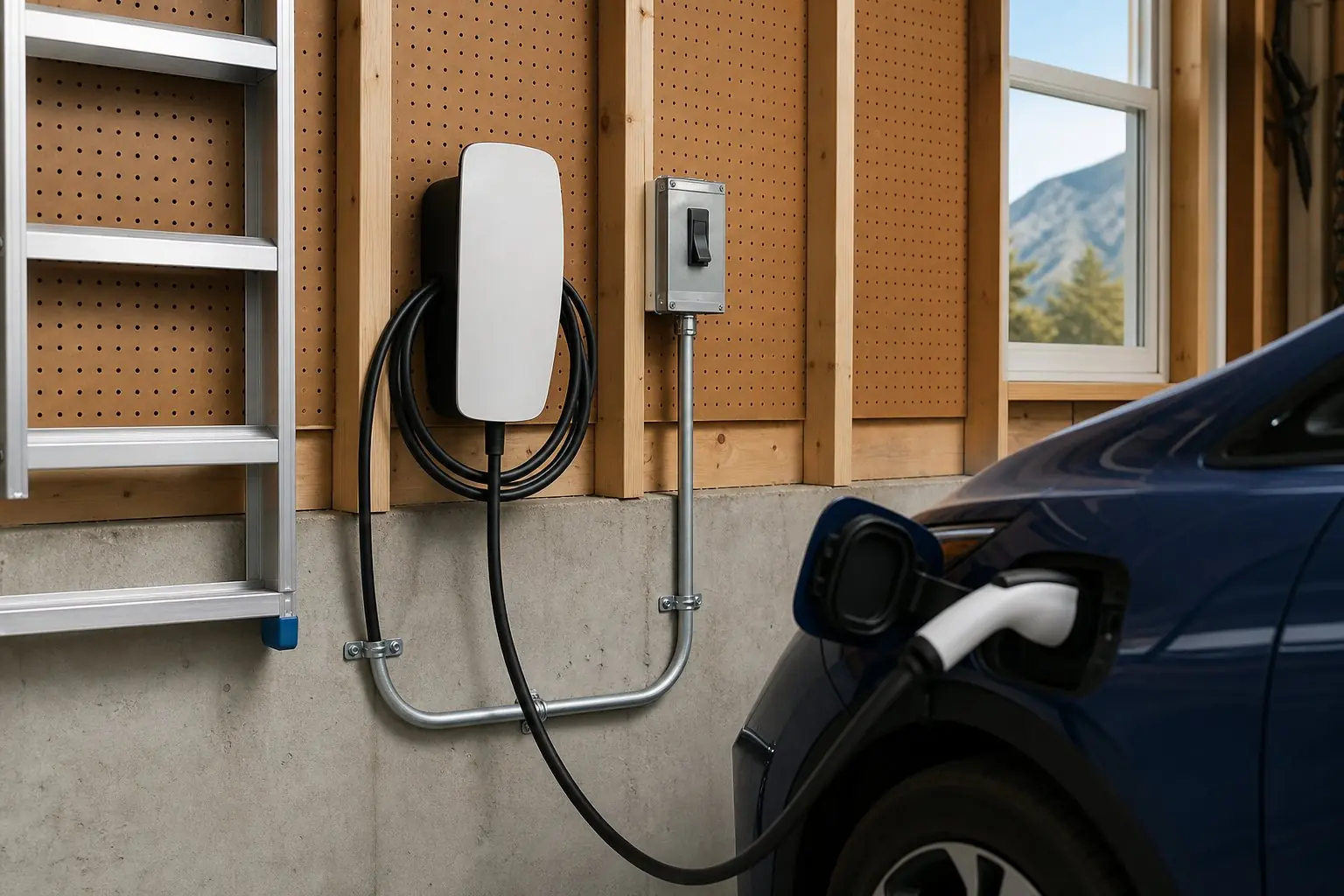
Safety first. Do not remove, bypass or swap out a GFCI breaker or GFCI outlet that protects an EV charging receptacle. Code requires it, and it may be catching a real fault. Do not open the panel, remove covers or take the charger apart. If anything is wet, hot, discolored or smells burnt, leave the breaker off and call an electrician.
Is it the GFCI breaker or the charger tripping?
There are two different trips. A GFCI breaker in the panel can trip, cutting power so the charger goes dark. Or the charger's own ground-fault protection, often called a CCID, stops charging and shows a fault code while the charger stays powered. Which one you have changes the likely cause, so check the breaker and the charger's lights first.
Most Level 2 chargers have that protection built in. Wallbox says the Pulsar Plus "has built-in internal GFCI protection that is sensitive to 20mA AC as certified per UL-2231." ChargePoint's Home Flex datasheet lists a 20 mA CCID "with auto retry."
If the breaker trips but it is not a GFCI type (no test button), the cause is likely overload, heat or a failing breaker instead. That is covered on EV charger keeps tripping the breaker.
Why does my EV charger trip the GFCI breaker?
Two protection devices on one circuit can conflict, which manufacturers say causes nuisance trips, especially with plug-in chargers. A real ground fault causes the same symptom: water in an outdoor install, a damaged cable or handle, or a wiring fault. You cannot tell them apart by looking, so a repeating trip needs testing.
Double protection
ChargePoint says a GFCI breaker, "especially with a plug-in installation, can cause nuisance breaker tripping in certain circumstances and interrupt charging." Emporia says "redundant GFCI protection will cause nuisance tripping that interrupts charging and requires a manual breaker reset." Tesla's 2020 Wall Connector manual says "do not install a GFCI circuit breaker." Trips that happen right at plug-in, every time, on a plug-in charger fit this pattern.
A real ground fault
Tesla describes its one-blink code as a "ground fault circuit interruption due to unsafe current path," and tells owners to inspect "for damage or signs of water ingress." Trips after rain or snow, or with a damaged cable, point here.
A wiring fault
Tesla's fix for that code includes having an electrician check "that ground is not directly connected to a conductor wire in the branch circuit." Emporia's guide says that if its charger reports it is not grounded on a 14-50, the line and neutral connections "may be reversed." Both are checks inside the outlet or charger, so they are electrician work.
Can I remove the GFCI to stop the trips?
Not on an outlet. NEC 625.54 requires GFCI protection for receptacles installed for EV charging, and Utah's amendments leave that rule in place. A hardwired charger is not a receptacle, so that rule does not apply to it. That is why the manufacturer fix for nuisance trips is hardwiring, not removing protection.
ChargePoint: "if local codes require a GFCI breaker for plug-in installation, ChargePoint recommends a hardwire installation." Emporia says the same: if code requires a GFCI breaker on a 14-50 circuit, buy the hardwire version. For hardwired Pulsar Plus installs, Wallbox calls an additional GFCI breaker "optional, as per article 625.54." ChargePoint's datasheet adds that an outdoor plug-in install is "required by code to install an outdoor rated GFCI breaker upstream."
An electrician makes the change: new hardwired connection, correct non-GFCI breaker where the charger maker calls for one, and the receptacle removed. Costs and trade-offs are on hardwired vs NEMA 14-50 and hardwired EV charger installation.
Ground-fault codes by charger
| Charger | Ground-fault indication | Maker's first step |
|---|---|---|
| Tesla Wall Connector | 1 red blink | Inspect handle, cable, unit and charge port for damage or water |
| Tesla Mobile Connector | Green off, red flashing continuously | Unplug from the car and replug; "Try a different outlet" |
| Emporia Pro | Orange, 1 slow and 7 fast: current leakage | Unplug from the car, power down, check the connector for foreign material |
From each maker's current manual. Other chargers use their own codes; check yours.
What can I safely check, and when do I call?
Check whether the breaker has a test button, whether the charger plugs in or is hardwired, when the trip happens, and what code the charger shows. Look for water or cable damage without opening anything. Reset once. If it trips again, or the code keeps returning, call an electrician.
- Test button on the breaker: a GFCI breaker. Plug-in charger plus GFCI breaker matches the nuisance-trip pattern.
- Trip timing: right at plug-in, after weather, or at random.
- The charger's light or app code.
- Water in the in-use cover, or damage to the cable and handle.
Changing a breaker, removing an outlet or hardwiring is electrician work. See EV charger repair.
GFCI tripping questions
Can I swap my GFCI breaker for a standard one to stop the trips?
Not on an outlet. NEC 625.54 requires GFCI protection for receptacles installed for EV charging, and Utah did not amend that rule. The fix ChargePoint and Emporia point to is hardwiring the charger on a standard breaker, which removes the receptacle. An electrician should make that change.
Does my charger already have GFCI protection?
Most Level 2 chargers do. Wallbox describes built-in protection sensitive to 20 mA, certified to UL 2231. ChargePoint lists a 20 mA CCID with auto retry, and Tesla's Wall Connector lists integrated protection with no additional GFCI required. Check your model's spec sheet for its wording.
Is every GFCI trip a nuisance trip?
No. The protection exists because current can leak through water, a damaged cable or a wiring fault. Tesla describes its ground-fault code as an unsafe current path. Treat trips as real until an electrician has ruled out damage, moisture and wiring.
GFCI still tripping? Tell us the charger, whether it plugs in, and when it trips.
Request a charger repair visit