
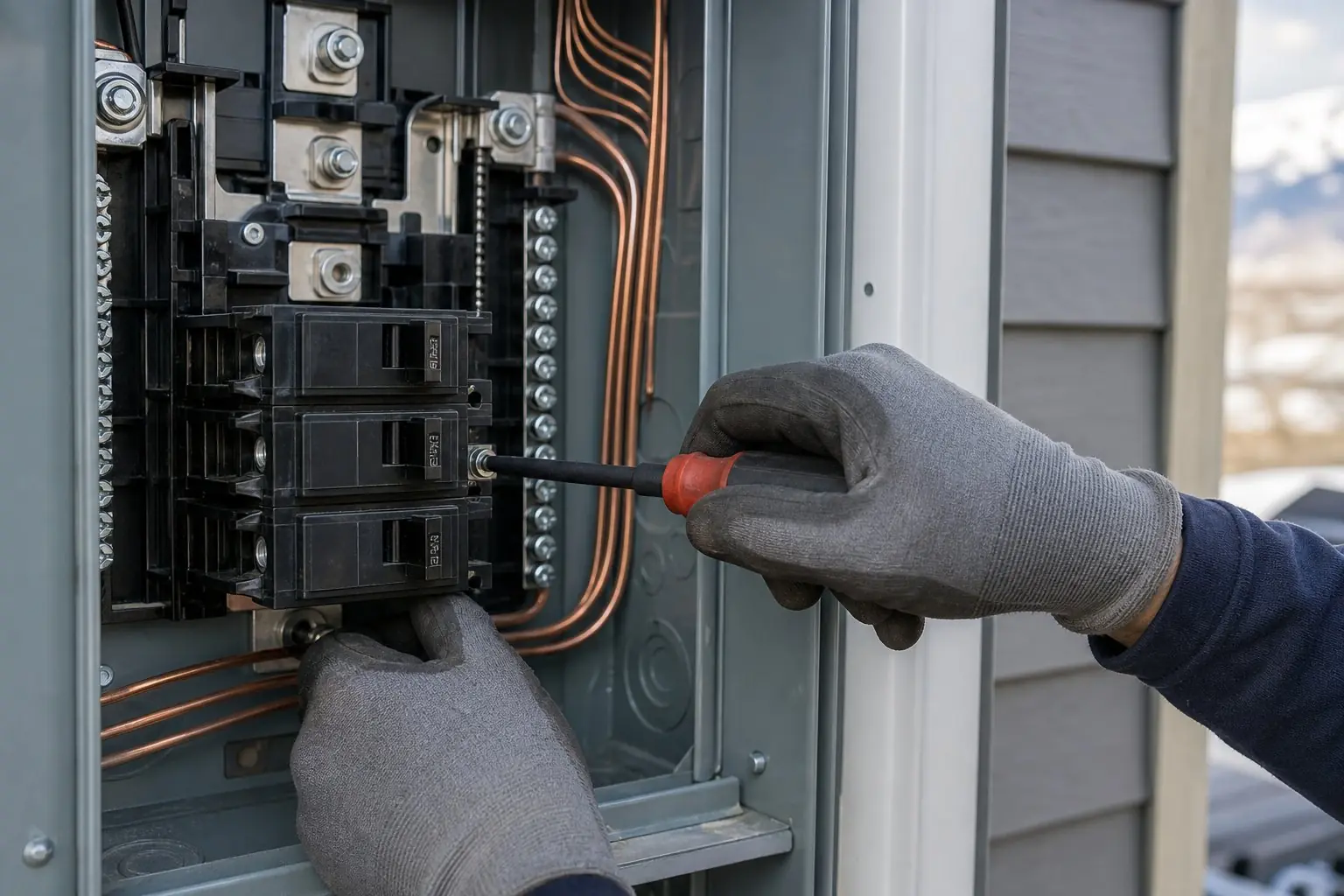
Do you really need a panel upgrade for an EV charger?
Often not. The answer comes from a load calculation, not from the age of the panel or how full it looks. If the calculation shows spare capacity, the charger goes on the existing panel. If it does not, a lower charger setting or a load management device may close the gap. An upgrade is for when those options fall short.
Rocky Mountain Power's EV page says Level 2 charging "will likely require upgrades to your home's electrical panel and the addition of a new circuit." The circuit is a given; the panel upgrade is something to test. We run the load calculation and look at load management before we recommend a panel or service upgrade.
Is your panel out of space or out of capacity?
These are two different problems. Space means there is no room for another two-pole breaker. Capacity means the house's calculated load leaves too little amperage for a continuous charging load. A panel can be full of breakers with capacity to spare, or have open slots and no capacity left.
A space problem can often be solved with a subpanel, if the capacity is there. A capacity problem is solved only by using less, managing the load, or getting more service from the utility.
Capacity is set by your service rating, usually stamped on the main breaker. Ratings you may see on a house include 100, 125, 150 and 200 amps. Rocky Mountain Power's current service manual lists 200 and 400 amps as the single-phase choices for a new home. Ogden's housing is old (median build year 1966 in Census estimates for 2020 to 2024), so some homes may have smaller services or aging panels. Only the panel itself tells you.
How does a load calculation decide it?
An electrician adds up your home's loads under the rules in NEC Article 220 and compares the result with the service rating. Under the 2023 NEC, which Utah adopted, a charger counts at 7,200 watts or its nameplate rating, whichever is larger, with no discount for diversity. The question is whether that fits.
| Charger setting | Breaker | Counted in the calculation |
|---|---|---|
| 24 amp | 30 A | 7,200 W (the minimum) |
| 32 amp | 40 A | 7,680 W |
| 40 amp | 50 A | 9,600 W |
| 48 amp | 60 A | 11,520 W |
Nameplate watts are output amps times 240 volts. NEC 220.57 (2023) counts the larger of 7,200 W or nameplate. Breaker sizes follow the 125 percent rule explained in what size breaker for an EV charger.
Electric heat, a tank water heater, an electric range and a hot tub weigh heavily, so the same 100 amp service can pass in one house and fail in the next.
What does a service upgrade involve with Rocky Mountain Power?
A service upgrade raises the amperage the utility delivers. The electrician replaces your side of the service, such as the main panel and the meter socket, and Rocky Mountain Power handles its side: disconnecting, reconnecting and resetting the meter. Rocky Mountain Power asks you to call 1-888-221-7070 when your electrician needs utility service upgrades.
Rocky Mountain Power's Electric Service Requirements manual, shared with Pacific Power, sets the ground rules:
- Added load. Section 2.4 says that before adding load beyond what existed when service was established, the customer "shall contact the Power Company," and it names car chargers.
- The meter. Any work involving relocation, rewiring, removal or installation of a meter needs the company's consultation first.
- Only the utility connects. Only authorized company employees make a permanent connection or disconnection, and services may not be jumpered before local inspection.
- The meter socket. The customer provides and installs it.
- Fees and inspection. Connections and disconnections carry a fee from the company's schedule, and the company may refuse to connect service until the local inspection approval is in place.
The utility may also need to upgrade its own equipment, and both the manual and Electric Service Regulation No. 5 let it require a contract first. Rocky Mountain Power does not publish a standard residential timeline, so the utility should be contacted early and its schedule built into the plan.
When is a panel-only upgrade enough?
When the service has enough capacity but the panel itself is the problem: no spaces, a panel that is damaged or obsolete, or no way to add a breaker of the right type. Replacing the panel at the same service rating does not raise capacity, so it fixes space and condition, not a failed load calculation.
A subpanel is the other route for space. It is common in detached rear garages behind older Ogden homes, where a feeder from the house panel serves the charger and the garage. More on that in garage EV charger installation.
What should you rule out before upgrading?
Three things. First, a lower charger setting: a 32 amp charger on a 40 amp breaker refills most daily driving overnight. Second, load management, which caps or pauses charging when the house is busy and lets the 2023 NEC count the capped value. Third, sharing one circuit between two chargers instead of adding a second.
The tradeoffs are on our EV charger load management page. An upgrade can still make sense if you plan a heat pump or a second EV, or the panel needs replacing anyway.
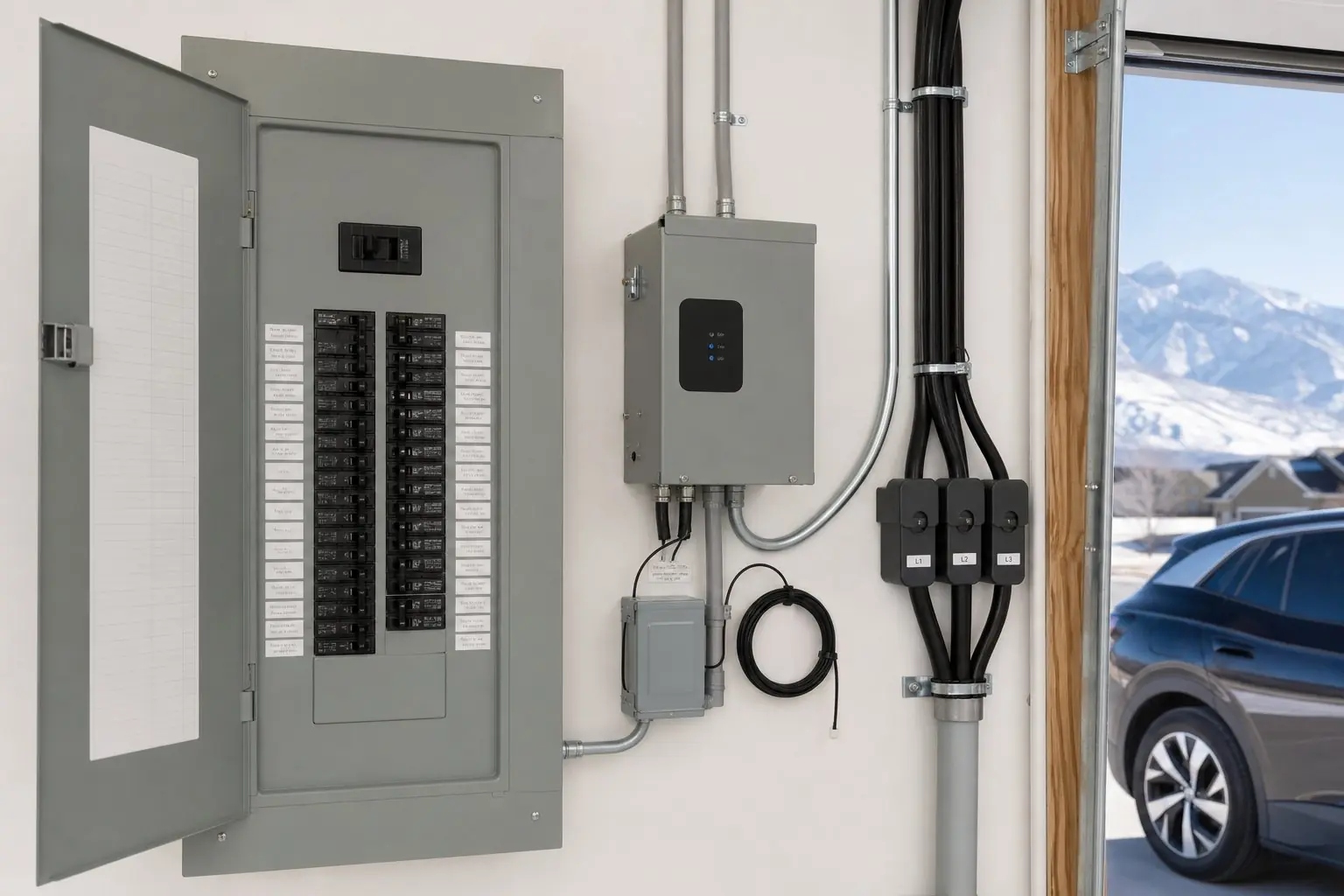
Do panel and service upgrades need a permit?
Panel and service work is permitted electrical work in all four cities. Ogden City requires a permit to install, alter, change, extend, repair or replace an electrical system. Before work starts, confirm in writing who pulls the permit and who coordinates with Rocky Mountain Power.
Utah's Division of Professional Licensing runs a public license lookup where you can check any electrical contractor by name or license number. The city-by-city permit process is on our EV charger permits page, and the variables that drive price are on the installation cost page.
Never open the meter socket or pull a meter yourself. Rocky Mountain Power's rules reserve that work for the utility, and the service conductors ahead of the main breaker stay energized even with the main off.
EV charger panel upgrade questions
Does every Level 2 charger need a panel upgrade?
No. A load calculation decides it. Many homes can take a Level 2 charger as is, sometimes at a lower amp setting. When the calculation comes up short, a load management device can often cap the charger so the service is never overloaded. A panel or service upgrade is the answer when neither works, or when the panel itself is worn out.
What is the difference between a panel upgrade and a service upgrade?
A panel upgrade replaces the breaker panel inside or on the house. A service upgrade raises the amperage the utility delivers, which means work on your service equipment, such as the main breaker and meter socket, and it requires Rocky Mountain Power. A new panel at the same rating does not add capacity.
Do I have to call Rocky Mountain Power for a service upgrade?
Yes. Rocky Mountain Power asks you to call 1-888-221-7070 if your electrician needs utility service upgrades. Its service manual says only its employees connect or disconnect service and that meter work needs the company's approval first. The electrician doing the work normally coordinates the timing with the utility.
Does a panel or service upgrade need a permit?
Yes. Ogden City requires a permit to install, alter, change, extend, repair or replace an electrical system, and South Ogden, North Ogden and Ogden Valley City have similar rules. The work must pass a local inspection, and Rocky Mountain Power may refuse to connect service until the local approval is in place.
Not sure if your panel is enough? Send your car model and a photo of the open panel.
Get a panel upgrade quote