
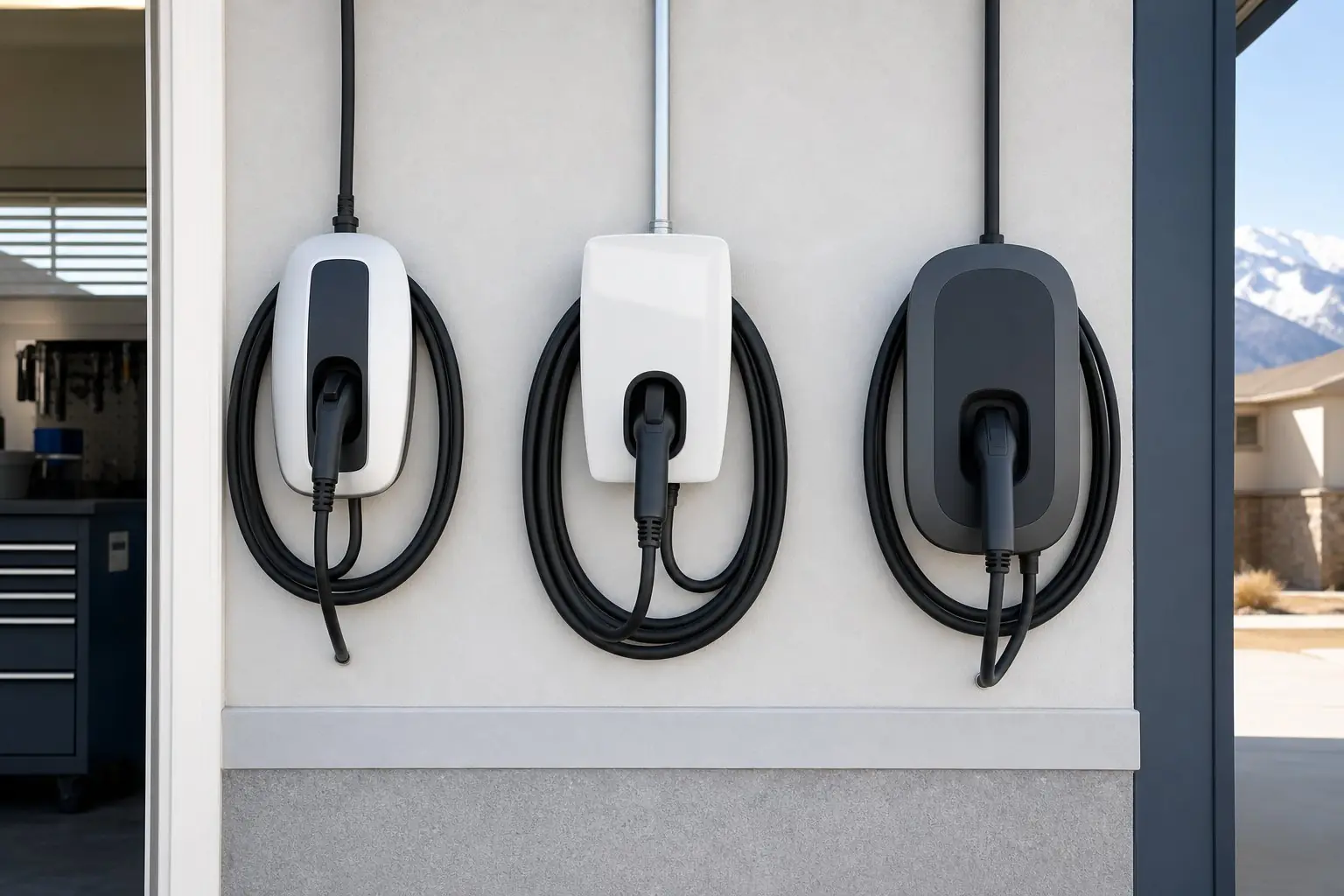
What is Level 2 charging?
Level 2 charging runs on 240 volts, the same supply a dryer or range uses, instead of a standard 120-volt outlet. The U.S. Department of Energy says a typical residential Level 2 unit adds about 25 miles of range per hour and can charge a typical EV battery overnight. It needs its own dedicated circuit.
Level 2 is the home charging most EV owners end up with. Level 1, the cord plugged into an ordinary outlet, works for light driving. Level 2 makes the car's range a non-issue for daily use, because the battery is back where you want it every morning.
How does Level 2 compare with Level 1?
Level 1 adds about 5 miles of range per hour, so eight hours on a 120-volt outlet replenishes about 40 miles, per the Department of Energy. Level 2 adds about 25 miles per hour at 7.2 kW, and more on a higher-amperage circuit. If you drive more than about 40 miles on a typical day, Level 1 falls behind.
| Level 1 | Level 2 | |
|---|---|---|
| Voltage | 120 V outlet | 240 V or 208 V |
| Typical power | Up to 1.9 kW | 7.2 kW for a typical 30 amp home unit, up to 11.5 kW at 48 amps |
| Range per hour (DOE) | About 5 miles | About 25 miles at 7.2 kW |
| Circuit | Existing outlet, ideally on a dedicated circuit | New dedicated 240 V circuit |
Level 1 and Level 2 range figures are from the DOE Alternative Fuels Data Center. Real-world range per hour depends on the car's efficiency and onboard charger. Tesla's Mobile Connector, for example, draws 12 amps (1.3 kW) on a standard NEMA 5-15 outlet.
How fast will a Level 2 charger charge my car?
As fast as the slowest of three things allows: the circuit, the charger's setting and the car's onboard charger. A 32 amp charger supplies about 7.7 kW, 40 amps about 9.6 kW and 48 amps about 11.5 kW. If your car accepts 32 amps, a 48 amp charger still charges it at 32.
| Charger output | Breaker | Power at 240 V | Energy in 8 hours |
|---|---|---|---|
| 24 A | 30 A | 5.7 kW | about 46 kWh |
| 32 A | 40 A | 7.7 kW | about 61 kWh |
| 40 A | 50 A | 9.6 kW | about 77 kWh |
| 48 A | 60 A | 11.5 kW | about 92 kWh |
Breaker pairs follow the 125 percent rule for continuous loads (NEC 625.41 and 625.42) and match Tesla's Wall Connector manuals. Energy is circuit output before charging losses.
Onboard charger ratings vary by model and even by trim. The F-150 Lightning is a good example, with different onboard chargers across model years and trims. Look up your car in our vehicle charging guides before choosing a circuit.
Which Level 2 setup fits your home?
There are three common setups: a hardwired wall charger on a 60 amp or smaller circuit, a NEMA 14-50 outlet for a plug-in or portable charger, and a Tesla Wall Connector, which is hardwired only. Hardwired reaches 48 amps; a 14-50 tops out at 40 amps of charging.
- Hardwired charger: no plug to wear, the highest rate, and the best choice outdoors. See hardwired EV charger installation.
- NEMA 14-50 outlet: portable and plug-in chargers, and easy to take when you move. In Utah it needs a GFCI breaker. See NEMA 14-50 outlet installation or other 240V EV charger outlets.
- Tesla Wall Connector: 12 to 48 amps, with a J1772 adapter on the Universal model. See Tesla Wall Connector installation.
The trade-offs are laid out side by side in hardwired vs NEMA 14-50.
How do you choose the right amperage?
Start with your car's onboard charger, then check what your panel can spare. Many homes land on a 40 or 48 amp charger. When the panel is tight, 32 amps on a 40 amp circuit still fills most batteries overnight, and load management can cap charging when the house is busy.
Three questions settle it:
- What does your car accept? There is no benefit to a circuit bigger than the onboard charger can use.
- How far do you drive? Most Ogden commutes, even a round trip to Salt Lake, are covered by 32 amps overnight.
- What can your panel spare? The 2023 NEC counts an EV charger at 7,200 watts or its nameplate, whichever is larger, in the load calculation.
If a second EV or a bigger truck is likely, wire sized for 60 amps now with the charger set lower costs less than pulling new wire later. We do the load calculation first and only recommend an upgrade when the numbers call for it. The full sizing table is in what size breaker an EV charger needs, and the alternatives to an upgrade are on EV charger load management.
Do you need a smart Level 2 charger?
Not always. Many EVs can schedule charging from the car itself. The Department of Energy describes smart Level 2 products as adding data collection, displays, charging timers and communications. They earn their place when you want scheduling at the charger, energy tracking, or power sharing between two chargers.
Before relying on Wi-Fi features, check the signal where the charger will hang. Tesla's Wall Connectors use 2.4 GHz Wi-Fi, which detached garages and basements often barely reach. Power sharing is the feature that matters most for two-EV households: two Tesla Wall Connectors, for example, can share one site limit set by the installer, so the panel does not have to carry two full-rate cars at once.
Rocky Mountain Power also runs Wattsmart Drive, a managed-charging program that enrolls through supported vehicles' own accounts, with no charger hardware needed.
When should you charge on Rocky Mountain Power's time-of-use rate?
After 10 p.m. on weekdays, or any time on weekends. Rocky Mountain Power's optional residential time-of-use schedule sets on-peak hours at 6 to 10 p.m. Monday through Friday. Its tariff lists on-peak energy at about 33.6 cents per kWh in summer and 29.7 cents in winter, against about 7.5 and 6.6 cents off-peak.
Rates are from the Utah Schedule 1 tariff effective August 10, 2026, and they change. The option carries a one-year commitment, so compare it with your current bill before switching. A Level 2 charger makes the schedule easy to live with: even a few off-peak hours at 7 to 11 kW cover a typical day of driving.
Ended Rocky Mountain Power's residential charger rebate was removed effective January 1, 2026, and the federal 30C credit does not apply to chargers placed in service after June 30, 2026.
What does a Level 2 installation involve?
A new two-pole breaker, wire sized to it, a route from the panel to the parking spot, and the charger or receptacle at the end. The charger is set to match the breaker, tested under load and connected to Wi-Fi if it has an app. A new charging circuit is permitted electrical work in Ogden, South Ogden, North Ogden and Ogden Valley City. We pull the permit and book the inspection. The step-by-step version is on home EV charger installation, and the circuit itself on dedicated EV charger circuit installation.
Level 2 charger installation questions
How much faster is Level 2 than Level 1?
The U.S. Department of Energy puts Level 1 at about 5 miles of range per hour of charging and a typical residential Level 2 unit at about 25 miles per hour. A 48 amp Level 2 charger on a 60 amp circuit delivers 11.5 kW, well above the typical 7.2 kW unit those figures assume.
Do I need a 240-volt outlet for Level 2?
You need a 240-volt circuit. It can end at a hardwired charger or at a receptacle such as a NEMA 14-50 for a plug-in charger. Either way the circuit is dedicated to the charger and sized at 125 percent of the charger's output.
Is 32 amps enough for a Level 2 charger?
For most daily driving, yes. A 32 amp charger on a 40 amp circuit supplies about 7.7 kW, roughly 60 kWh over eight hours before charging losses. That covers a long commute with room to spare. Go higher if your car accepts more and you often arrive home low.
Can I use a Level 2 charger with any EV?
Any EV can charge on Level 2, but the plug has to fit. Cars with a J1772 port need a J1772 charger or adapter, and newer cars with the Tesla-style NACS port need a NACS charger or adapter. Universal units, such as Tesla's Universal Wall Connector, carry both.
When is the cheapest time to charge in Ogden?
On Rocky Mountain Power's optional residential time-of-use schedule, on-peak is 6 to 10 p.m. on weekdays and everything else is off-peak, including weekends. Scheduling the car or charger to start after 10 p.m. keeps nearly all home charging in off-peak hours.
Not sure which amperage fits? Send your car model and a photo of your open panel.
Get a Level 2 installation quote