
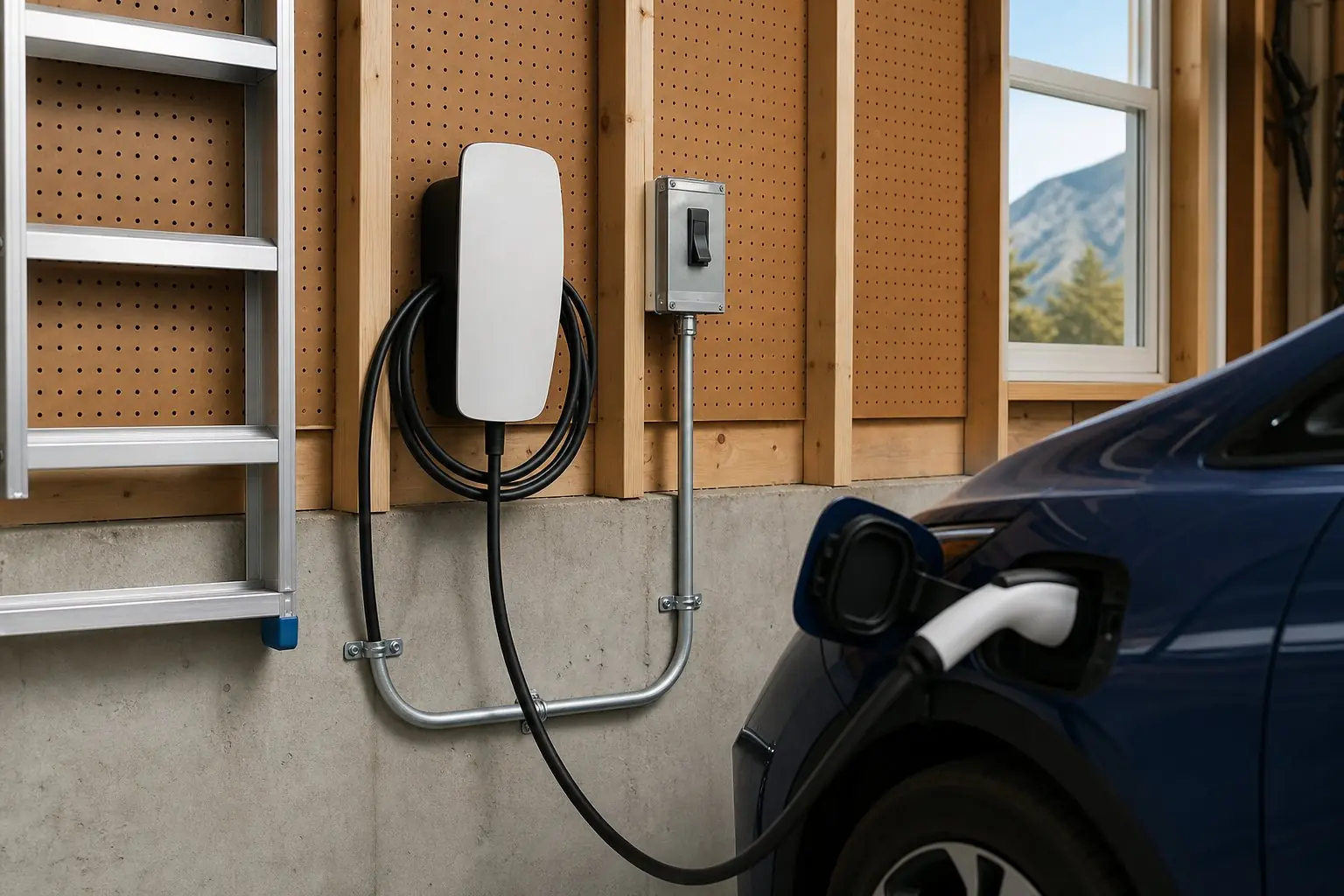
Why does an EV charger need a dedicated circuit?
Because the code requires it and the load demands it. NEC 625.40 gives EV charging equipment rated over 16 amps or 120 volts its own branch circuit, and NEC 625.42 treats charging as a continuous load. A circuit shared with a dryer, range or shop tools cannot carry that safely.
A dedicated circuit is also what makes the charger predictable. Nothing else on it can push the breaker over the edge halfway through the night, and the breaker, wire and charger setting can all be matched to one known load. The Department of Energy's summary puts it simply: a typical 30 amp residential Level 2 unit needs a dedicated 40 amp circuit.
What does a dedicated circuit installation include?
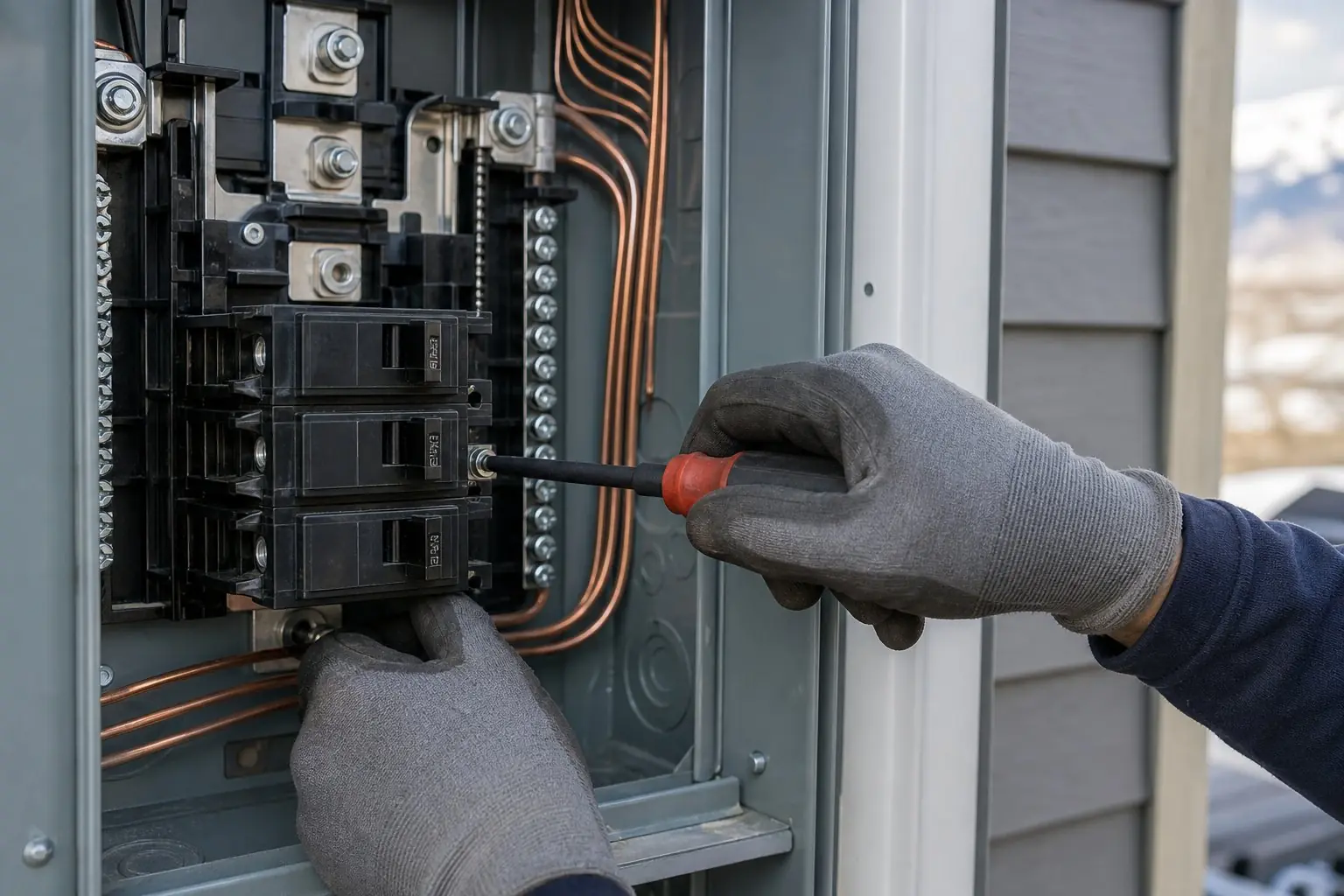
A new two-pole breaker in your panel, copper conductors sized to that breaker, the cable or conduit that carries them to the parking spot, and the termination: a receptacle, a hardwired charger, or a junction box ready for one. It ends with labeling, testing and the city inspection.
- Breaker: new, two-pole, rated at least 125 percent of the charger's output. ChargePoint's electrician notes say to use only new breakers, because used ones can damage equipment.
- Conductors: copper, sized for the breaker, not just the charger.
- Wiring method: NM-B cable inside dry framing, or individual conductors in conduit where the run is exposed, outdoors or underground.
- Termination: a hardwired connection, a NEMA 14-50 or other receptacle with a GFCI breaker, or a covered box for a charger to come.
- Permit and inspection with Ogden, South Ogden, North Ogden or Ogden Valley City. We pull the permit and book the inspection.
What breaker and wire size does the circuit need?
Size the breaker at 125 percent of the charger's output, then size the wire for the breaker. A 32 amp charger takes a 40 amp breaker, 40 amps takes 50, and 48 amps takes 60. The wire size then depends on whether it is NM-B cable or conductors in conduit.
| Charger output | Breaker | Copper in conduit (75°C) | NM-B cable (60°C) |
|---|---|---|---|
| 32 A | 40 A | 8 AWG | 8 AWG |
| 40 A | 50 A | 8 AWG | 6 AWG |
| 48 A | 60 A | 6 AWG | 4 AWG |
Copper ampacities from NEC 310.16 as published by Cerrowire, checked against each breaker. Tesla's Wall Connector manual gives the same 60 amp minimums. The full table, including smaller and larger circuits, is in what size breaker an EV charger needs.
The charger's setting has to match the breaker. Most hardwired chargers can run at several output levels, and on Tesla's Wall Connectors the breaker size is programmed during commissioning. A charger set higher than 80 percent of its breaker can trip it after a long session.
Conduit or NM cable?
NM-B cable is the usual choice inside walls, attics and crawlspaces, but it is limited to its 60°C ampacity and listed by its maker for normally dry locations. Conduit with THWN-2 conductors suits exposed garage walls, outdoor runs and underground runs, and its conductors are rated for wet and dry locations.
Each method has a cost logic. NM-B is fast to pull through framing but needs a size larger wire at 50 and 60 amps. Conduit takes more labor to bend and mount, yet carries smaller conductors for the same breaker when the terminals are rated 75°C, and it protects the wire on a garage wall where bikes, ladders and car doors live.
Charger makers set their own limits too. Tesla's Wall Connector manuals call for copper only, accept 12 to 4 AWG at the terminals, and use a 3/4 inch conduit entry by default with 1 inch as an option. Check your charger's manual for the same details before the wire is bought.
How does distance change the circuit?
Distance is the biggest single cost driver. Every foot adds wire and conduit, and the heavier conductors for 48 amp charging cost more per foot. Long runs to a detached garage can also call for a larger wire size, and underground runs add trenching and burial-rated conduit.
Older Ogden neighborhoods make this real. City plans for areas such as Hillcrest/Bonneville and Horace Mann describe garages set at the back of the lot, often detached. Reaching one means a trench from the house and sometimes a small subpanel in the garage rather than a single long branch circuit. See garage EV charger installation for the options, and the EV charger installation cost guide for how each variable moves the price.
Already have a charger, or plan to mount it yourself?
Bring the charger's model and manual to the quote. The circuit is designed around the charger's maximum output, breaker requirement, wire range and conduit entry, and whether it wants a standard or GFCI breaker. A receptacle lets you plug in your own portable unit; a hardwired connection is part of the permitted electrical work.
We install chargers customers supply, and we can also run the circuit only. Two practical routes:
- Plug-in charger: the circuit ends at a NEMA 14-50 or 6-50 receptacle on a GFCI breaker. You hang the charger's bracket and plug it in. See 240V EV charger outlets.
- Hardwired charger: the circuit ends at the charger's wiring compartment, and the final connection, torque and amperage setting are part of the inspected work.
In Ogden, an owner-occupant may pull their own electrical permit; rentals require a contractor holding a Utah license. A 40 to 60 amp, 240-volt circuit is not beginner work, and opening a panel is electrician territory.
Can your panel take another circuit?
That takes two checks: physical room for a two-pole breaker, and spare capacity in a load calculation. The 2023 NEC counts an EV charger at 7,200 watts or its nameplate, whichever is larger. When capacity is short, a lower charger setting or load management often fits without an upgrade.
We do the load calculation first and only recommend an upgrade when the numbers call for it. More on EV charger load management and panel upgrades for EV charging.
Dedicated EV charger circuit questions
Does an EV charger need a dedicated circuit?
Yes. NEC 625.40 requires EV charging equipment rated over 16 amps or 120 volts to have its own branch circuit, and every Level 2 home charger is over that line. The Department of Energy notes that a typical 30 amp residential unit needs a dedicated 40 amp circuit.
What wire size does a 60 amp EV charger circuit need?
For a 48 amp charger on a 60 amp breaker, 6 AWG copper in conduit when the breaker and terminals are rated 75°C, or 4 AWG if the breaker is rated 60°C or the run is NM-B cable. Tesla's Wall Connector manual states both minimums, using 90°C THWN-2 copper.
Can I run the circuit now and add the charger later?
Yes. The circuit can end at a receptacle, or at a covered junction box ready for a hardwired charger. Size the wire for the largest charger you expect, and remember the breaker and charger setting must match when the charger goes in. The final hardwired connection is part of the permitted electrical work.
Can I use NM cable for an EV charger circuit?
Inside dry walls, attics and crawlspaces, often yes, but NM-B is limited to its 60°C ampacity, so it needs a larger size than conductors in conduit. Its maker lists it for normally dry locations, so exposed garage runs, outdoor runs and underground runs to a detached garage use conduit with wet-rated conductors.
Will the length of the run change the wire size?
It can. Wire size starts with the breaker, but long runs to detached garages or across a large house can call for a larger conductor so the charger sees full voltage. Ask the installer whether the quote upsizes the wire for distance and why.
Need just the circuit? Send the charger model, a panel photo and where you park.
Get a charger circuit quote