
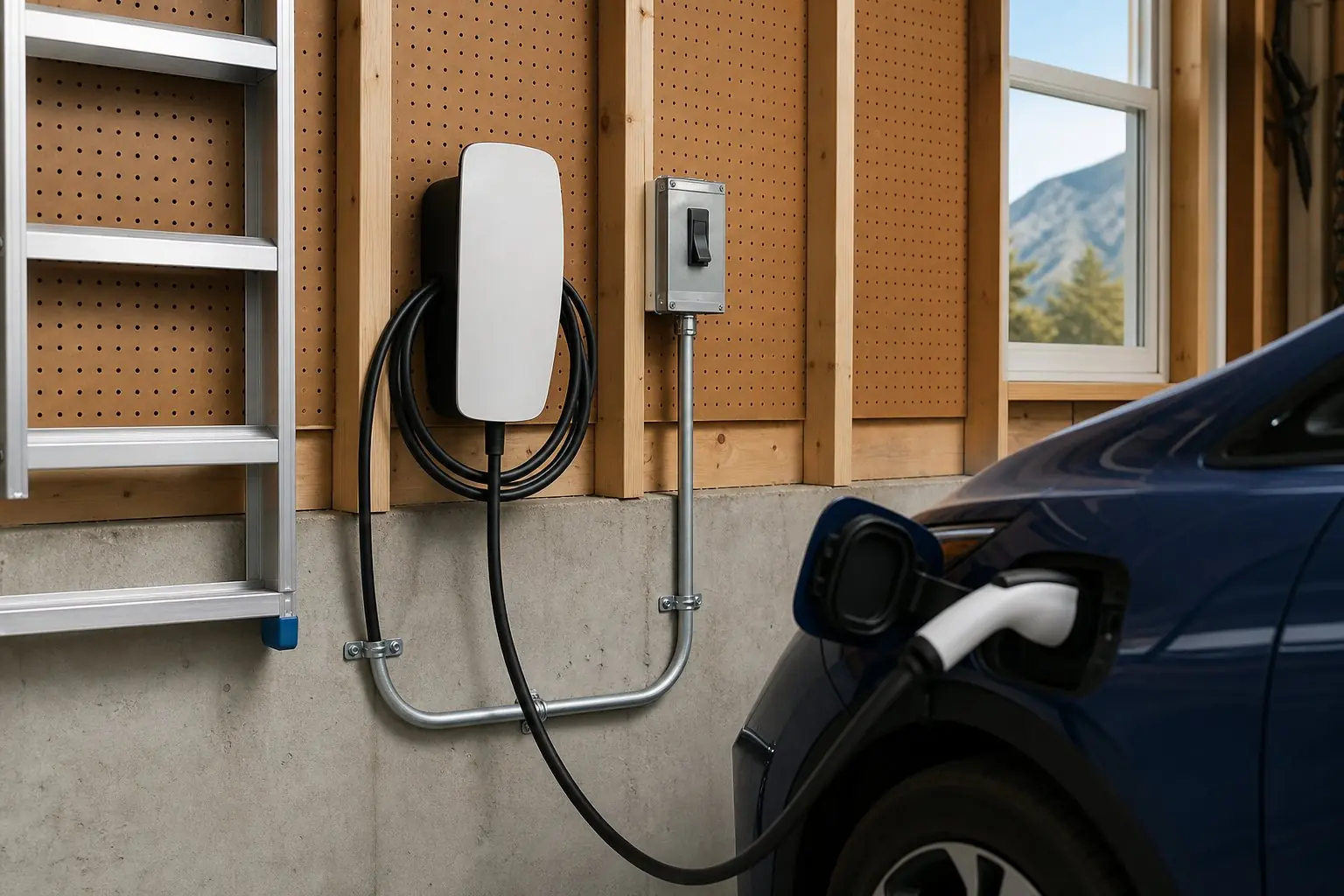
What does a hardwired EV charger installation involve?
The circuit conductors run from a two-pole breaker in your panel, usually through conduit, into the charger's own wiring compartment, where they land on terminals torqued to the maker's spec. There is no plug or receptacle. Then we set the charger's current limit to match the breaker and test a charge.
Under NEC 625.40, a charger rated over 16 amps or 120 volts needs an individual branch circuit, so the charger gets its own breaker. EV charging also counts as a continuous load (625.42), which is why the breaker is sized at 125 percent of the charger's output.
Hardwiring is the only option for some chargers. Tesla's Gen 3 and Universal Wall Connector manuals both say: "Hardwire branch circuits to disconnects or circuit breakers. Do NOT install cord-and-plug type connections." Other brands sell hardwired and plug-in versions of the same unit.
Deciding between hardwired and a plug-in charger? The hardwired vs NEMA 14-50 comparison covers speed, GFCI rules, wear and portability side by side. This page covers the install itself.
What circuit does a 48 amp charger need?
A 60 amp two-pole breaker, with wire rated for 60 amps. That usually means 6 AWG copper in conduit with 75°C terminations, or 4 AWG if the run uses NM-B cable, which is limited to its 60°C rating. A charger set to 40 amps needs a 50 amp breaker instead.
| Charger setting | Breaker | Copper in conduit (75°C) | NM-B cable (60°C) |
|---|---|---|---|
| 32 A | 40 A | 8 AWG | 8 AWG |
| 40 A | 50 A | 8 AWG | 6 AWG |
| 48 A | 60 A | 6 AWG | 4 AWG |
From NEC Table 310.16 ampacities as published by Cerrowire. Tesla's manual specifies 4 AWG for a 60°C rated breaker and 6 AWG for a 75°C rated breaker at full power, both in 90°C THWN-2 copper.
Whether 48 amps is worth it depends on your car's onboard charger and your panel. That decision has its own page: 40 amp vs 48 amp EV charger. For the sizing rule itself, see what size breaker for an EV charger.
Most current chargers set their limit in software. Tesla's manual says "Circuit breaker size is programmed during the commissioning process," and ChargePoint warns that "incorrect amperage settings during installation can cause circuit breaker tripping." We set it to match the breaker and show you the setting.
Do you need a separate disconnect switch?
For most home chargers, no. NEC 625.43 requires a readily accessible disconnect for charging equipment rated more than 60 amps. A 48 amp charger is under that line, and the breaker in the panel serves as its means of disconnect. Tesla's manual says external disconnect switches are "neither required nor recommended."
Bigger chargers are different. Units rated above 60 amps, such as Ford's Charge Station Pro, which reached 80 amps only on a 100 amp circuit, need that disconnect. When it sits away from the charger, Mike Holt's summary of the 2023 code says a plaque on the charger must show where it is, and it must be lockable in the open position.
A local inspector can ask for more than the minimum, so the requirement is confirmed with your city before the job. Permit details for Ogden, South Ogden, North Ogden and Ogden Valley City are in the EV charger permit guide.
Does a hardwired charger need a GFCI breaker?
No. The code's EV-charging GFCI rule, 625.54, covers receptacles, and Mike Holt notes it "only applies to cord-and-plug-connected EVSE." Most hardwired chargers have ground-fault protection built in, and several makers say a GFCI breaker on top of it causes nuisance trips. A standard two-pole breaker is the usual choice.
- Tesla Gen 3 Wall Connector: integrated protection, "Means of Disconnect: External branch circuit breaker."
- Emporia: for hardwired installs, "Always use a standard non-GFCI breaker."
- Wallbox Pulsar Plus: an additional GFCI breaker is "optional, as per article 625.54."
This is one reason ChargePoint recommends hardwiring "when local codes mandate GFCI protection" for plug-in installs, as Utah's code does.
What separates a good hardwired install from a poor one?
Mostly details you never see once the cover is on: terminals torqued to the stated value, the right conductor for the breaker's temperature rating, sealed fittings outdoors, and a mounting spot where the cable reaches the charge port without strain. Loose terminations are the classic cause of heat at the charger.
- Torque. NEC 110.14(D) calls for a calibrated torque tool where the maker gives a value. Tesla specifies 50 in-lb at its terminals; Wallbox specifies 11.5 in-lb. Hubbell warns under-torquing leads to "arcing, overheating, and potential electrical fires."
- Copper only. Tesla's wirebox accepts copper conductors only, 12 to 4 AWG, with 3/4 inch conduit by default and 1 inch optional.
- Panel compatibility. Tesla warns against Eaton BR breakers for the Universal Wall Connector when the panelboard is aluminum and recommends BRH breakers.
- Placement. Tesla recommends mounting about 45 inches high, no higher than 60 inches, where its 24 foot cable reaches the port comfortably.
- Ventilation. Not needed for chargers listed for indoor charging without it (625.52); Tesla's spec table says "Not required."
Is hardwired the better choice outdoors?
Usually. A hardwired charger keeps every connection inside its sealed enclosure, with no plug and receptacle exposed to snow each time you charge. Tesla's manual calls for watertight fittings on the feeder outdoors and notes its Type 3R rating depends on gasketed washers. ChargePoint recommends hardwiring for outdoor use.
Enclosure ratings, minimum heights, pedestals and snow placement are covered on the outdoor EV charger installation page. In Eden and the Ogden Valley, read the Eden charger guide as well.
What we check before quoting a hardwired charger
The charger, the car and the panel decide the circuit, so those come first. A photo of your open panel and the spot where you park lets us size the breaker and wire before a visit, check capacity and load management before suggesting a panel upgrade, and itemize the breaker, wire run, conduit and mounting.
- Your car's onboard charger rating, so the circuit is not bigger than it needs to be.
- The charger model and its install manual: hardwire only, torque values, conduit size.
- The route from panel to parking spot, indoors or outside.
- The electrical permit and inspection with your city.
Hardwired EV charger questions
Do I need a separate disconnect switch for a hardwired EV charger?
Usually not for a home charger. The 2023 NEC requires a readily accessible disconnect for charging equipment rated more than 60 amps. Typical home chargers top out at 48 amps on a 60 amp breaker, and Tesla's Wall Connector manual says external disconnect switches are neither required nor recommended. Your local inspector has the final say.
What size wire does a 48 amp hardwired charger need?
A 48 amp charger needs a 60 amp breaker, and the wire must be rated for that breaker. Copper in conduit with 75°C terminations is typically 6 AWG; NM-B cable, limited to its 60°C rating, needs 4 AWG. Tesla's manual gives the same pair for its Wall Connector at full power.
Does a hardwired charger need a GFCI breaker?
No. The NEC's GFCI rule for EV charging, 625.54, covers receptacles, not hardwired equipment, and most hardwired chargers have ground-fault protection built in. Tesla says not to add a GFCI breaker to its Wall Connector, and Emporia says to use a standard breaker for hardwired installs.
Can I move a hardwired charger later?
Yes, but it takes an electrician. The charger has to be disconnected at its terminals and the circuit either extended, capped safely or reused for a new unit. If you expect to move house soon, a NEMA 14-50 outlet with a plug-in charger may suit you better.
Ready to hardwire a charger? Tell us your car and where you park.
Get a hardwired charger quote