
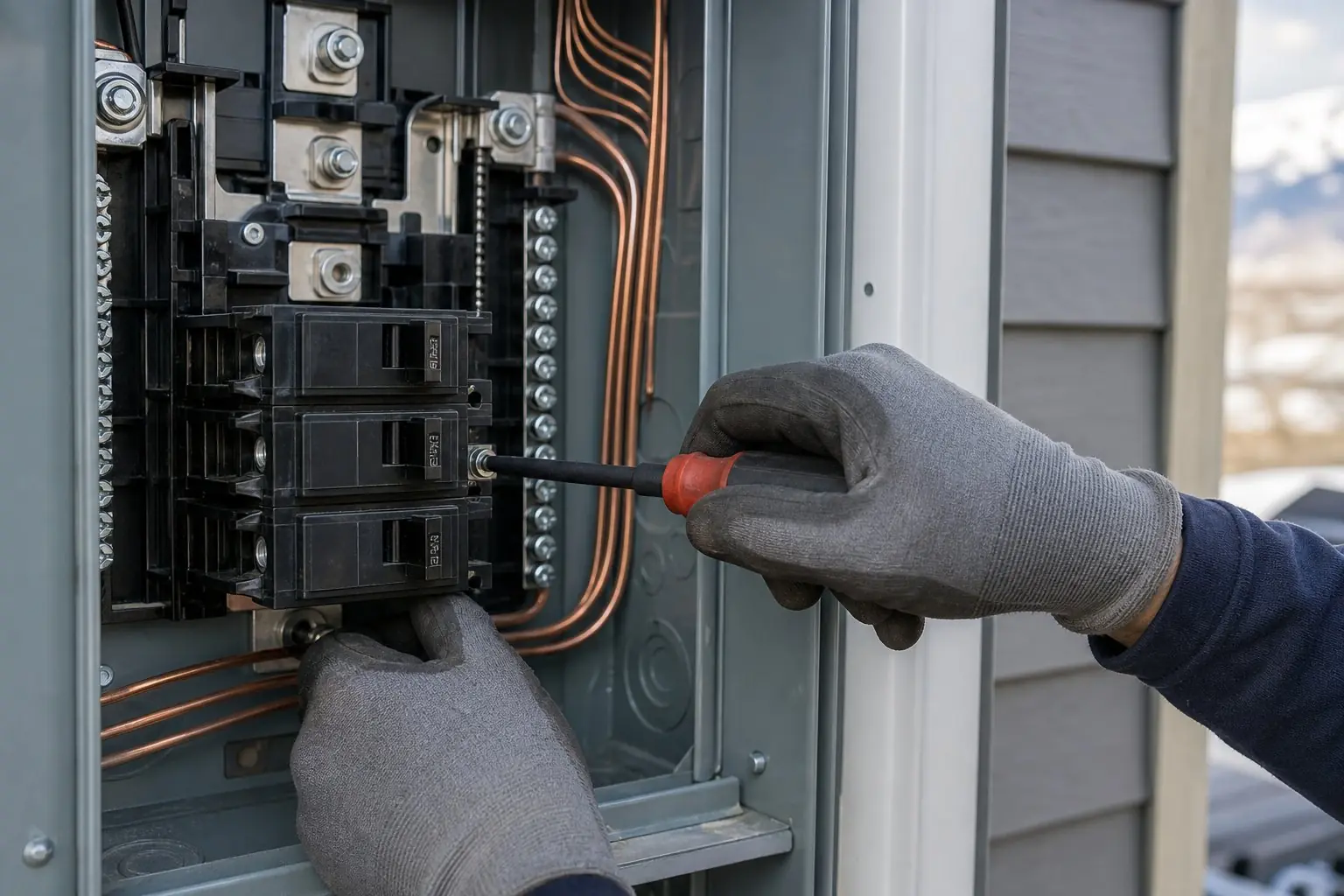
Is a 48 amp charger worth it over 40 amps?
Only when two things are true: your car's onboard charger accepts 48 amps, and your panel can spare a 60 amp circuit. Then you get about 20 percent more power, 11.5 kW instead of 9.6 kW. If either is missing, a 40 amp charger on a 50 amp circuit charges just as fast in practice and costs less to wire.
What changes in the circuit?
EV charging is a continuous load, so the breaker must be at least 125 percent of the charger's output. A 40 amp charger needs a 50 amp breaker, and a 48 amp charger needs a 60 amp breaker. The wire steps up one size, and a 48 amp setup must be hardwired.
| 40 amp charger | 48 amp charger | |
|---|---|---|
| Breaker | 50 A two-pole | 60 A two-pole |
| Power at 240 V | 9.6 kW | 11.5 kW |
| Energy in 8 hours | about 77 kWh | about 92 kWh |
| Copper in conduit (75°C) | 8 AWG | 6 AWG |
| NM-B cable (60°C) | 6 AWG | 4 AWG |
| Connection | Hardwired or NEMA 14-50 | Hardwired only |
| Load calculation value | 9,600 W | 11,520 W |
Breaker and output pairs from Tesla's Wall Connector manuals. Wire sizes from the NEC 310.16 ampacity values published by Cerrowire. Energy is circuit output before charging losses. Long runs can need larger wire.
The full breaker table is in what size breaker an EV charger needs, and the plug-in limit is explained in hardwired vs NEMA 14-50.
Which cars can use 48 amps?
Many current EVs top out right at 48 amps, or 11.5 kW. Some take less: Tesla's Model 3 Rear-Wheel Drive accepts 32 amps, and Hyundai and Kia list a 10.9 kW onboard charger, about 45 amps. A charger can never push more current than the car accepts.
| Vehicle | Onboard charger (maker's figure) | Gain from 48 A over 40 A |
|---|---|---|
| Tesla Model S, Model X, Model 3 Long Range and Performance | 48 A, 11.5 kW | Full 8 amps |
| Tesla Model 3 Rear-Wheel Drive | 32 A, 7.7 kW | None |
| Ford Mustang Mach-E (2024, 2025) | "Up to 11kW with 48 Amps capability" | Full 8 amps |
| Ford F-150 Lightning, 2024 and 2025 retail | 48 A, about 11.3 kW | Full 8 amps |
| Rivian R1T and R1S | 11.5 kW | Full 8 amps |
| Chevrolet Equinox EV and Blazer EV (trims checked) | 11.5 kW standard | Full 8 amps |
| Hyundai IONIQ 5, IONIQ 6; Kia EV6, EV9 | 10.9 kW | About 5 amps |
Ratings from Tesla, Ford, Rivian, Chevrolet, Hyundai and Kia documents, checked October 4, 2026. Ratings vary by year and trim; see the linked vehicle guide for yours.
Tesla's Model Y is listed at 48 amps in one Tesla table and 32 amps for Rear-Wheel Drive in another, so check the car itself: tap the lightning bolt icon on the touchscreen. Details by model are in our vehicle charging guides.
How much faster is 48 amps in daily use?
Less than the numbers suggest. Both settings refill a normal day of driving in a few hours overnight. The 48 amp setting matters when you arrive home nearly empty and need a big refill before morning, or when a large battery and long drives are routine.
Tesla's Wall Connector chart shows the gap for a Model S: about 41 miles of range per hour at 48 amps against 34 at 40 amps. Over an eight-hour night that is roughly 330 miles against 270, both well beyond most commutes.
Can your panel handle the 60 amp circuit?
That is usually the deciding question. The 2023 NEC counts an EV charger at 7,200 watts or its nameplate, whichever is larger, so a 48 amp charger adds 11,520 watts to the load calculation against 9,600 for 40 amps. On a busy panel, that difference can trigger an upgrade.
If the numbers are close, a 40 amp setting or a load management device that caps charging when the house is busy can avoid a panel or service upgrade. See can my panel handle an EV charger and EV charger load management.
What changes the cost?
The charger is often similar, since many models do both settings. The difference is in the circuit: a larger breaker, heavier and more expensive wire on every foot of the run, and sometimes panel work. The longer the run from the panel, the more the wire size matters.
- Wire: one gauge heavier for 48 amps, which costs more per foot and can need larger conduit.
- Run length: a detached garage or far driveway spot multiplies the wire difference.
- Panel capacity: the extra 1,920 watts in the load calculation can tip a full panel into load management or an upgrade.
More in our EV charger installation cost guide.
Choose 48 amps if
- Your car accepts 48 amps or more.
- A load calculation shows room for a 60 amp circuit.
- You often arrive home low, or you share one charger between two EVs.
Choose 40 amps if
- Your car accepts 40 amps or less, or about 45 like Hyundai and Kia models.
- Your panel is tight and 48 amps would force an upgrade.
- You want a plug-in charger on a NEMA 14-50.
40 amp vs 48 amp charger questions
Will I notice the difference between 40 and 48 amps?
Usually not on a normal day. A 40 amp charger on a 50 amp circuit adds about 77 kWh in eight hours and a 48 amp charger about 92 kWh, both far more than a typical commute uses. The gap shows only when you arrive home nearly empty and need a full battery by morning.
Can I install a 48 amp charger and set it to 40 amps?
Yes. Most hardwired Level 2 chargers let the installer set the output to match the breaker, so a 48 amp unit on a 50 amp breaker runs at 40 amps. Wire sized for 60 amps lets you raise the setting later without pulling new wire.
Can a NEMA 14-50 outlet supply 48 amps?
No. A 14-50 is a 50 amp receptacle on a 50 amp breaker, so a plug-in charger can draw at most 40 amps. Every 48 amp setup is hardwired on a 60 amp circuit.
How do I find my car's maximum charging amps?
Check the onboard charger rating in the automaker's spec sheet, order guide or window sticker. On a Tesla, tap the lightning bolt icon on the touchscreen to see the car's maximum amperage. Our vehicle charging guides list the ratings we have verified.
Not sure your panel can take 60 amps? A car model and a panel photo get the quote moving.
Get a charger installation quote