
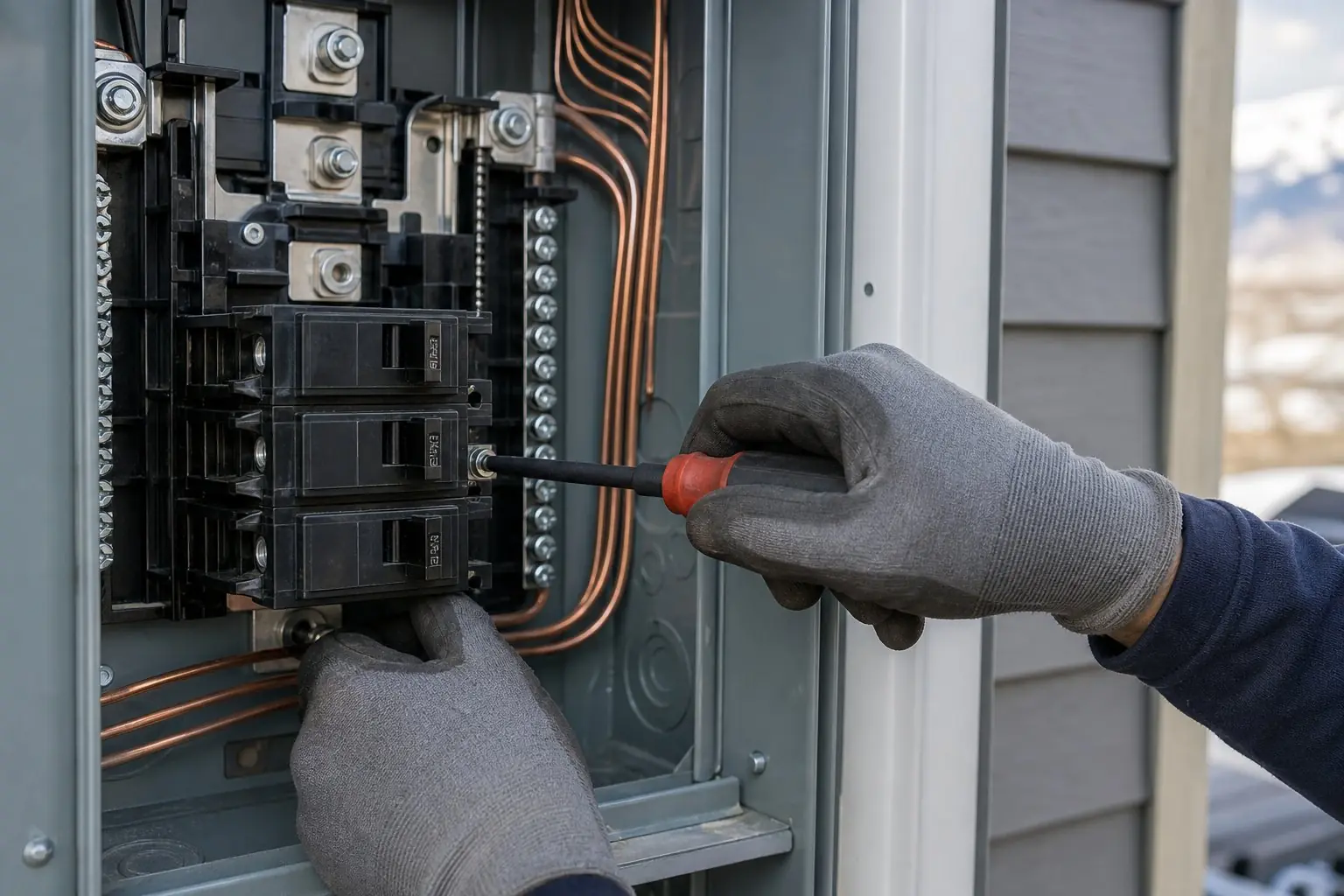
Can my panel handle an EV charger?
Many can. The answer depends on your service rating and on how much of it the house already uses, and an electrician settles it with a load calculation. A home with gas heat and appliances often has room even on a smaller service. A home with electric heat, an electric range and a hot tub may not, even at 200 amps.
For a quick first look, try the panel capacity checker.
You can do the first part yourself: find the rating, look at what the house runs on, and note whether there is space for another breaker. That tells you whether to expect an easy yes or a closer look.
How do you read your panel's rating?
Open the panel door, not the inner cover. The main breaker, usually the large one at the top, controls the whole house and normally shows its amp rating on the handle. The label inside the door lists the panel's maximum rating. Your service capacity is the main breaker's rating, not the sum of the branch breakers.
Ratings you may see on a house include 100, 125, 150 and 200 amps. Rocky Mountain Power's current service manual lists 200 and 400 amps as the single-phase choices for a new home. Older homes vary. Ogden's median build year is 1966 in Census estimates for 2020 to 2024, and only the panel itself tells you what a given house has.
- Main breaker rating: the number on the large breaker at the top of the panel.
- Open spaces: are there empty slots, or is every position filled?
- Big electric loads: electric furnace or baseboard heat, heat pump, electric range, electric dryer, tank or tankless electric water heater, hot tub, shop equipment.
- Panel condition: rust, scorch marks, a warm cover or a buzzing sound are reasons to call an electrician regardless of the charger.
Never remove the panel's inner cover (the dead front). The wires behind it are live, and the conductors feeding the main breaker stay energized even when it is switched off.
Is it a space problem or a capacity problem?
They are different. Space means room for another two-pole breaker. Capacity means enough spare amperage for a continuous charging load. A full panel can still have capacity, and a panel with open slots can have none. A space problem can often be solved with a subpanel; a capacity problem cannot.
The fixes for each are covered on our EV charger panel upgrade page. The rest of this guide is about capacity, the question that decides most jobs.
What does a load calculation count?
An electrician adds up the home's existing loads under the rules in NEC Article 220 and compares the total with the service rating. The charger is then added at the value the code sets for it. If the new total fits within the service, the charger can go on the existing panel at that setting.
Utah has used the 2023 NEC statewide since July 1, 2025. Under the 2023 NEC, a charger counts at 7,200 watts or its nameplate rating, whichever is larger, with no discount for diversity (section 220.57). Nameplate watts are output amps times 240 volts:
| Charger setting | Breaker | Counted in the calculation | Amps at 240 V |
|---|---|---|---|
| 24 amp | 30 A | 7,200 W (the minimum) | 30 A |
| 32 amp | 40 A | 7,680 W | 32 A |
| 40 amp | 50 A | 9,600 W | 40 A |
| 48 amp | 60 A | 11,520 W | 48 A |
Watts per NEC 220.57 (2023), as summarized by Leviton. The last column is the counted watts divided by 240 volts. Breaker sizes follow the 125 percent rule in what size breaker for an EV charger.
Note the first row: even a small charger is counted at 7,200 watts, the same 30 amps at 240 volts as a 24 amp unit. Going from 32 to 48 amps adds 16 amps to the calculation.
What makes the same service pass or fail?
The fuel your home runs on. Electric heat, an electric range, an electric water heater and a hot tub take a large share of a service, so two 100 amp houses can give opposite answers. Plans matter too: a heat pump or second EV you expect to add should go into the calculation now, not after the charger is in.
Two EVs on two full-size circuits add up fast. Chargers that share one current limit can cut that, as our load management page explains.
Does a smaller charger setting help?
Yes. Under NEC 625.42, a charger with an adjustable setting can be counted at the setting marked on its label. Dropping from 48 to 32 amps removes 3,840 watts from the calculation, and a 32 amp charger on a 40 amp breaker still refills most daily driving overnight. Check what your car can accept before paying for more.
A car's onboard charger caps the speed anyway. Tesla, for example, lists the Model 3 Rear-Wheel Drive at 32 amps and its Long Range and Performance versions at 48. Our vehicle charging guides list the rating for each model, and how long home EV charging takes shows what each setting means in hours.
What if the calculation comes up short?
Three options, usually in this order: a lower charger setting, a load management device that caps charging when the house is busy (the 2023 NEC lets the calculation count that cap), and a panel or service upgrade. An upgrade is for when the first two do not fit, or when the panel needs replacing anyway.
Rocky Mountain Power's service manual asks customers to contact the company before adding load beyond what existed when service was established, and it names car chargers as an example. If the job needs a service or meter upgrade, the utility must be involved; Rocky Mountain Power's number for that is 1-888-221-7070. The steps are on the panel upgrade page, and the devices are on the load management page.
Panel capacity questions
Can a 100 amp panel handle an EV charger?
Sometimes. It depends on what else the house runs, not on the 100 amp number alone. A home with gas heat, a gas range and a gas water heater has far more room than one with electric heat and appliances. A load calculation answers it, and a lower charger setting or load management can close a small gap.
Is a 200 amp panel always enough for a Level 2 charger?
Usually, but not automatically. A 200 amp service with electric heat, a hot tub and an electric range can still come up short for a 48 amp charger. The same load calculation applies at every service size; a larger service just tends to leave more margin.
Where do I find my service rating?
Look at the main breaker, the large breaker usually at the top of the panel, often marked with its amp rating on the handle. The panel's label also lists its maximum rating. Read both with the door open and the inner cover left on. Never remove the cover yourself.
My panel has empty slots. Does that mean it can take a charger?
Not by itself. Open slots mean there is physical space for a breaker. Whether the service has enough spare amperage for hours of continuous charging is a separate question that only a load calculation answers.
Not sure if your panel is enough? Send your car model and a photo of the open panel.
Get a charger installation quote