
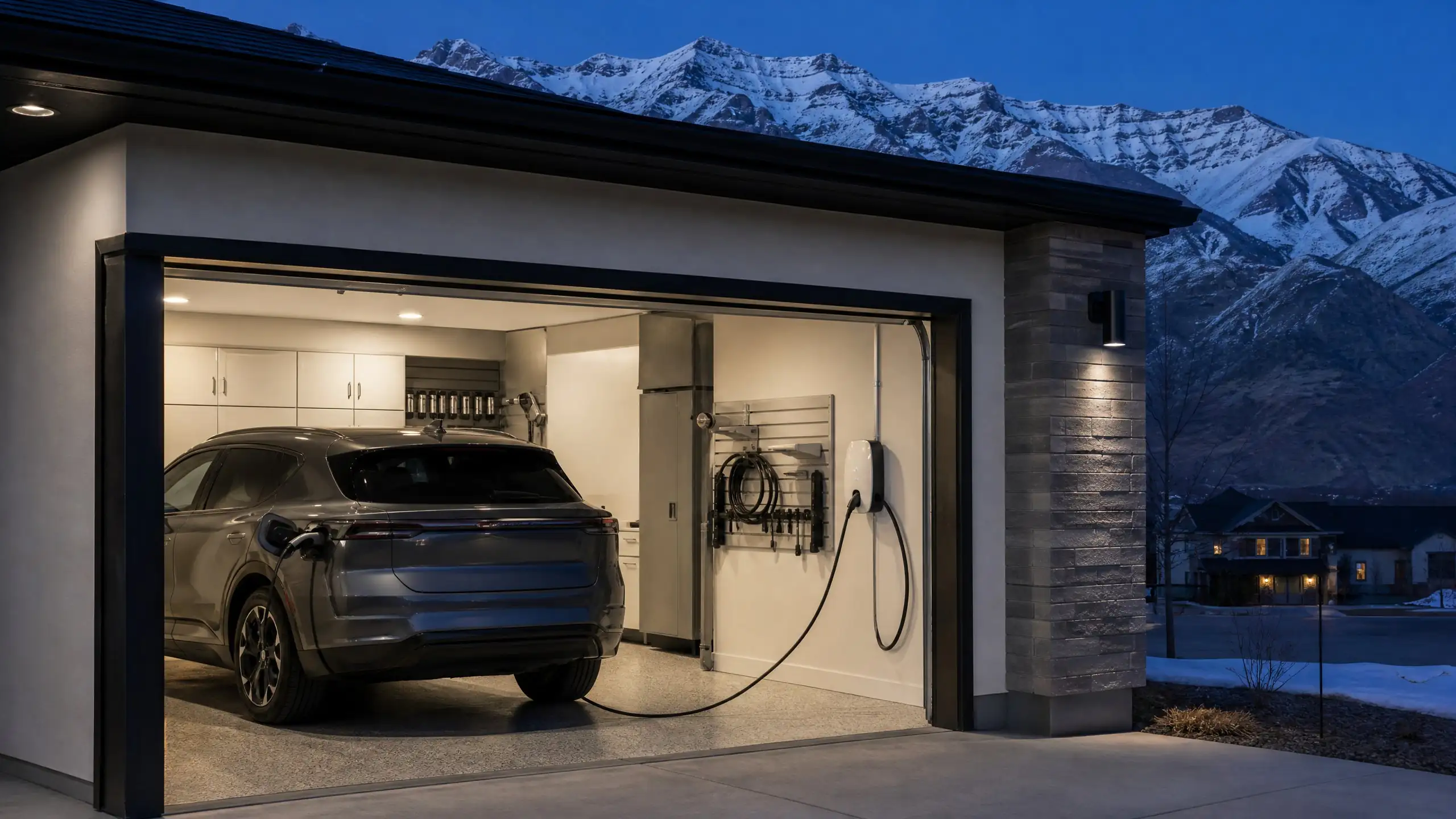
How long does home EV charging take?
On a Level 2 charger, a typical day of driving refills in a few hours and a near-empty battery refills overnight. On a standard 120 volt outlet, a full charge can take days. fueleconomy.gov says fully recharging a battery pack can take 3 to 12 hours. Your car's onboard charger sets the top speed.
Most owners never charge from empty. They plug in each evening and replace what they used that day, which takes far less time than the full-charge figures below.
How do you calculate charging time?
Hours equal the kWh you need to add divided by the kW you charge at. The kWh needed is your battery size times the share you are refilling. Charging power is the charger's amps times 240 volts, unless the car's onboard charger is lower. Then add a margin, since some energy is lost along the way.
fueleconomy.gov says battery charging efficiency "is often 84% to 93%," so allow roughly 8 to 19 percent more time than the bare division gives. A worked example:
- Energy needed: you want to add 40 kWh.
- Power: a 32 amp charger on a 40 amp breaker delivers about 7.6 kW, and the car accepts it.
- Bare math: 40 divided by 7.6 is about 5.3 hours.
- With losses: plan on roughly 6 hours.
How long does each circuit size take?
Every step up in amps cuts the time, as long as your car can use it. Adding 40 kWh takes about 31 hours on a 12 amp Level 1 cord, about 5.3 hours at 32 amps and about 3.5 hours at 48 amps, before losses. Most homes land on 32, 40 or 48 amps.
| Setup | Breaker | Power | Hours to add 40 kWh |
|---|---|---|---|
| Level 1, 120 V, 12 A | 15 A | 1.3 kW | 31 |
| Level 2, 24 A | 30 A | 5.7 kW | 7.0 |
| Level 2, 32 A | 40 A | 7.6 kW | 5.3 |
| Level 2, 40 A | 50 A | 9.6 kW | 4.2 |
| Level 2, 48 A | 60 A | 11.5 kW | 3.5 |
Level 2 power at 240 V from Tesla's Wall Connector breaker table; Level 1 from Tesla's Mobile Connector rate on a standard 5-15 outlet. Hours are 40 kWh divided by power, before charging losses, and assume the car accepts the full rate.
The Department of Energy's rule of thumb in miles: about 5 miles of range per hour on Level 1 and about 25 per hour on Level 2. More on that tradeoff in Level 1 vs Level 2 charging.
What sets the top speed?
The lowest of three numbers: the car's onboard charger, the charger's amp setting and the circuit's rating. A Level 2 charger supplies AC power, and the car's onboard charger converts it for the battery. If the car accepts 32 amps, a 48 amp charger still charges at 32.
| Vehicle | Onboard AC charger | Source |
|---|---|---|
| Tesla Model S, Model X, Model 3 Long Range and Performance | 48 A, 11.5 kW | Tesla onboard charger table |
| Tesla Model 3 Rear-Wheel Drive | 32 A, 7.7 kW | Tesla onboard charger table |
| Ford F-150 Lightning, 2024 and 2025 retail | 48 A | Ford specifications and order guides |
| Ford Mustang Mach-E, 2024 and 2025 | Up to 11 kW, 48 A | Ford order guides |
| Hyundai IONIQ 5, Kia EV6, Kia EV9 | 10.9 kW | Hyundai and Kia specifications |
| Rivian R1T and R1S | 11.5 kW | Rivian support |
Ratings as published by each automaker, read October 4, 2026. Model years and trims vary; our vehicle charging guides have the details for each model.
What do automakers say it takes?
Ford lists 10, 12 and 13 hours for a 15 to 100 percent charge of the 2025 F-150 Lightning's 98, 123 and 131 kWh batteries on a 48 amp charger. Kia lists 8 hours 45 minutes for a 10 to 100 percent charge of the EV9's 99.8 kWh battery at 240 volts and 48 amps, at room temperature.
Kia's EV9 figures show what the circuit does to the same car:
| EV9, 10 to 100 percent | 76.1 kWh battery | 99.8 kWh battery |
|---|---|---|
| 240 V, 48 A (11 kW charger) | 6 h 45 min | 8 h 45 min |
| 240 V, 30 A (Kia's portable cord) | 11 h 15 min | 14 h 35 min |
| 120 V, 12 A | 64 h 25 min | 84 h 20 min |
Kia 2026 EV9 specifications and owner's manual. Kia states its Level 2 times "at room temperature."
Hyundai lists 7 hours 20 minutes for a 10 to 100 percent charge of the 84.0 kWh IONIQ 5 on a 10.9 kW, 240 volt charger, and Ford lists 15 to 20 hours for a 15 to 100 percent Lightning charge on its 30 amp Mobile Power Cord.
Why are published times longer than the math?
Because the simple division leaves out losses and the car's own charging behavior. Refilling 85 percent of a 131 kWh Lightning battery means adding about 111 kWh. At 11.5 kW that is about 9.7 hours on paper; Ford's published figure is 13 hours. Use the automaker's number when it exists.
Cold weather can lengthen times too; see EV charging in Utah winters. If your car charges well below the rate it should, EV charger charging slowly covers the usual causes.
How much fits in one night?
More than most people drive. Rocky Mountain Power's optional time-of-use schedule ends on-peak hours at 10 p.m. on weekdays. Plugging in then and leaving at 7 a.m. gives 9 hours: about 68 kWh at 7.6 kW, or 103 kWh at 11.5 kW, before losses. The Department of Energy says Level 2 "can charge a typical EV battery overnight."
Choosing between 40 and 48 amps is covered in 40 amp vs 48 amp EV charger, and the breaker and wire behind each setting are in what size breaker for an EV charger.
Home charging time questions
How long does it take to fully charge an EV at home?
On Level 2, usually overnight. Ford lists 10 to 13 hours for a 15 to 100 percent charge of a 2025 F-150 Lightning on a 48 amp charger, and Kia lists 6 hours 45 minutes to 8 hours 45 minutes for a 10 to 100 percent EV9 charge. Smaller batteries take less. On Level 1, a full charge can take days.
How do I calculate charging time?
Divide the energy you need to add, in kWh, by the charging power in kW. Charging power is the charger's amps times 240 volts, capped by your car's onboard charger. Then allow some extra for losses: fueleconomy.gov says charging efficiency is often 84 to 93 percent.
Will a 48 amp charger charge my car faster than a 40 amp one?
Only if your car accepts more than 40 amps. A car with a 10.9 kW onboard charger, such as a Hyundai IONIQ 5 or Kia EV6, gains a little from 48 amps; a Tesla Model 3 Rear-Wheel Drive, listed by Tesla at 32 amps, gains nothing. Check the onboard rating first.
How many miles does an hour of home charging add?
The Department of Energy estimates about 25 miles per hour on a typical Level 2 charger and about 5 miles per hour on Level 1. Ford's charger comparison lists about 30 miles per hour for a Mustang Mach-E on its 48 amp charger.
Want the right circuit for your car? Tell us your car model and how far you drive.
Get a home charger quote