
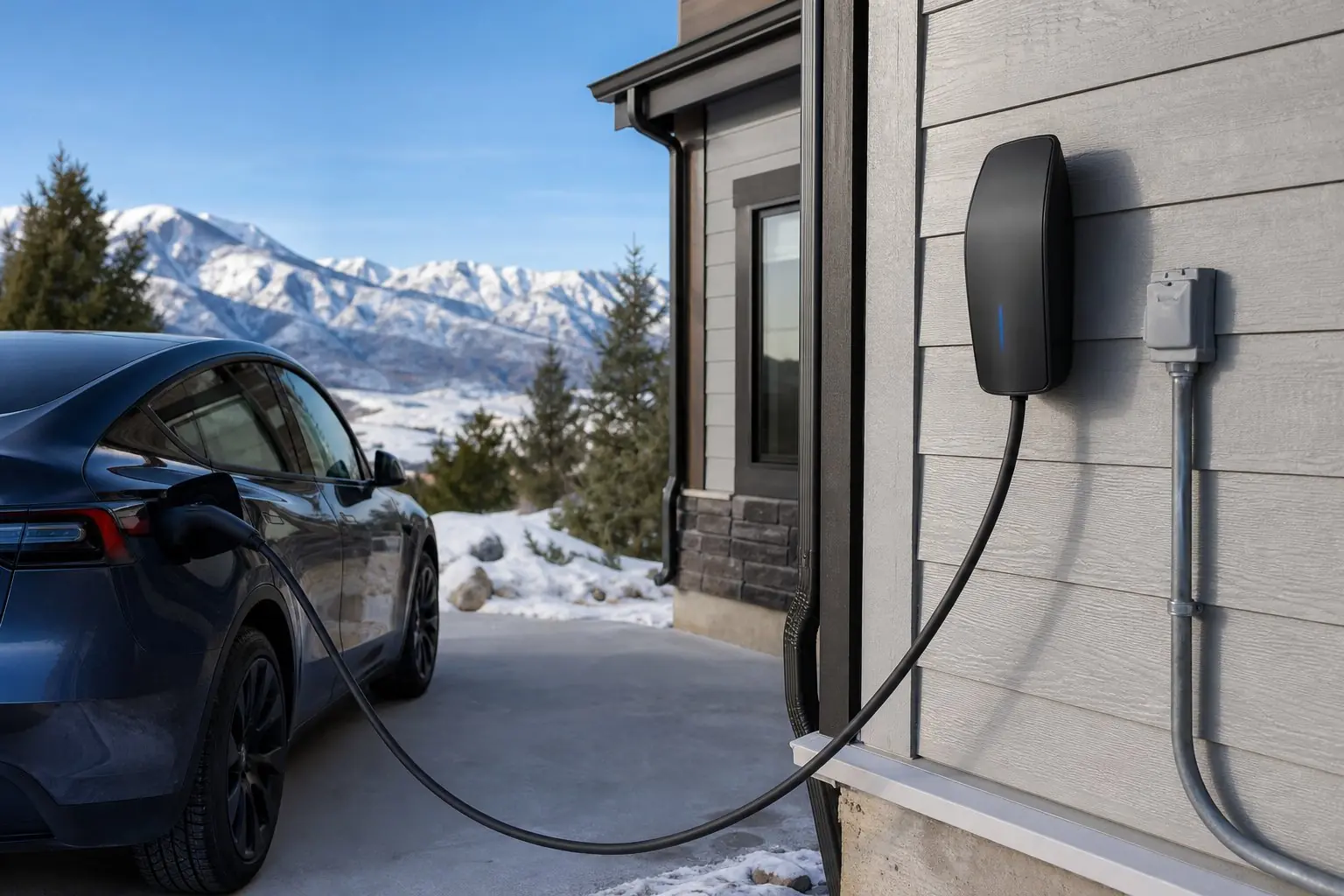
How does a Utah winter affect EV charging?
Mostly through the car, not the charger. Cold weather raises the energy each mile takes, so you use more range and need more charging. Most home chargers are rated to run down to -22°F. The habits that help most are parking in a garage when you can, plugging in every night and preheating the car while it is still plugged in.
How much range does cold weather cost?
A lot, mostly from heating. fueleconomy.gov, run by the Department of Energy and EPA, cites testing at 20°F in which EV fuel economy dropped roughly 39 percent in mixed city and highway driving and range dropped 41 percent. About two-thirds of the extra energy went to heating the cabin. Without the heater, range was about 12 percent lower.
The figures come from a 2019 AAA study that fueleconomy.gov uses for its EV estimates, comparing 20°F against about 75°F. Cold weather effects vary by model. The test temperature is a useful local reference: NOAA's normal January low for Ogden is 21.9°F, so a typical January morning commute in Ogden starts close to that test point.
How different are Ogden and Eden winters?
Very. NOAA's 1991 to 2020 normals put downtown Ogden's January average low at 21.9°F, with essentially no nights at or below 0°F. Pineview Dam, at about Eden's elevation in Ogden Valley, averages 9.5°F in January, about 16 nights a year at or below zero and roughly 108 inches of snow.
| NOAA station | Jan avg low | Jan avg high | Nights at or below 0°F | Annual snowfall |
|---|---|---|---|---|
| Ogden Pioneer PH (Ogden city) | 21.9°F | 38.3°F | 0.0 | Not reported |
| Ogden NE Bench | 22.2°F | 36.9°F | 0.6 | Not reported |
| Pineview Dam (Ogden Valley) | 9.5°F | 31.7°F | 16.5 | 107.9 in |
NOAA NCEI U.S. Climate Normals, 1991 to 2020. No normals station sits inside South Ogden or North Ogden; the Ogden stations are the nearest references.
In practice, an Ogden driver mostly deals with cold mornings. An Eden or Liberty driver deals with real sub-zero nights and a lot of snow, which matters more for where the charger goes than for whether it works. Our Eden EV charger installation page covers the valley's permits and snow planning.
Why preheat while plugged in?
Because the energy then comes from the wall, not the battery. fueleconomy.gov says preheating the cabin of an EV "while plugged into the charger can extend your vehicle's range," and that using seat warmers instead of the cabin heater saves energy. Set a departure time in the car's app and leave it plugged in overnight.
Tesla's owner's manual says the same in its own terms. Tesla "strongly recommends" leaving the Model 3 plugged in when not in use, points owners to scheduled preconditioning, and notes that in cold weather the charge port latch can freeze, with an inlet heater on some vehicles to free it. Your owner's manual has the exact settings for your car.
A Level 2 circuit gives preheating room to work. Tesla warns that charging Cybertruck on less than 2 kW, such as a 120 volt outlet, is very slow, "especially in low ambient temperatures." If you are still on a Level 1 cord, see Level 1 vs Level 2 charging.
Does cold weather slow home charging?
It can. Automakers publish Level 2 charge times under mild conditions: Kia, for example, gives its EV9's times "at room temperature." Tesla's warning that low-power charging is slow "especially in low ambient temperatures" points the same way. Treat a published charge time as a best case in January, not a promise.
Parking in a garage helps; fueleconomy.gov's first cold-weather tip is to park in a warmer place, such as a garage. How long a full charge takes on each circuit size is in how long home EV charging takes. If the car is charging slower than it should even in mild weather, see EV charger charging slowly.
Which home chargers are rated for the cold?
All the common ones are rated well below a normal Ogden or Eden winter. Tesla, ChargePoint, Wallbox, Emporia and Grizzl-E list operation down to -22°F, and Autel lists -40°F. Pineview Dam's January average low is 9.5°F, so the ratings leave margin. The upper limits differ more than the lower ones.
| Charger | Operating range | Enclosure |
|---|---|---|
| Tesla Wall Connector and Universal Wall Connector | -22°F to 122°F | Type 3R |
| Tesla Mobile Connector | -22°F to 122°F | Portable cord |
| ChargePoint Home Flex | -22°F to 122°F | Type 3R |
| Wallbox Pulsar Plus | -22°F to 104°F | Type 4 |
| Emporia Pro | -22°F to 122°F | Type 4 |
| Grizzl-E Ultimate 48A | -22°F to 122°F | Type 4 |
| Autel MaxiCharger AC Elite Home | -40°F to 131°F | NEMA 4 |
From each maker's manual, datasheet or product page, read October 4, 2026. Full specs on our home EV chargers page.
Garage or outdoor charger?
A garage, when you have the space. It keeps the car warmer, keeps snow and ice off the connector and cable, and lets the car preheat in shelter. Outdoors works too with a weather-rated charger, but placement matters more than the temperature rating: snow-shed from the roof, plow piles and a cable left on the ground cause most of the trouble.
Holster the connector after every session so it does not fill with snow, and mount the charger above where the snowbank builds. The full outdoor checklist is on our outdoor EV charger installation page, and detached and attached garage options are on the garage EV charger installation page.
Winter EV charging questions
How much range does an EV lose in a Utah winter?
It varies by car, but fueleconomy.gov cites testing at 20°F that found EV range can drop by 41 percent in mixed driving with the heater on, and about 12 percent without it. Ogden's normal January low is 21.9°F, close to that test point. Most of the extra energy goes to heating the cabin.
Should I leave my EV plugged in overnight in winter?
Check your owner's manual first. Tesla, for example, says it "strongly recommends" leaving the Model 3 plugged in when not in use. Being plugged in lets the car heat its cabin and battery from the wall before you leave, instead of from the battery you need for driving.
Can a home EV charger be installed outside in Eden?
Yes. Most current home chargers are rated to operate down to -22°F, and Pineview Dam's January average low is 9.5°F. Snow, ice and plows are the bigger concerns, so mount the charger high, out of the roof snow-shed line and away from where the plow piles snow.
Is Level 1 charging enough in winter?
Often not. Cold raises the energy each mile takes, and preheating uses more. Tesla warns that charging Cybertruck on less than 2 kW, such as a 120 volt outlet, is very slow, especially in low ambient temperatures. A Level 2 circuit leaves room for both preheating and a full refill overnight.
Planning a charger before winter? Tell us your car model and where you park.
Get a home charger quote