
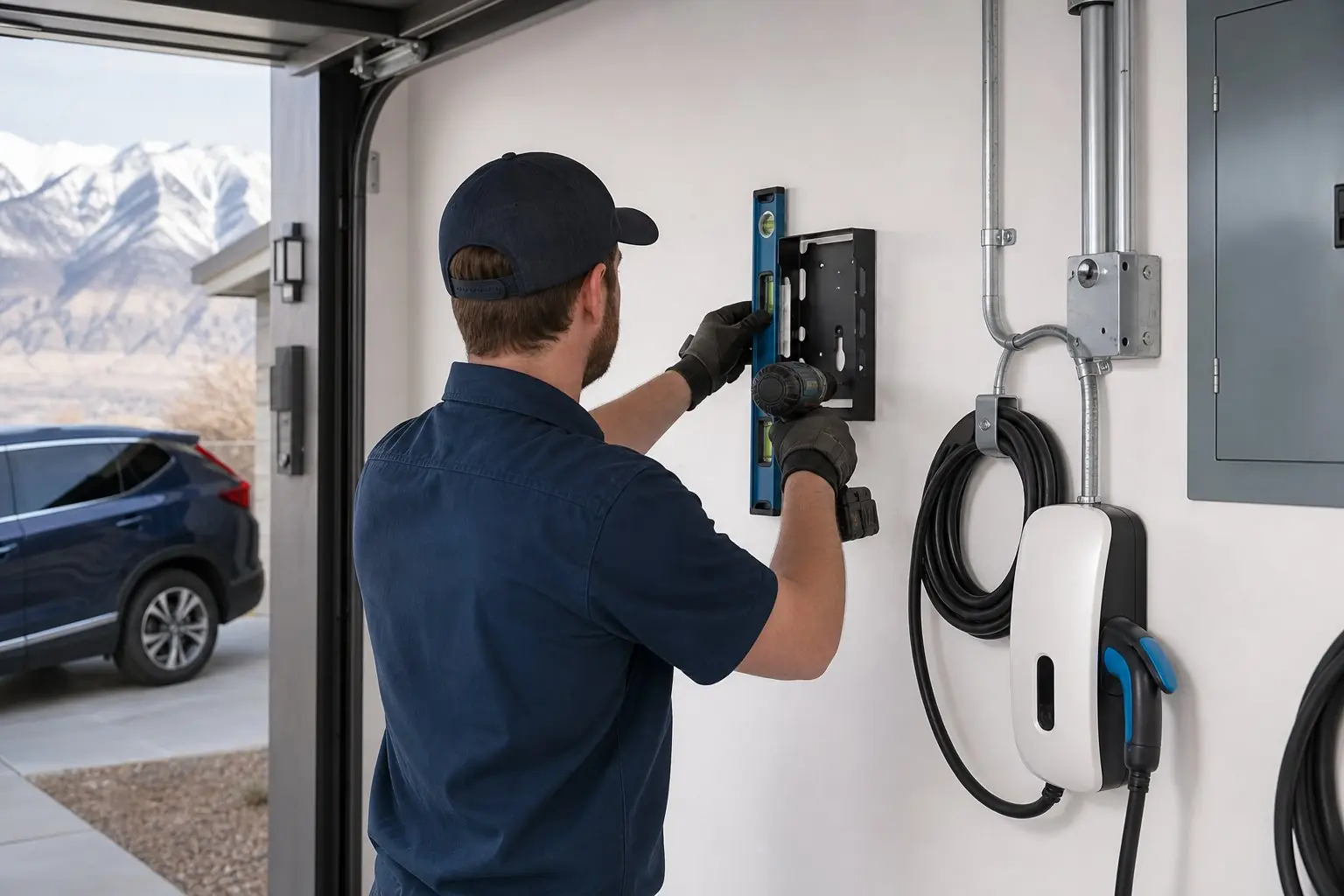
What does an EV charger installer actually do?
An EV charger installer matches the circuit to your car, your charger and your panel, runs a dedicated 240-volt circuit to where you park, mounts and sets up the charger or outlet, and gets the work permitted and inspected. Ogden EV Charger Pros does EV charging work only, from single garages to apartment lots.
Choosing an installer is mostly about choosing who makes the sizing decisions: amperage, wire, breaker, route, and if your panel needs help. This page lists every service we offer, explains what to look for in whoever does the work, and gives you a checklist that works for any quote, ours included.
Which installation service do you need?
Most homeowners need a Level 2 charger on a new 240-volt circuit. The details depend on your car, your garage and your panel. Find your situation below; each link goes to a page that explains that job in depth, including what drives its cost.
Home charging
- Home EV charger installation: the full process for a charger in a garage or driveway.
- Level 2 charger installation: Level 1 vs Level 2, charging speeds and choosing amperage.
- 240V EV charger outlet: adding a 240-volt receptacle, NEMA 6-50 vs 14-50, and the dryer outlet question.
- Dedicated EV charger circuit: the breaker, wire and conduit run on its own.
- Hardwired EV charger installation: the highest home charging rate, with no plug to wear out.
- NEMA 14-50 outlet installation: for portable and plug-in chargers.
- Tesla charger installation: Wall Connector, Universal Wall Connector or Mobile Connector, with the Tesla Wall Connector installation process on its own page.
Where the charger goes
- Garage EV charger installation: attached and detached garages, including the long runs behind older Ogden homes.
- Outdoor EV charger installation: weather-rated equipment and placement for snow country.
Panel capacity
- EV charger load management: limiting charging when the house is busy, often instead of an upgrade.
- EV charger panel upgrade: when a bigger panel or service really is the answer.
Repairs and swaps
- EV charger repair: tripping breakers, hot outlets and chargers that stop charging.
- EV charger replacement: swapping an old unit onto an existing circuit.
Businesses and properties
- Commercial EV charger installation: retail, fleet and customer charging.
- Multifamily EV charging: apartments, condos and HOAs.
- Workplace EV charging: employee parking and demand-charge planning.
What separates an EV specialist from a general electrician?
Any electrician can run a 240-volt circuit. An EV specialist starts with your car's onboard charger, sizes the breaker by the 125 percent rule, checks a load calculation and load management before a panel upgrade, knows Utah's GFCI rule for EV receptacles, and commissions the charger to match the circuit. Those details decide speed, safety and cost.
None of this is secret knowledge. It is a short list of rules and judgment calls that come up on every EV job and rarely on others:
- Sizing to the car. The car's onboard charger sets the useful charging rate. A 48 amp circuit buys nothing for a car that accepts 32 amps. A good installer asks for your make, model and year, and the size of any second EV you expect.
- The 125 percent rule. NEC 625.42 treats EV charging as a continuous load, and 625.41 sizes the breaker at 125 percent of the charger's output. The charger's own amperage setting has to match. See what size breaker an EV charger needs.
- A load calculation first. The 2023 NEC counts EV charging at 7,200 watts or the charger's nameplate, whichever is larger, and lets an energy management system's setpoint stand in for the full load (NEC 220.70). Load management or a lower setting can avoid an upgrade.
- Utah's GFCI nuance. Utah removed 240-volt receptacles from the general GFCI rule but left NEC 625.54 alone, so a receptacle installed for EV charging still needs GFCI protection. Hardwired chargers have it built in.
- Charger commissioning. Many chargers set their breaker size in an app during setup. On Tesla's Wall Connectors it is programmed in software during commissioning, so a careless setup can trip the breaker later.
- Torque and terminations. Manufacturers give torque values, such as 50 inch-pounds on Tesla's Wall Connector terminals. Loose terminations under hours of load cause heat.
That focus is the reason this business exists. We do the load calculation first and only recommend an upgrade when the numbers call for it. Whoever you hire, ask how often they install chargers and for photos of recent EV work.
What should you ask any installer before hiring?
Ask for a license number you can verify, proof of insurance, who pulls the permit, the breaker size, wire size and charger setting, whether a load calculation was done, and exactly what the price includes. Written answers make quotes comparable and keep surprises out of install day.
- What is your Utah license number? Check it on the DOPL Licensee Lookup, and confirm the name matches the quote.
- Can you send a current certificate of insurance?
- Who applies for the electrical permit, and with which city? We pull the permit and book the inspection.
- What breaker size, wire size and charger amperage setting are you proposing, and why?
- Did you do a load calculation? If my panel is tight, would load management or a lower setting work instead of an upgrade?
- For a 14-50 outlet: is the breaker a GFCI type, and is the receptacle EV-rated or industrial grade?
- Does the price include the charger, the permit, patching, trenching and conduit? Our quotes are itemized.
- Will you install a charger I already bought? We install chargers customers supply.
- Who schedules the inspection, and what happens if it fails?
- What could change the price once work starts?
The EV charger installation cost guide explains each cost variable, and the EV charger permit guide covers each city's process.
Which areas do we serve?
Ogden, South Ogden, North Ogden and Eden. Each city runs its own permits: Ogden City Building Services, South Ogden and North Ogden building departments, and Ogden Valley City for Eden addresses, which no longer go through Weber County. An installer should confirm jurisdiction by address before applying.
- Ogden: owner-occupants may pull their own permit; rentals need a contractor holding a Utah license. Older neighborhoods often mean detached rear garages and longer circuit runs.
- South Ogden: City Center, Burch Creek and nearby neighborhoods.
- North Ogden: some Coldwater and Southtown addresses sit in unincorporated county pockets.
- Eden: Eden, Liberty and Wolf Creek in Ogden Valley City, where cold and snow shape outdoor charger placement.
EV charger installer questions
What does Ogden EV Charger Pros install?
EV charging and nothing else: Level 2 home chargers, NEMA 14-50 and other 240-volt outlets, dedicated circuits, Tesla Wall Connectors, outdoor and detached garage installs, load management, panel work for EV charging, repairs and replacements, and commercial, workplace and multifamily chargers in Ogden, South Ogden, North Ogden and Eden.
How do I check an electrician's license in Utah?
Use the Utah Division of Professional Licensing's Licensee Lookup and Verification System at secure.utah.gov. You can search by name or license number, and electricians are included. Ask the installer for the license number in writing and confirm the name on the license matches the business on the quote.
Is an EV charger installation different from other electrical work?
The trade skills are the same, but the details are specific. EV charging is a continuous load under NEC 625.42, receptacles for EV charging need GFCI protection under 625.54 in Utah, and the 2023 NEC adds EV-specific load calculation and energy management rules. An installer who does this often will raise those points without being asked.
Why are EV charger installation quotes so different?
Quotes often cover different things. One includes the charger and permit, another includes neither, and a third assumes a panel upgrade. Distance from the panel, wire size, wall finishes, trenching and the city permit all move the price. Ask each installer to list what is and is not included so you can compare like with like.
Which cities do you serve?
Ogden, South Ogden, North Ogden and Eden, which is now part of Ogden Valley City. Each city issues its own electrical permits, and some North Ogden addresses in county pockets are permitted by Weber County, so an installer should check jurisdiction by address.
Ready to compare quotes? Start with your car model and a photo of your open panel.
Get an installation quote