
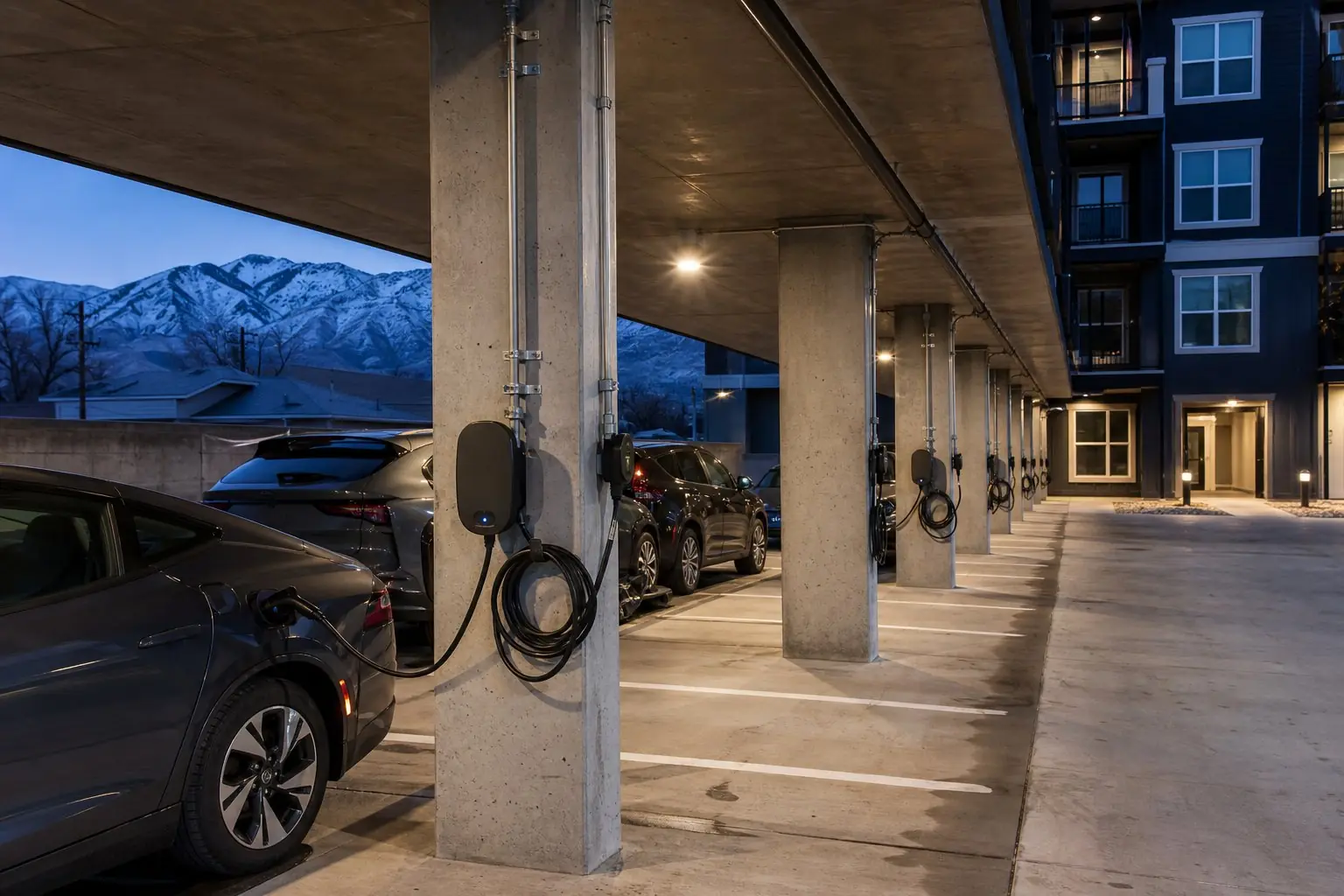
Shared chargers or assigned chargers?
Shared chargers in a few common spaces serve the most residents per dollar and are easiest to manage at the start. Assigned chargers at each resident's own space are more convenient and avoid the shuffle of moving cars, but cost more and need more electrical capacity. Many properties start shared and wire for assigned spaces later.
| Shared common-area chargers | Assigned chargers | |
|---|---|---|
| Upfront cost | Lower: a few ports serve many residents | Higher: one port per space |
| Daily use | Residents move cars when charged | Plug in at your own space overnight |
| Electrical capacity | Modest | Grows with every space; load management needed |
| Billing | Networked chargers or access control | Per-space fee or networked billing |
| Rebate meter | House or common meter | Eligible only on a non-residential meter |
Overnight parking is the advantage multifamily sites have. Ten hours on even a 32 amp port adds about 77 kWh before losses, so a single port can serve more than one resident with a rotation schedule.
Does the Rocky Mountain Power multifamily incentive apply?
Live Yes. As of October 4, 2026, Rocky Mountain Power's program covers multifamily properties: 75 percent of charger cost, up to $1,000 per single-port or $1,500 per dual-port Level 2 charger bought on or after January 1, 2026. The key condition is the meter: chargers must sit behind a meter not enrolled in a residential rate plan.
That rules out chargers wired from an individual tenant's or unit owner's residential meter. Chargers on a house or common-area meter on a general service schedule can qualify. Other conditions:
- New equipment listed by UL or an equivalent testing laboratory
- Apply after the chargers are installed and energized, within one year of purchase
- IRS Form W-9, an itemized invoice with charger specifications, and installation photos
- Up to $200,000 per location; funding is first come, first served and the page showed "over $1.5 million" left when checked
Rocky Mountain Power's service requirements also say multifamily sites "shall provide the Power Company with the expected new load and charging frequency," so the utility belongs in the plan early. The Not open Utah DEQ EV Charger Program lists HOAs and property managers as eligible once applications open.
How do you bill residents for charging?
Three common models: include charging in rent or dues, charge a flat monthly fee for access, or price by the kilowatt hour through networked chargers. Per-kWh pricing is the fairest for heavy and light users. Selling charging per kWh, per hour or by subscription makes the property a charging station operator under Utah's 12.5 percent EV charging tax.
Under Utah Code 59-30-102, operators file the tax on the same schedule as their sales tax and give an itemized receipt for each sale showing the kWh or time used, the unit price and the total. Networked chargers generate those receipts automatically. If charging is bundled into rent or dues, ask a tax professional how that is treated.
Condo associations have one more option. Utah Code 57-8-8.2 lets an association require an owner who installs a charger to pay the "installation, metering, and use" costs, including the electricity.
Fitting chargers on an existing service
Use load management. An energy management system watches the building's load and caps total charging current, so many chargers can share capacity that would only support a few at full power. NEC 625.42 lets managed chargers be counted at the system's limit, which often avoids a service upgrade.
Demand charges are the second reason. If the chargers are on a general service meter, Rocky Mountain Power's Schedule 6 bills every kilowatt of the month's highest 15-minute demand, at $12.82 to $14.49 per kW in power charges. The commercial EV charger installation page walks through Schedules 23 and 6, and EV charger load management covers the equipment.
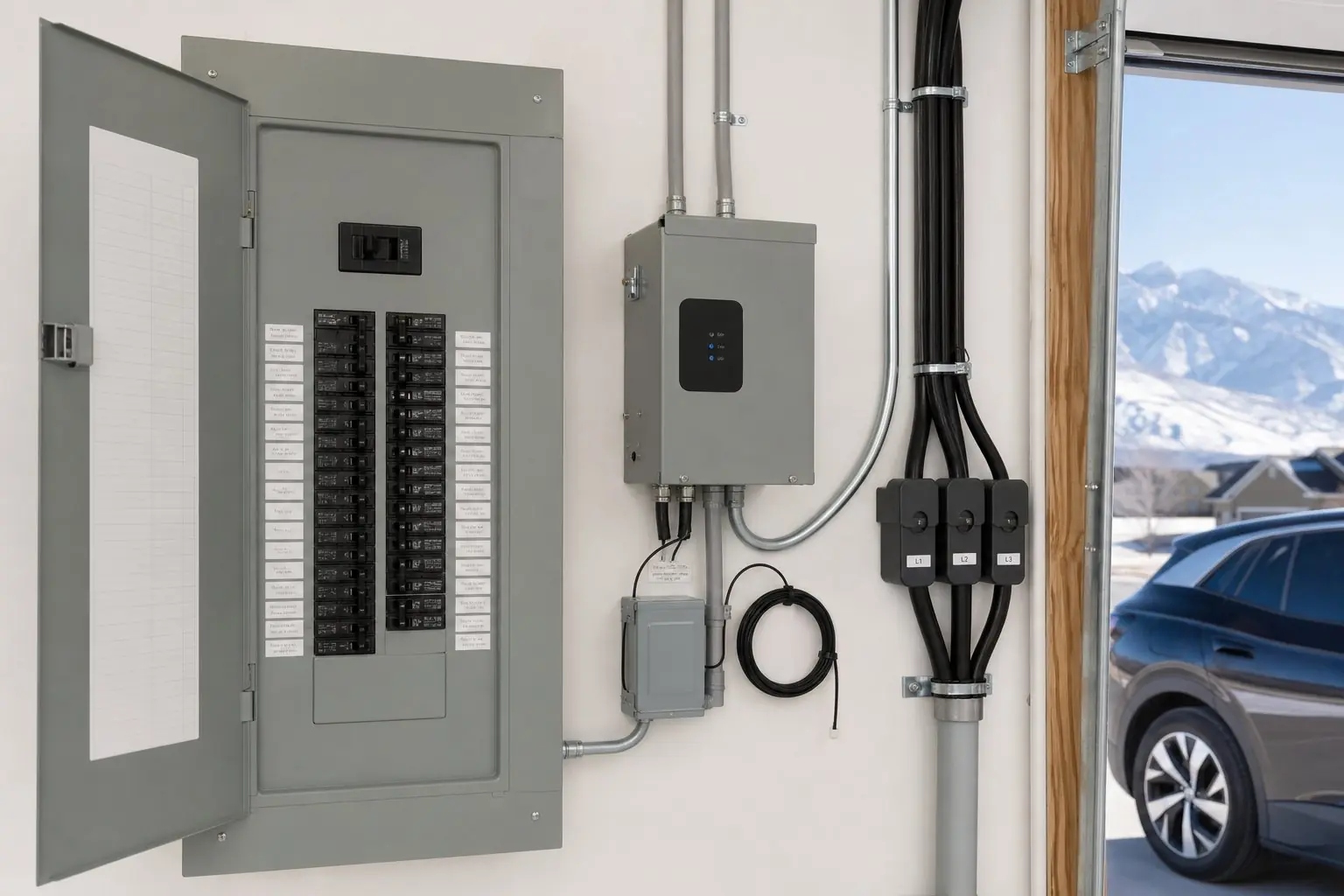
Apartment and condo buildings that fall outside the residential code follow the 2023 National Electrical Code under Utah Code 15A-3-601, including Article 625 for EV charging.
Existing garages, carports and parking structures
Retrofits are about routing. The circuit needs a path from the electrical room to the parking area, through walls, along garage ceilings in surface conduit, or underground to a surface lot. Placing chargers close to the electrical room and grouping them keeps runs short, which is where most of the cost sits.
- Locate the electrical room and the meter that will feed the chargers before choosing spaces
- Check the structural drawings before any drilling or coring of parking decks
- Plan cable reach and wheel stops so connectors stay off the ground and out of snow-removal paths
- Run conduit to future spaces while walls and trenches are open
When a condo or HOA owner asks for a charger
Boards should know the law before the first request. Under Utah Code 57-8-8.2 (condominiums) and 57-8a-802 (community associations), effective May 3, 2023, an association may not prohibit an owner from installing a charger in a space assigned to their unit or lot, or in a limited common area space for their exclusive use. It may require an application, a written agreement to hire "a general electrical contractor or residential electrical contractor," reasonable design criteria, a reasonable review fee, and reimbursement of any insurance premium increase for a common-area install. A written policy saves the board from deciding each request from scratch. The resident's side is on EV charging for apartment renters and condo owners.
Permits and what a proposal should show
Multifamily charging is commercial electrical work. In Ogden, Ogden City's FAQ limits permits for "Commercial and all residential rentals" to contractors holding a Utah State contractor license. We apply for the permit and prepare the invoice and photos for the rebate application. A solid proposal shows the load calculation, the power-sharing limit, the meter the chargers will use and which ports are wired for future expansion.
Multifamily EV charging questions
Do apartment and condo chargers qualify for the Rocky Mountain Power rebate?
Yes, if they are wired to a meter that is not on a residential rate plan, such as a house or common-area meter. As of October 4, 2026 the incentive is 75 percent of charger cost, up to $1,000 per single-port or $1,500 per dual-port Level 2 charger bought on or after January 1, 2026, subject to funds.
Can an HOA refuse a condo owner's request for a charger?
Not in a parking space assigned to the owner's unit or a limited common area space for their exclusive use. Utah Code 57-8-8.2 lets the association require an application, use of an electrical contractor, reasonable design rules and code compliance, and that the owner pay installation, metering and electricity costs.
How do we bill residents for charging?
Common approaches are a flat monthly fee, an amount built into rent or dues, or per-kWh pricing through networked chargers. Selling charging per kWh, per hour or by subscription is taxed at 12.5 percent under Utah Code 59-30-102, with an itemized receipt for each sale.
Can we add chargers without upgrading the building's electrical service?
Often, with load management. An energy management system caps the total current the chargers draw, and NEC 625.42 allows managed chargers to be sized at that cap. A load calculation on the existing service shows how much capacity is free and how many ports it can support.
Planning charging for residents? Tell us the number of units, the parking layout and where the meters are.
Get a multifamily charging quote