
What does Utah law say about charging at apartments and condos?
Owners and renters are treated differently. Utah gives condo unit owners and HOA lot owners a right to install a charger in their own assigned or exclusive-use space, with conditions the association can set. We did not find any Utah statute giving renters that right. Renters need the landlord's written permission.
Condo and HOA owners
Utah Code 57-8-8.2 (condominiums) and 57-8a-802 (community associations), in effect since May 3, 2023, say that "notwithstanding any provision in an association's governing documents to the contrary," an association may not prohibit an owner from installing or using a charger in:
- a parking space assigned to the owner's unit, or on the owner's lot, used for parking a vehicle; or
- a limited common area parking space designated for the owner's exclusive use.
It does not cover general common parking that anyone can use. The association may still:
- require an application for approval;
- require a written agreement to hire "a general electrical contractor or residential electrical contractor";
- set reasonable design rules on size, placement and appearance, and require building-code compliance;
- charge a reasonable fee to review and permit the charger;
- impose reasonable restrictions that do not significantly raise the cost or cut the charger's performance;
- make the owner pay installation, metering and electricity costs, any damage to common areas, and any insurance premium increase for a common-area install.
Two more rules follow you at sale. You must tell a buyer about the charger and your responsibilities, and unless agreed otherwise the charger is your personal property, which you remove and restore before closing unless the buyer takes it on.
Renters
The Utah Fit Premises Act, which sets landlord and tenant duties, says nothing about EV charging. Two bills tried to change that. H.B. 447 in 2021 would have allowed renters to install chargers, and H.B. 189 in 2022 would have required owners to set up a process for renter applications. Neither passed; H.B. 189 failed a House floor vote in February 2022. Rules change, so check the current session before relying on this.
How do you ask a landlord or HOA for EV charging?
In writing, with a specific proposal. Name the parking space, the type of charging, who pays for the equipment, installation and electricity, and what happens when you move out. A landlord says yes more easily to a plan that costs them little, uses a permitted contractor and can be removed cleanly.
- Find your parking situation. Is your space assigned, deeded, limited common area or open lot? The answer decides your options and, for owners, your legal footing.
- Look for power nearby. Note any outlet, light pole or electrical room close to your space. Photos help.
- Pick the ask. Level 1 from an existing outlet, a new Level 2 circuit at your space, or shared chargers for the building.
- Offer to cover your share. Equipment, installation and electricity, or a monthly fee.
- Address move-out. Leave the charger in place, or remove it and restore the wall.
- Get approval in writing before any work, and keep a copy with your lease or HOA records.
In Ogden, electrical work at a rental needs a permit pulled by a contractor. Ogden City's FAQ says: "Commercial and all residential rentals: Utah State licensed contractor only." A tenant cannot pull the permit, so the landlord or their contractor will be involved either way.
What charging options work at an apartment or condo?
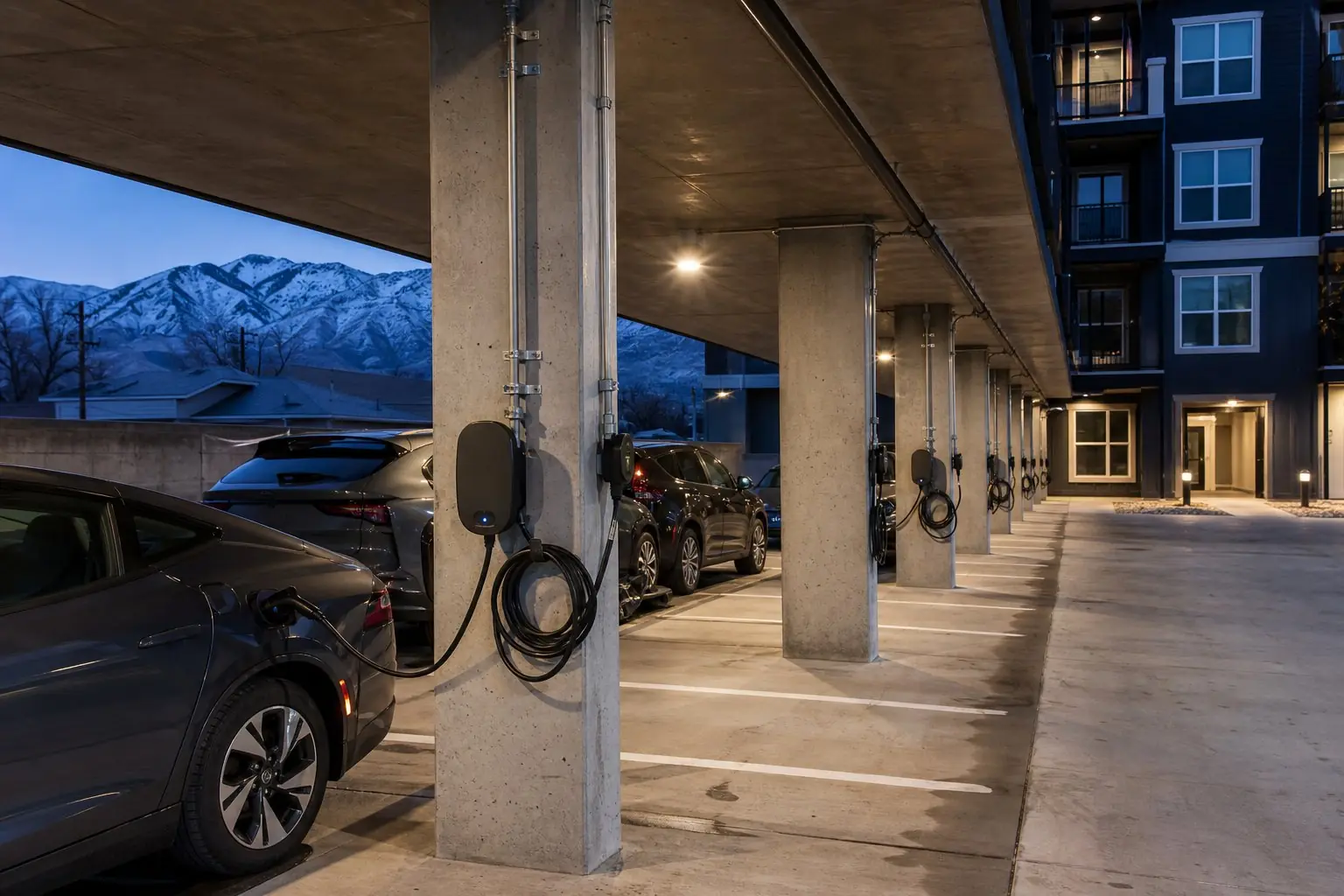
Level 1 from an outlet at an assigned space is the cheapest start and covers many commutes. A Level 2 circuit at your own space is the most convenient. Shared Level 2 chargers paid for by the property serve many residents at once. Which one fits depends on parking, the building's electrical capacity and who pays.
| Option | Overnight energy | Who usually pays | Good fit |
|---|---|---|---|
| Level 1 outlet at your space | about 11 kWh in 8 hours | Resident, by agreement | Short commutes, existing outlet nearby |
| Level 2 at your own space | about 61 kWh at 32 amps | Owner or resident | Condo owners with an assigned space |
| Shared Level 2 in common parking | depends on rotation | Property, recovered by fees | Apartments with open parking |
Energy before charging losses, limited by your car's onboard charger.
Plugging into an existing outlet is not one of the actions Ogden lists as needing a permit (alter, change, extend, install, repair or replace). Charging still loads that circuit for hours, so ask the landlord to have an electrician confirm it is a suitable circuit first. A new circuit or outlet does need a permit.
Why it can make sense for the property owner
Rocky Mountain Power pays property owners part of the cost. Live As of October 4, 2026, its program covers multifamily properties at 75 percent of charger cost, up to $1,000 per single-port or $1,500 per dual-port Level 2 charger bought on or after January 1, 2026, on a meter not on a residential rate plan. Funding is first come, first served.
That meter rule matters: a charger wired from your own apartment meter would not qualify, but one on the building's common meter can. Mention it in your request. Owners and HOA boards can find the planning side, including billing, load management and the rebate paperwork, on multifamily EV charger installation, and the wider business picture on commercial EV charger installation.
If your landlord or HOA wants a quote, we can look at the parking area and electrical room and send them the options in writing. For condo owners installing at their own space, the same circuit sizing applies as in a house; see home EV charger installation.
Apartment and condo charging questions
Does Utah law give renters the right to install an EV charger?
We did not find one. Utah's right-to-charge rules in Utah Code 57-8-8.2 and 57-8a-802 cover condo unit owners and HOA lot owners, not tenants. Bills that would have covered renters, H.B. 447 in 2021 and H.B. 189 in 2022, did not pass. Renters need the landlord's written permission.
Can my condo HOA stop me from installing a charger?
Not in a parking space assigned to your unit or a limited common area space for your exclusive use, under Utah Code 57-8-8.2. The association can require an application, an electrical contractor, reasonable design rules, a review fee, and that you pay installation, metering and electricity costs.
Can I charge from a regular outlet at my apartment?
Only with permission and if the outlet suits hours of continuous load. A 120-volt outlet adds about 1.4 kW, or roughly 11 kWh overnight, which covers many daily commutes. Ask the landlord to have an electrician confirm the circuit, since charging runs it near capacity for hours.
Who pays for a charger at a rental?
Whatever you and the landlord agree in writing. Common splits are tenant pays for the charger and electricity, landlord pays and adds a monthly fee, or the property installs shared networked chargers that bill per session. Rocky Mountain Power's business rebate can offset the landlord's charger cost on a common meter.
Want charging at your building? Send the parking layout and the nearest power source.
Get a quote for your building