
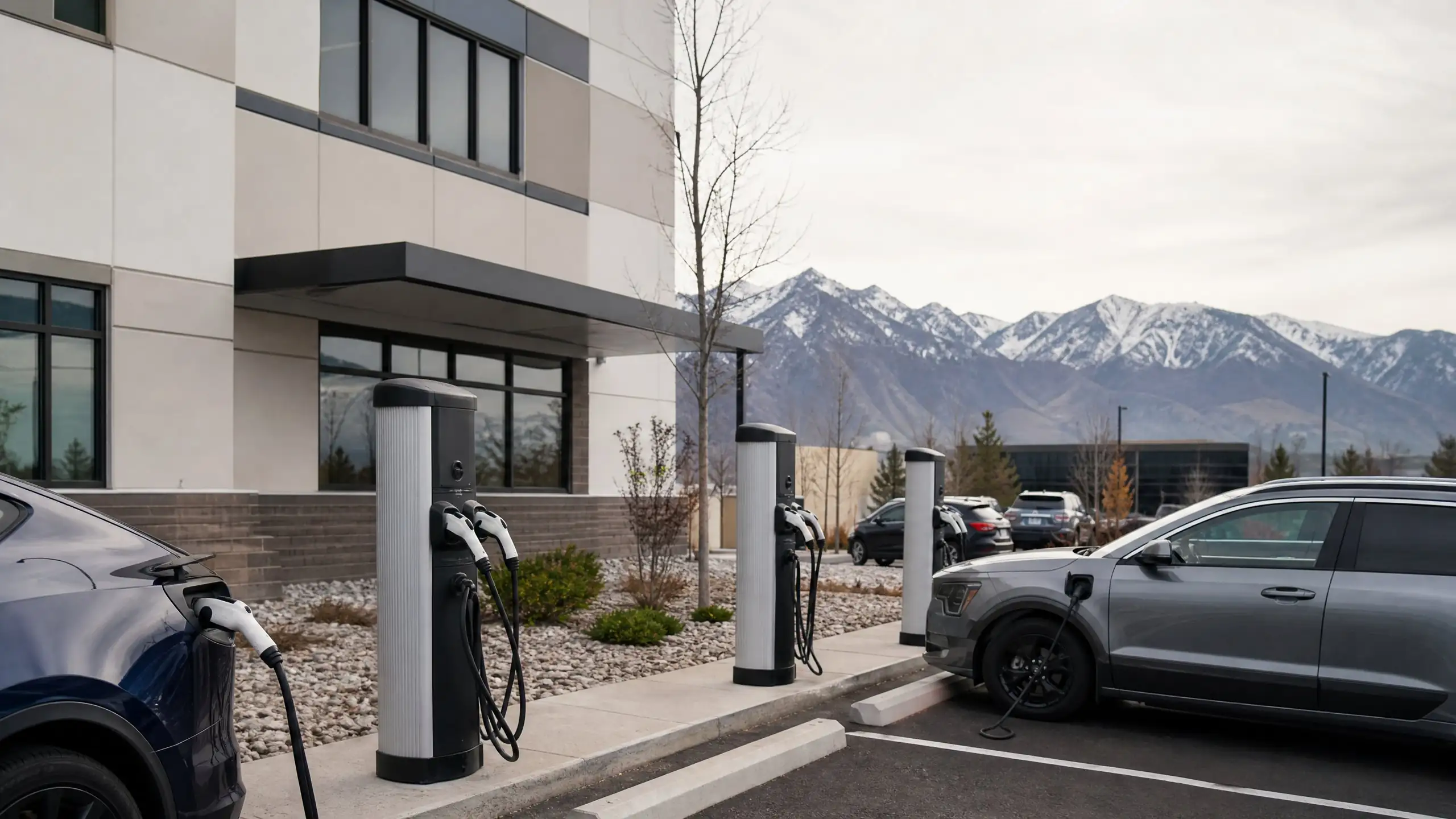
Level 2 or DC fast charging for a business?
Level 2 fits anywhere cars stay an hour or more: offices, hotels, gyms, apartments and overnight fleets. DC fast charging fits stops measured in minutes, such as a highway-adjacent store or a fleet that runs all day. A DC fast port draws many times the power of a Level 2 port, which changes the utility service, the demand charge and the budget.
A single 150 kW fast-charging port is more than four times the 35 kW ceiling of the utility's small business rate.
| Charger | Power per port | Best fit |
|---|---|---|
| Level 2, 32 amp | 7.7 kW | Workplace and overnight parking |
| Level 2, 48 amp | 11.5 kW | Customer stops of one to three hours, fleets |
| DC fast, under 150 kW | under 150 kW | Short retail stops, fleet top-ups |
| DC fast, 150 kW and up | 150 kW or more | Travel corridors, high-turnover sites |
DC fast projects also need early contact with the utility. Rocky Mountain Power's service requirements say nonresidential and multifamily sites "shall provide the Power Company with the expected new load and charging frequency."
How many charging ports does a business need?
Start from how long cars park and how much energy they need, not a ratio. A 7.7 kW port delivers about 7.7 kWh per hour, so a two-hour customer visit adds about 15 kWh. Count the cars that will charge at the same time, then size the electrical work for growth while installing only the ports you need now.
- Customer parking: short dwell times favor fewer, faster ports and time limits.
- Employee parking: a full workday lets slower ports serve more cars. See workplace EV charging.
- Residents: overnight parking spreads load across many hours. See multifamily EV charger installation.
- Fleet: count vehicles, daily miles and the hours they sit at the yard.
Run conduit to future spaces while the lot is open, rather than cutting asphalt twice.
How do EV chargers affect a demand charge?
Many small businesses are on Rocky Mountain Power's Schedule 23, which bills demand only above 15 kW. A site qualifies only while its demand stays at or under 30 kW in at least 7 of any 12 consecutive months and never tops 35 kW. Exceed that and the account moves to Schedule 6, where every kilowatt of peak demand is billed, for at least 12 months.
Demand is the highest 15-minute interval of the month. Three 48 amp ports charging together draw about 34.5 kW on top of the building's own load.
| Rate (effective August 10, 2026) | Demand billing |
|---|---|
| Schedule 23, small general service | Power charge on kW above 15 kW: $9.54 per kW June to September, $8.44 October to May |
| Schedule 6, general service | Power charge on all kW: $14.49 per kW summer, $12.82 winter, plus a $4.36 per kW facilities charge and a $58 customer charge |
| Schedule 6A, time-of-day option | Energy priced by time of day, on-peak 6 to 10 p.m. weekdays |
Example arithmetic, power charge only: 23 kW of extra coincident charging on Schedule 6 is 23 × $12.82 to $14.49, or about $295 to $333 a month before facilities charges.
The fix is a ceiling on simultaneous draw. Power sharing or an energy management system caps the total, and NEC 625.42 lets a managed group be sized at that setpoint, which can also avoid a service upgrade.
Networked chargers, payment and the Utah charging tax
A networked charger connects to software that controls access, sets prices, shares power and reports usage. You need one if you plan to charge drivers. Utah taxes charging sold "for a fee" at 12.5 percent, and the statute requires an itemized receipt for every sale, which payment software produces.
Under Utah Code 59-30-101 and 59-30-102, in effect since January 1, 2024, a "charging station operator" selling electricity per kilowatt hour, per hour or by subscription owes the tax, filed on the same schedule as its sales tax. A site that gives charging away does not match the "for a fee" wording, but confirm your situation with a tax professional.
Rocky Mountain Power business charger incentives
Live As of October 4, 2026, Rocky Mountain Power pays 75 percent of charger cost for business, workplace and multifamily sites, up to the amounts below. Chargers must be new, bought on or after January 1, 2026, and installed behind a meter not on a residential rate plan. Funding is first come, first served.
| Charger | Single port, up to | Dual port, up to |
|---|---|---|
| AC Level 2 | $1,000 | $1,500 |
| DC fast, under 150 kW per port | $15,000 | $21,000 |
| DC fast, 150 kW or more per port | $30,000 | $42,000 |
- DC fast chargers need pre-approval before purchase.
- Level 2 applications are filed after installation and energizing, within one year of purchase.
- Documents: IRS Form W-9, an itemized invoice with charger specifications, and installation photos.
- Caps: $200,000 per location, or $60,000 per dealership location.
- Equipment listed by UL or an equivalent testing laboratory. The tariff also says chargers "must be approved by the Company," so confirm the model with the utility before ordering.
The page showed "over $1.5 million" remaining when checked. The Not open Utah DEQ EV Charger Program lists businesses as eligible, with applications "to be announced." More in the Ogden EV charging guide.
ADA considerations for public chargers
Where the ADA Standards apply, chargers with accessible features must sit on an accessible route, with operable parts no higher than 48 inches, a clear floor space of at least 30 by 48 inches and surfaces no steeper than 1:48. The U.S. Access Board also recommends, without making it binding, at least two accessible charging spaces.
Its recommended accessible charging space is 11 feet wide and 20 feet long with a 5-foot access aisle, not counted toward the site's required accessible parking. Lay these out before trenching.
Permits and inspection for commercial chargers
Commercial EV charging work needs an electrical permit, and in Ogden only a contractor holding a Utah State contractor license may pull a commercial permit. Commercial sites follow the 2023 National Electrical Code, and the city inspects the work before the chargers go into service.
Ogden City's FAQ states the rule for "Commercial and all residential rentals." South Ogden also requires a contractor for all commercial work, and Eden addresses now permit through Ogden Valley City. The EV charger permit guide covers each office. We apply for the permit, schedule inspections and assemble the invoice and photos Rocky Mountain Power asks for.
Projects using federal NEVI or other Title 23 highway funds must use electricians with EVITP certification or a qualifying apprenticeship credential under 23 CFR 680.106; Rocky Mountain Power's program lists no such rule.
Commercial EV charging questions
Does Rocky Mountain Power still pay for business EV chargers?
Yes, as of October 4, 2026. Its Utah program pays 75 percent of charger cost, up to $1,000 for a single-port or $1,500 for a dual-port Level 2 charger bought on or after January 1, 2026. Funding is first come, first served and the charger must be behind a meter that is not on a residential rate plan.
Do I need pre-approval before buying a DC fast charger?
Yes. Rocky Mountain Power requires pre-approval for DC fast charger incentives before you buy the equipment. Level 2 applications are filed after the chargers are installed and energized, within one year of purchase, with a W-9, an itemized invoice and photos.
Do I have to collect tax if I charge drivers for charging?
If you sell charging by the kilowatt hour, by the hour or by subscription, Utah Code 59-30-102 levies a 12.5 percent tax on the sale, remitted on your sales tax schedule with an itemized receipt for each sale. Ask a tax professional how it applies to your setup.
Will EV chargers raise my business's demand charge?
They can. On Rocky Mountain Power's Schedule 6, every kilowatt of the month's highest 15-minute demand is billed. Several Level 2 ports charging at once can add tens of kilowatts. Power sharing or load management caps that peak so the chargers do not set it.
Planning chargers for your lot? Tell us the site, the ports you want and who will use them.
Get a commercial charging quote