Can My Panel Handle an EV Charger?
How to read your panel's service rating, tell a space problem from a capacity problem, and see what a load calculation counts for a charger.

How home charging works, what your circuit and panel need, and how Utah winters and utility rates change the picture.
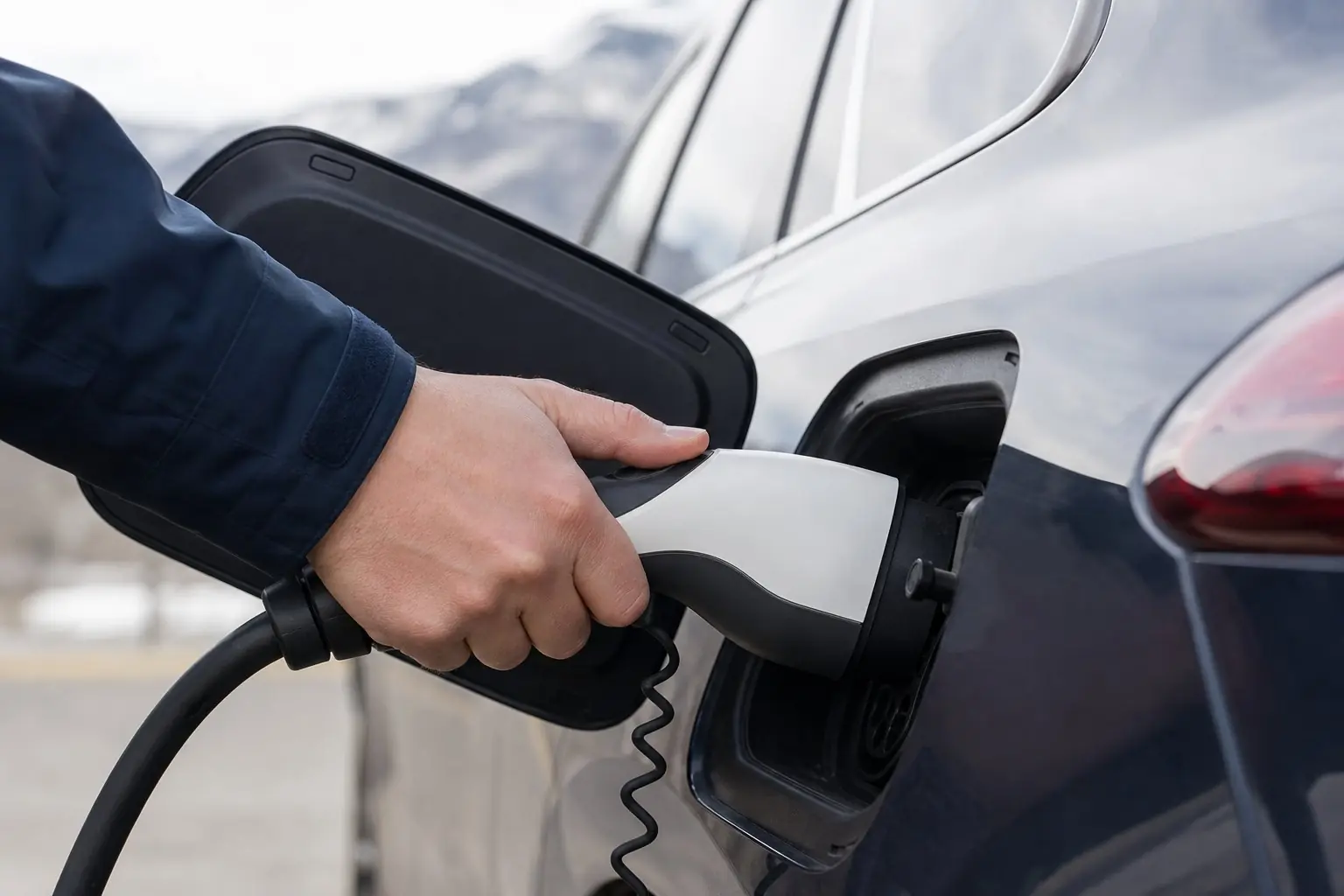
Level 1 uses a standard 120 volt outlet and adds about 5 miles of range per hour. Level 2 uses 240 volts and adds about 25 miles per hour, which is what most homes install. DC fast charging delivers up to 500 kW at public stations and is not a home option. Figures are Department of Energy estimates.
Prefer to plug in your own numbers? See the EV charging tools.
| Level | Power source | Range added (DOE estimate) | Where it fits |
|---|---|---|---|
| Level 1 | 120 V household outlet | About 5 miles per hour | Short commutes, plug-in hybrids, a backup |
| Level 2 | 240 V dedicated circuit at home | About 25 miles per hour | Daily home charging, workplaces |
| DC fast | Public station, up to 500 kW | About 100 to 200+ miles per 30 minutes | Road trips; Ogden's Historic Union Station has 350 kW chargers |
Read the full comparison in Level 1 vs Level 2 charging, and see how long home EV charging takes for your battery size. Actual speed is capped by your car's onboard charger, listed in our vehicle charging guides.
A Level 2 charger needs its own circuit. The code treats EV charging as a continuous load, so the breaker must be at least 125 percent of the charger's output: 40 amps of charging on a 50 amp breaker, 48 amps on a 60 amp breaker. Start with what size breaker an EV charger needs, then whether an EV charger needs a dedicated circuit and EV charger GFCI requirements, which matter in Utah if you want a NEMA 14-50 outlet.
Whether your panel can carry a charger is a calculation, not a guess. It adds up the house's existing loads and shows what is left for a continuous charging load. When the margin is thin, a lower charger setting or a load management device can often avoid a panel upgrade. See can my panel handle an EV charger and EV charger load management.
Put the charger where the cable reaches the charge port with the car parked normally. An attached garage near the panel is the simplest job. Older Ogden homes often have detached rear garages, which usually means a trench and a longer run. Outdoor units need weather-rated equipment kept clear of snow piles and plows. Compare chargers and placements in our comparison guides.
NOAA's 1991 to 2020 normals put Ogden's January average low near 22°F, while Pineview Dam, at Eden's elevation in Ogden Valley, averages 9.5°F with about 108 inches of snow a year. The Department of Energy notes EV range can drop sharply in cold weather, and suggests garage parking and preheating the cabin while still plugged in. Most home chargers we cover, including Tesla's Wall Connector, are rated to operate down to -22°F. More in EV charging in Utah winters.
Rocky Mountain Power's optional residential time-of-use schedule (effective August 10, 2026) sets on-peak hours at 6 to 10 p.m. on weekdays. Off-peak energy is priced far below on-peak, so most home charging can be scheduled into cheaper hours from the car or the charger. Local permits, rates and public chargers are collected in the Ogden EV charging guide.
For what moves an installation price, see our EV charger cost guides. If a charger trips its breaker, runs hot or will not start, the EV charger troubleshooting guides cover what is safe to check yourself and when to stop.
Short, sourced answers to the questions we hear most from Ogden-area EV owners.
How to read your panel's service rating, tell a space problem from a capacity problem, and see what a load calculation counts for a charger.
What NEC 625.40 requires, why a Level 2 charger cannot simply share the dryer circuit, where splitters fit and what Level 1 needs.
Which EV charging setups need a GFCI breaker in Utah, how the state's 210.8 amendment fits with NEC 625.54, and what a charger's built-in CCID does.
What an Ogden or Eden winter does to EV range and charging, how preheating while plugged in helps, and which home chargers are rated for the cold.
The simple kWh and kW math for home charge times, what caps the speed, and published times from Ford and Kia on Level 1 and Level 2.
The 125 percent rule, a breaker to charger output table, wire sizes and why a bigger breaker does not always charge faster.
For short daily drives, sometimes. The Department of Energy puts Level 1 at about 5 miles of range per hour, so eight hours overnight adds roughly 40 miles to a mid-size EV. Longer commutes, cold weather and larger vehicles usually call for Level 2, which adds about 25 miles per hour.
Yes for Level 2. The electrical code requires charging equipment rated over 16 amps or 120 volts to have its own branch circuit. Some chargers, such as Tesla's Wall Connectors with power sharing, are designed to share one circuit and split its capacity; the manufacturer's installation manual sets the rules.
Practically, no. DC fast chargers deliver up to hundreds of kilowatts and are built for highway corridors and public sites, such as the 350 kW chargers at Historic Union Station in Ogden. Home charging is Level 1 or Level 2.
On Rocky Mountain Power's optional residential time-of-use schedule, on-peak hours are 6 to 10 p.m. on weekdays, and every other hour is off-peak at a much lower price. Starting the charge at 10 p.m. or later keeps nearly all of it off-peak.
It affects range more than the charger. The Department of Energy says EV range can drop sharply in cold weather, and recommends parking in a garage and preheating the cabin while plugged in. Most home chargers are rated to operate down to minus 22°F.
Ready to plan a charger? A car model and a panel photo get the quote moving.
Get a home charger quote