
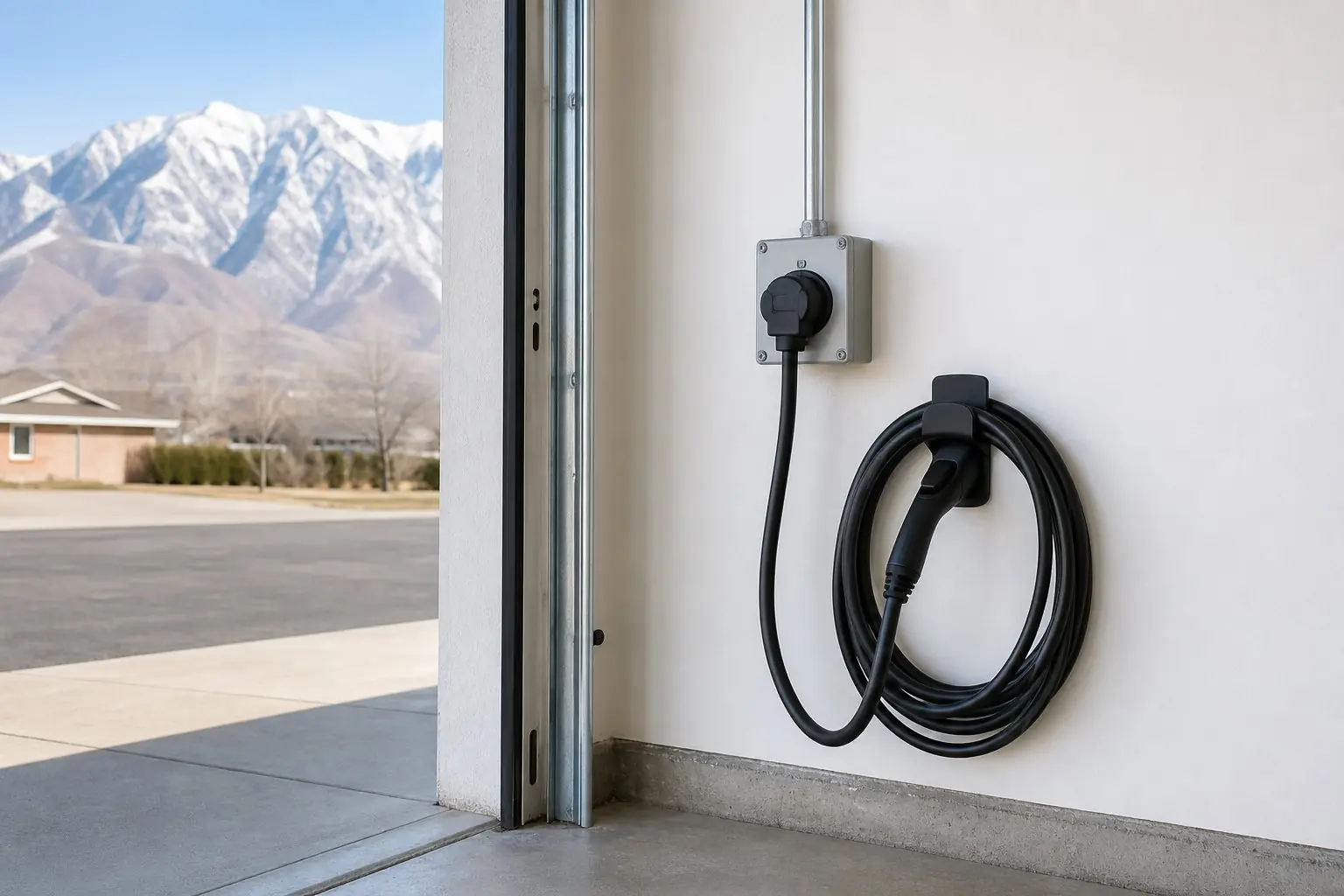
What is a 240V EV charger outlet?
It is a 240-volt receptacle on a dedicated circuit that a portable or plug-in Level 2 charger plugs into. The usual choice is a NEMA 14-50 on a 50 amp breaker, which allows up to 40 amps of continuous charging. A NEMA 6-50 is the main alternative. In Utah, either one needs GFCI protection when it is installed for EV charging.
A 240-volt outlet is the most flexible way to get Level 2 charging at home. The charger can come with you when you move, and the same receptacle works with portable cords from several automakers. The cost is a slightly lower top speed than a hardwired charger and a receptacle that has to stand up to daily use.
NEMA 14-50 or NEMA 6-50?
Both are 50 amp receptacles, and both allow up to 40 amps of charging on a 50 amp breaker. The 14-50 has four wires, including a neutral, and is rated 125/250 volts. The 6-50 has three wires with no neutral and is rated 250 volts. Pick the one your charger's plug or adapter matches; for most portable chargers that is the 14-50.
| NEMA 14-50 | NEMA 6-50 | |
|---|---|---|
| Wiring | 3-pole, 4-wire grounding (two hots, neutral, ground) | 2-pole, 3-wire grounding (two hots, ground) |
| Voltage rating | 125/250 V | 250 V |
| Breaker | 50 A two-pole | 50 A two-pole |
| Max continuous charging | 40 A | 40 A |
| Tesla Mobile Connector | 32 A, 7.6 kW | 32 A, 7.6 kW |
Configurations from Leviton's 1450R (14-50R) and 5374 (6-50R) product pages. Charging limits follow the 125 percent rule for continuous loads; Tesla figures from its Mobile Connector manual.
The 14-50 is also the receptacle EV-specific products are built around. Leviton sells its 1450R as a heavy duty EV charging receptacle with a 75 inch-pound terminal torque spec. Whichever you choose, use a receptacle rated for the duty and torque it to the maker's spec. More on the 14-50 job itself on NEMA 14-50 outlet installation.
Can you charge an EV from your dryer outlet?
You can, with limits. A dryer circuit is 30 amps, so a charger on it may draw at most 24 amps, about 5.7 kW. The dryer and the car cannot run at once, daily plug swapping wears the receptacle, and the electrical code calls for an individual branch circuit for EV charging equipment. Treat it as a stopgap, not the plan.
What is verified, point by point:
- The speed cap. Tesla's Mobile Connector draws 24 amps (5.7 kW) on its NEMA 14-30 and 10-30 dryer-outlet adapters. That is 80 percent of a 30 amp breaker, the continuous-load limit.
- Receptacle wear. Tesla's manual warns: "Do not plug the Mobile Connector into a damaged, loose or worn power outlet." A dryer receptacle was never expected to see a plug swapped twice a day. Leviton's own 14-30R product page, for one model, reads "Not Recommended for Electric Vehicle Charging."
- The circuit rule. NEC 625.40 requires EV charging equipment rated over 16 amps or 120 volts to have its own branch circuit, which is why a charger that permanently shares the dryer circuit is not a standard installation.
- Splitters. Listed devices exist that share a dryer outlet and pause the car while the dryer runs. NeoCharge, for example, lists 24 amp models for 30 amp circuits and rates them indoor only. Ask your city's building department if an inspector will accept one before relying on it.
Never put a larger breaker on a dryer circuit to charge faster. The breaker protects the wire, and 30 amp wire on a 50 amp breaker can overheat without ever tripping.
When do you need a new 240V circuit?
Almost always for a permanent setup. You need a new circuit when there is no 240-volt receptacle where you park, when you want more than 24 amps, or when the only 240-volt outlet serves the dryer or a welder. A 50 amp circuit for a 14-50 uses 6 AWG NM-B cable or 8 AWG copper in conduit.
The new circuit runs from a two-pole breaker in your panel to the receptacle, sized for the 50 amp breaker. NM-B cable is limited to its 60°C ampacity, which is why it needs the larger 6 AWG; individual conductors in conduit can use the 75°C rating when the terminals allow. Distance, wall finishes and detached garages drive most of the labor.
The panel also has to have room and capacity. A load calculation answers that, and when capacity is short, a 30 amp circuit for a 24 amp charger or load management can avoid an upgrade. Every quote starts with a load calculation, and load management is priced before any upgrade. The circuit itself is covered on dedicated EV charger circuit installation.
Does a 240V EV outlet need GFCI protection in Utah?
Yes. NEC 625.54 requires GFCI protection for all receptacles installed for EV charging, and Utah did not amend that section. Utah did remove 240-volt receptacles from the general GFCI rule in NEC 210.8, but that does not reach an outlet installed for a car. A new 14-50 or 6-50 for your EV goes on a two-pole GFCI breaker.
Most Level 2 chargers already contain their own ground-fault protection, and some makers warn that a GFCI breaker on top can cause nuisance trips. Removing the GFCI is not a code-compliant fix; hardwiring the charger on a standard breaker is the route manufacturers point to. The details and manufacturer statements are on hardwired vs NEMA 14-50 and EV charger keeps tripping the breaker.
Outdoor outlets and permits
An outdoor 240-volt receptacle needs a cover that stays weatherproof with the plug inserted, and the plug sits in the weather every time you charge. For a driveway or carport, a hardwired charger is usually the better answer; see outdoor EV charger installation.
A new 240-volt circuit and receptacle is permitted electrical work. Ogden City requires a permit to install, alter, extend or replace an electrical system, and South Ogden, North Ogden and Ogden Valley City issue their own. The permit and inspection are part of our job, not yours.
240V EV charger outlet questions
Can I plug my EV charger into my dryer outlet?
A portable charger with the right plug will work on a 30 amp dryer circuit, but it is limited to 24 amps of charging, and swapping plugs every day wears the receptacle. The electrical code calls for an individual branch circuit for EV charging equipment, so a permanent setup belongs on its own circuit.
Is a NEMA 6-50 or a 14-50 better for an EV?
Both are 50 amp, 240-volt receptacles that allow up to 40 amps of continuous charging. The 14-50 adds a neutral and is the plug most portable EV chargers ship for. Choose a 6-50 only when your charger's plug or adapter is a 6-50. Tesla's Mobile Connector draws 32 amps on either.
Does a 240V EV outlet need a GFCI breaker in Utah?
Yes, if it is installed for EV charging. NEC 625.54 requires GFCI protection on receptacles installed for EV charging, and Utah did not amend it, even though Utah removed most 240-volt receptacles from the general GFCI rule. On a 14-50 that usually means a 50 amp two-pole GFCI breaker.
Can I just put a bigger breaker on my dryer circuit?
No. The breaker protects the wire, and dryer circuits are wired for 30 amps. A 50 amp breaker on that wire would let it carry more current than it is rated for. A higher-amperage outlet needs wire sized for the new breaker, which usually means a new run.
Want the right outlet in the right spot? Send your charger's plug type and a photo of your panel.
Get a 240V outlet quote