
What is the difference between hardwired and NEMA 14-50?
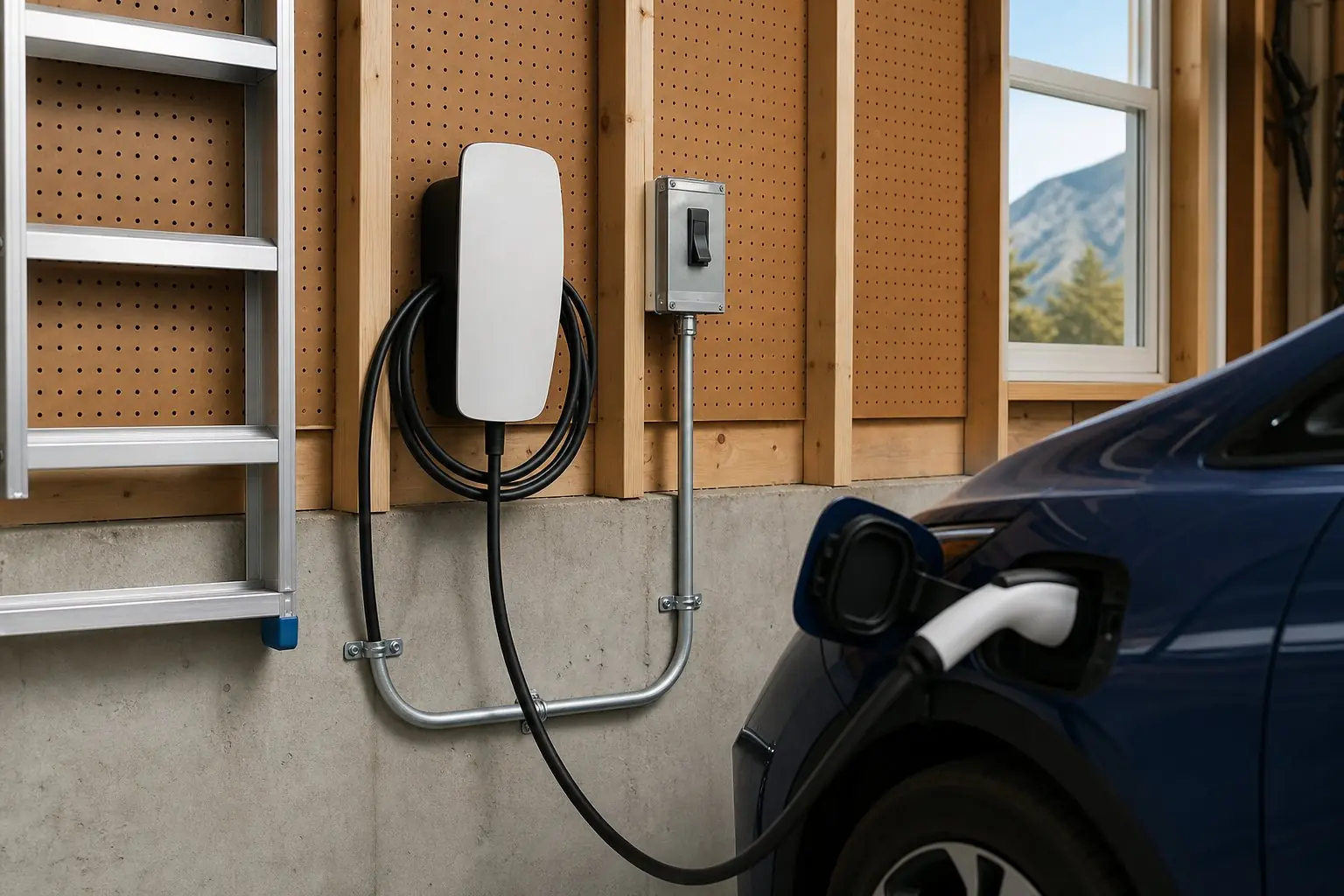
A hardwired charger is connected directly to the circuit wires inside its own enclosure, with no plug. A NEMA 14-50 setup puts a 50 amp, 240 volt receptacle on the wall, and a plug-in charger or portable cord plugs into it. The differences are top speed, GFCI rules, wear points and portability.
Which one charges faster?
Hardwired, if your car can use it. A NEMA 14-50 is a 50 amp receptacle, and because EV charging is a continuous load the breaker must be 125 percent of the charger's output, so the most a plug-in charger can draw is 40 amps. A hardwired charger on a 60 amp circuit can deliver 48 amps.
| Setup | Breaker | Max charger output | Power at 240 V |
|---|---|---|---|
| NEMA 14-50 receptacle | 50 A | 40 A | 9.6 kW |
| Hardwired, 60 A circuit | 60 A | 48 A | 11.5 kW |
Breaker-to-output pairs match the table in Tesla's Gen 3 and Universal Wall Connector manuals. Your car's onboard charger may cap the rate lower.
Many plug-in products stop below 40 amps. Tesla's Mobile Connector draws 32 amps on its 14-50 adapter, Ford's Mobile Power Cord charges at 30 amps on a 14-50, and ChargePoint limits the plug-in Home Flex to 32 or 40 amps. If your car only accepts 32 amps, the difference disappears; check our vehicle charging guides before paying for a 60 amp circuit.
Does a NEMA 14-50 for EV charging need GFCI protection in Utah?
Yes. NEC 625.54 requires GFCI protection for receptacles installed for EV charging, and Utah did not amend that section. Utah did remove 240 volt receptacles from the general GFCI rule, but that does not cover an outlet installed for a car. A hardwired charger is not covered by 625.54, and most Level 2 chargers have ground-fault protection built in.
So a 14-50 for your EV goes on a two-pole GFCI breaker. Most Level 2 chargers already have their own ground-fault protection, and several manufacturers warn that stacking the two causes nuisance trips:
- ChargePoint: "Using a GFCI breaker in the panel, especially with a plug-in installation, can cause nuisance breaker tripping in certain circumstances and interrupt charging." It adds that "if local codes require a GFCI breaker for plug-in installation, ChargePoint recommends a hardwire installation."
- Emporia: "Redundant GFCI protection will cause nuisance tripping that interrupts charging and requires a manual breaker reset." For hardwired installs: "Always use a standard non-GFCI breaker."
- Tesla: the 2020 Gen 3 Wall Connector manual says "do not install a GFCI circuit breaker," because protection is integrated.
- Wallbox: for hardwired Pulsar Plus installs, an additional GFCI breaker is "optional, as per article 625.54."
If yours trips, removing the GFCI is not a code-compliant fix. See EV charger keeps tripping the breaker.
How much does the receptacle matter?
A lot. A 14-50 used for charging carries a heavy load for hours and may be plugged in and out often. Manufacturers sell receptacles built for that duty, and terminals must be torqued to spec. A worn or loose receptacle is a heat risk that a hardwired charger simply does not have.
Hubbell describes its HBL9450A industrial grade 14-50R as "designed for plug-in EV charging applications" and advertises 50 percent greater contact force. Leviton says its 1450R "can sustain the necessary extended charge time and high frequency of insertions EV chargers require," and specifies 75 inch-pounds of terminal torque; the 1450W is its weather-resistant version. Tesla's Mobile Connector manual warns: "Do not plug the Mobile Connector into a damaged, loose or worn power outlet."
If you choose a 14-50, use an EV-rated or industrial grade receptacle torqued to spec. More on our NEMA 14-50 installation page.
Can I take the charger with me when I move?
With a 14-50, yes: unplug it and go. The outlet stays and works with portable cords and other plug-in chargers, which suits renters and anyone planning to move. A hardwired charger stays on the wall until an electrician disconnects it, though the circuit behind it can be reused for a new unit.
A Tesla Mobile Connector and a Ford Mobile Power Cord both plug into the same 14-50, which helps if you change cars.
Which is better outdoors?
Hardwired, in most cases. ChargePoint recommends hardwiring "for outdoor use or when local codes mandate GFCI protection." An outdoor 14-50 needs a cover that stays weatherproof with the plug inserted, and the plug and receptacle are exposed to snow and moisture every time you charge.
The NEC wet-location rule for 30 amp and larger receptacles with unattended loads calls for an enclosure weatherproof "with the attachment plug cap inserted or removed." In Eden and Ogden Valley winters, a hardwired charger with a holster keeps the connections sealed. More on outdoor EV charger installation.
What changes the cost?
The run from the panel to the parking spot costs about the same either way. A 14-50 adds a two-pole GFCI breaker, a quality receptacle and, outdoors, an in-use cover. A hardwired charger uses a standard breaker but may need larger wire if you want 48 amps, and the charger itself is often a pricier model.
- Breaker: GFCI two-pole for a 14-50; standard two-pole for most hardwired chargers.
- Wire size: 40 amps on a 50 amp circuit uses 8 AWG copper in conduit or 6 AWG NM-B cable. 48 amps on a 60 amp circuit needs 6 AWG in conduit or 4 AWG NM-B, per the NEC ampacity table and Tesla's manual.
- Receptacle and cover: EV-rated or industrial grade, plus a weatherproof in-use cover outside.
More in our EV charger cost guides.
Which chargers only install hardwired?
Tesla's Gen 3 Wall Connector and Universal Wall Connector are hardwire only. Both manuals say: "Hardwire branch circuits to disconnects or circuit breakers. Do NOT install cord-and-plug type connections." Other brands, such as ChargePoint, sell plug-in versions capped at 40 amps or less; see our home EV chargers table.
Pros and cons side by side
| Factor | Hardwired | NEMA 14-50 |
|---|---|---|
| Max charger output | 48 A on a 60 A circuit | 40 A |
| GFCI breaker | Not required by 625.54; most makers say use a standard breaker | Required for EV receptacles; can cause nuisance trips |
| Wear points | None beyond the charger itself | Plug and receptacle contacts and terminals |
| Outdoor use | Sealed connections; recommended by ChargePoint | Needs an in-use weatherproof cover |
| Portability | Stays on the wall | Unplug and take it |
| Charger choice | Includes hardwire-only models such as Tesla's | Plug-in models and portable cords |
Choose hardwired if
- Your car accepts more than 40 amps and your panel can spare a 60 amp circuit.
- The charger will be outdoors or in an unheated carport.
- You want a Tesla Wall Connector or Universal Wall Connector.
- You want to avoid GFCI nuisance trips and receptacle wear.
Choose a NEMA 14-50 if
- Your car charges at 40 amps or less, or you will use a portable cord.
- You rent or plan to move and want to take the charger.
- The outlet is indoors and you will use an EV-rated receptacle.
Hardwired vs NEMA 14-50 questions
Is a hardwired EV charger safer than a NEMA 14-50 outlet?
Both are safe when installed correctly. A hardwired charger removes the plug and receptacle, which are the parts that wear and loosen with daily use, and it avoids stacking a GFCI breaker on top of the charger's own ground-fault protection. A 14-50 needs an EV-grade receptacle, correct torque and a plug that fits snugly to stay trouble-free.
Can I plug a 48 amp charger into a NEMA 14-50 outlet?
No. A 14-50 is a 50 amp receptacle on a 50 amp breaker, and EV charging is a continuous load, so the most a charger can draw from it is 40 amps. Chargers that offer 48 amps reach it only on a hardwired 60 amp circuit, and plug-in versions are set lower by the manufacturer.
Why does my plug-in charger trip a GFCI breaker?
Most Level 2 chargers already contain ground-fault protection, and ChargePoint and Emporia both warn that adding a GFCI breaker can cause nuisance tripping. In Utah a receptacle installed for EV charging still needs GFCI protection, so removing it is not the answer. Hardwiring the charger on a standard breaker is the fix those manufacturers point to.
Can I switch from a 14-50 outlet to a hardwired charger later?
Usually, yes. If the existing wire and breaker suit the charger's setting, an electrician can replace the receptacle with a hardwired connection and a standard breaker. Going to 48 amps needs a 60 amp breaker and wire sized for it, which may mean pulling new wire if the original run was sized for 50 amps.
Not sure which fits your garage? Start with your car model and a photo of your panel.
Get a charger installation quote