
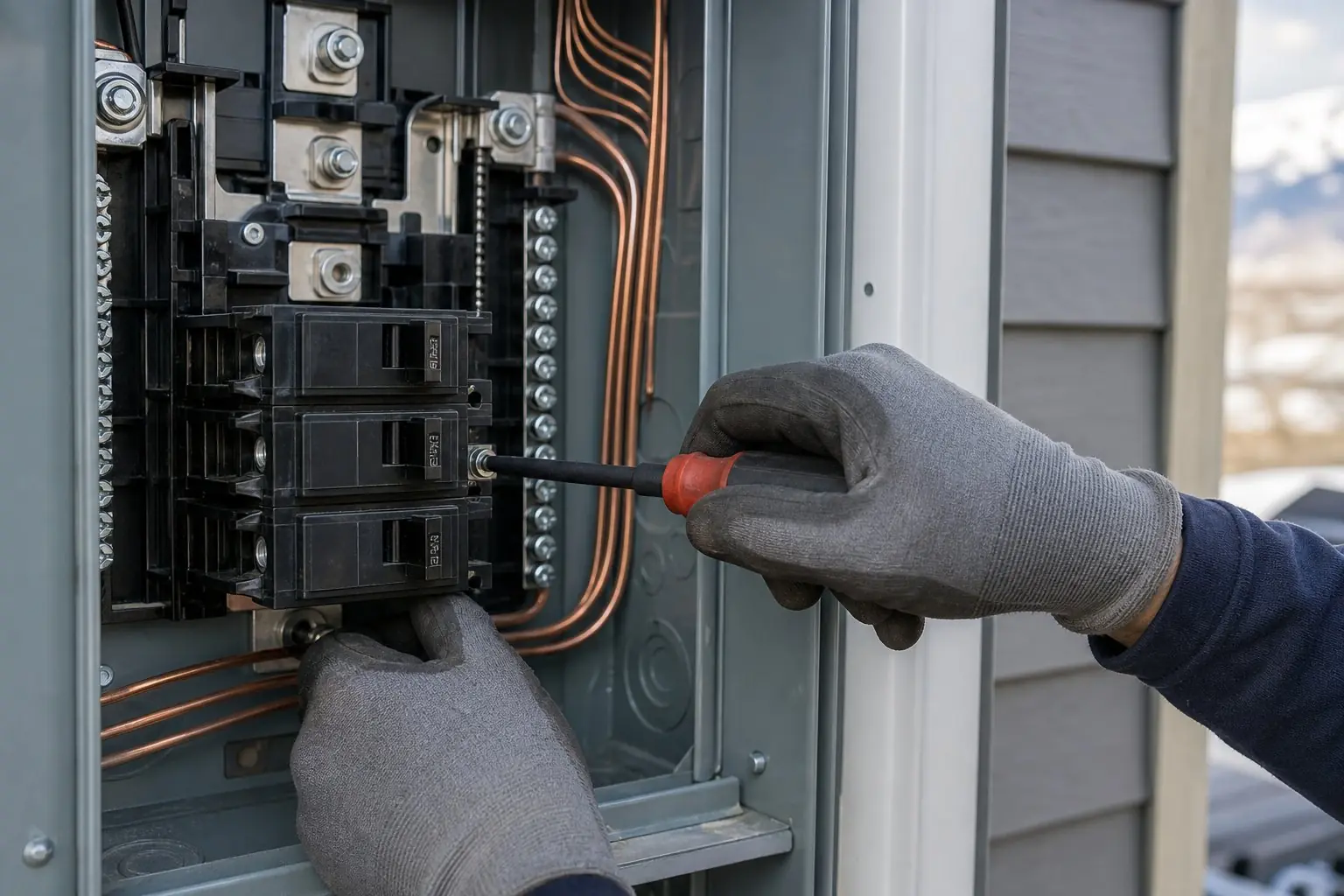
Safety first. If the plug, outlet, charger or breaker is hot, discolored, melted or smells like burning, stop charging, leave the breaker off and call an electrician. Do not open the panel, remove covers or take the outlet or charger apart. Reset a tripped breaker once at most.
Why does an EV charger keep tripping the breaker?
The usual causes are a GFCI breaker fighting the charger's own ground-fault protection, a charger set too high for its breaker, a loose or worn connection that heats up, moisture in an outdoor install, a circuit shared with other loads, or a failing breaker. When it trips tells you a lot about which one.
GFCI breaker plus the charger's own protection
Most Level 2 chargers have built-in ground-fault protection, so a GFCI breaker doubles it up. ChargePoint says a GFCI breaker, "especially with a plug-in installation, can cause nuisance breaker tripping." Emporia says "redundant GFCI protection will cause nuisance tripping that interrupts charging and requires a manual breaker reset." Tesla's 2020 Gen 3 Wall Connector manual says "do not install a GFCI circuit breaker."
On a NEMA 14-50 outlet that GFCI breaker is required: NEC 625.54 calls for GFCI protection on receptacles installed for EV charging, and Utah left that rule in place. So removing it is not the fix. ChargePoint's advice is that "if local codes require a GFCI breaker for plug-in installation, ChargePoint recommends a hardwire installation." The trade-offs are in hardwired vs NEMA 14-50.
Charger amperage set above 80 percent of the breaker
EV charging is a continuous load, so the breaker must be at least 125 percent of the charger's output. Put the other way, the charger should run at no more than 80 percent of the breaker: 32 amps on a 40, 40 amps on a 50, 48 amps on a 60. ChargePoint notes that "incorrect amperage settings during installation can cause circuit breaker tripping during charging sessions." A Tesla Wall Connector's breaker size is programmed at setup, so a wrong entry lets it draw too much. Sizing is covered in what size breaker for an EV charger.
Loose terminations and heat
Wire terminals in the breaker, outlet and charger must be tightened to the maker's torque value. Hubbell warns that under-torquing causes "arcing, overheating, and potential electrical fires." Tesla's fault table tells owners to have an electrician check "that the terminal block is torqued to specification." A heat problem does not always trip the breaker; Tesla's Mobile Connector, for example, reduces or stops charging when it detects "high temperature detected in the wall plug."
A worn or loose 14-50 receptacle
Tesla warns: "Do not plug the Mobile Connector into a damaged, loose or worn power outlet." EV-rated receptacles such as Leviton's 1450R are built for "extended charge time and high frequency of insertions."
Moisture in outdoor installs
Tesla's Wall Connector manual says that if resetting does not clear a ground fault, "look for a ground fault issue such as water ingress." An outdoor 14-50 needs a cover that stays weatherproof with the plug in, and ChargePoint recommends hardwiring outdoors.
A shared circuit
NEC 625.40 requires a charger rated over 16 amps to have its own branch circuit. If it shares a circuit with other equipment, the combined load can trip the breaker.
A failing breaker
Sometimes the breaker itself is the faulty part, tripping below its rating even with the charger set correctly. An electrician can test it. ChargePoint's installer guidance is blunt: "Only use new circuit breakers. Used breakers can damage equipment and introduce the potential for an electrical fire."
What can I safely check myself?
You can note when it trips, look at the breaker for a test button, compare the charger's app setting with the breaker's printed rating, look at the plug and outlet without touching anything inside, read the charger's fault code, and reset the breaker once. Anything beyond that belongs to an electrician.
- Note when it trips: right at plug-in, or after an hour or more of charging.
- Look at the breaker handle. A test button means it is a GFCI breaker. Note whether your charger plugs in or is hardwired.
- Compare the charger's amperage setting in its app or menu with the number printed on the breaker handle. The charger should be at or below 80 percent of it.
- Look at the plug and outlet for discoloration, melting or a loose fit. Do not touch exposed parts or remove the cover plate.
- Read the charger's light pattern or app fault code against its manual.
- Outdoors, check for water or snow inside the in-use cover or around the charger.
- Reset the breaker once: switch it fully off, then on. Tesla's manual uses a five second wait for some faults.
When should I stop and call an electrician?
Call an electrician if the breaker trips again after one reset, if anything is warm, discolored, melted or smells burnt, if the charger keeps showing ground-fault codes, or if the fix would mean opening the panel, removing an outlet or touching charger wiring. Swapping breaker types is electrician work too.
- The breaker trips again after a single reset.
- Any plug, outlet, cord or breaker is warm, discolored, melted or smells burnt.
- You hear buzzing or crackling from the outlet, charger or panel.
- Ground-fault or ground-loss codes keep coming back.
- The fix involves the panel, the receptacle, charger wiring or changing a breaker.
Our EV charger repair page explains what a diagnostic visit covers, or request a repair quote with your charger model and when it trips.
Causes and fixes at a glance
| Cause | Typical sign | Fix (electrician) |
|---|---|---|
| GFCI breaker plus charger protection | Trips at plug-in; GFCI breaker | Assess and hardwire the charger on a standard breaker; keep GFCI on any EV receptacle |
| Charger set too high | Trips after a long session | Set output to 80 percent of the breaker, or resize the circuit |
| Loose terminations | Heat, reduced charging, intermittent trips | Re-terminate and torque to spec |
| Worn receptacle | Loose plug, discoloration | Replace with an EV-rated receptacle or hardwire |
| Moisture | Trips after rain or snow, outdoor install | Correct cover, sealed fittings, or hardwire |
| Shared circuit | Trips when other equipment runs | Dedicated circuit for the charger |
| Failing breaker | Trips below its rating, settings correct | Test and replace with a new breaker |
If the outlet itself is the weak point, see NEMA 14-50 installation for what a proper EV receptacle setup looks like.
Tripping breaker questions
Why does my EV charger trip the breaker right when I plug in?
A trip at the moment charging starts usually points to ground-fault protection, not overload. The most common pattern is a plug-in charger on a GFCI breaker: the charger has its own ground-fault protection, and ChargePoint and Emporia both warn that the two together can cause nuisance trips. An electrician should confirm it, since a real ground fault looks the same.
Can I just replace the GFCI breaker with a regular one?
Not on a receptacle. NEC 625.54 requires GFCI protection for receptacles installed for EV charging, and Utah did not amend that rule. If your plug-in charger keeps tripping a GFCI breaker, the fix manufacturers point to is hardwiring the charger on a standard breaker, which an electrician can assess.
Is it safe to keep resetting the breaker?
Reset it once. If it trips again, stop charging on that circuit and call an electrician. Repeated resets can hide a loose connection or a failing part that is heating up, and every trip is the breaker doing its job. Never reset it if you see discoloration or smell burning.
Still tripping? Tell us your charger, your car and when it trips.
Request a charger repair visit