
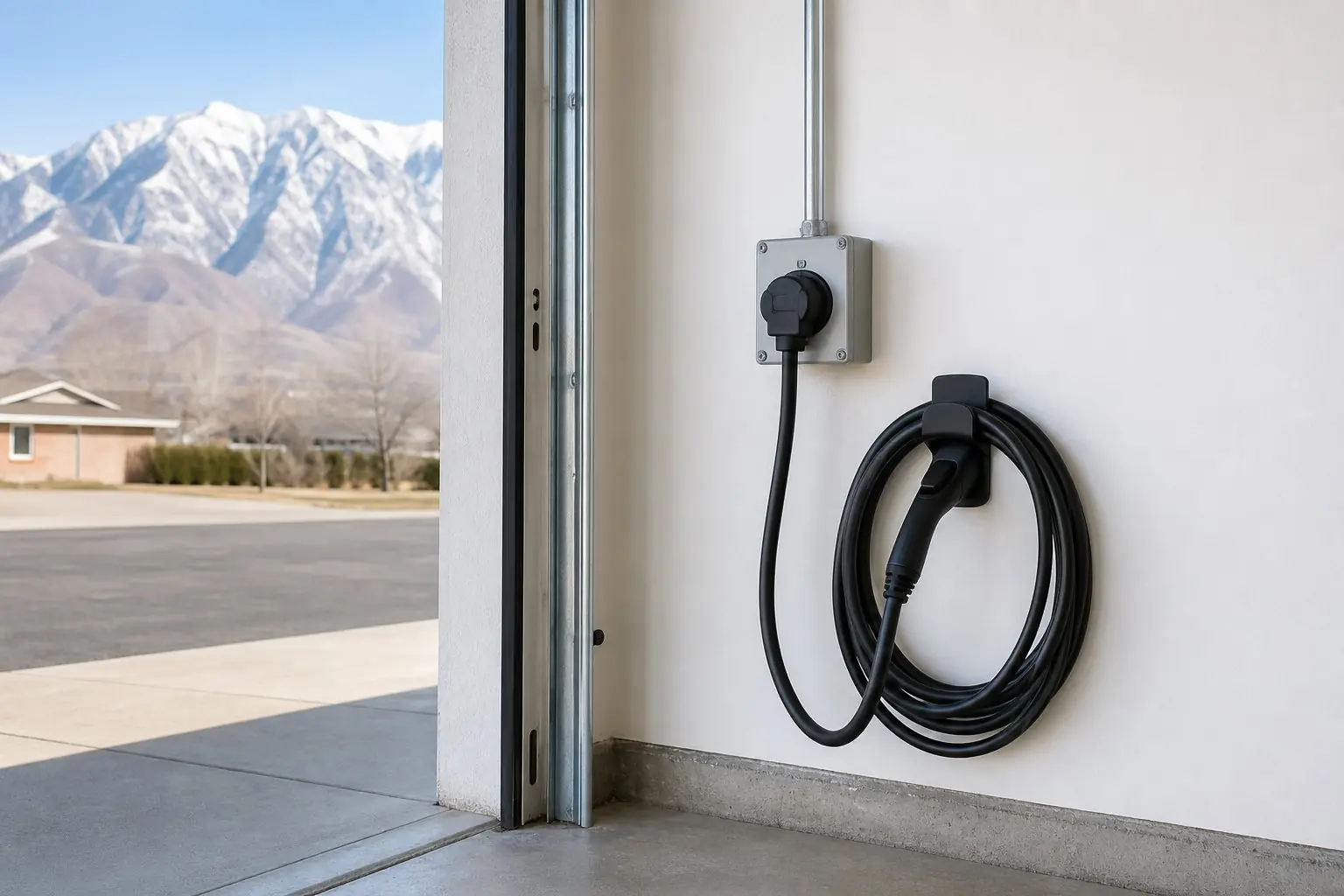
Stop using the outlet now. If the 14-50 outlet, faceplate or plug is hot, discolored, melted, or smells like burning plastic, stop charging. Turn off the outlet's breaker if you can reach it safely, and only then unplug. Do not charge on that outlet again until an electrician has checked it. Do not remove the cover plate or pull the outlet out of the wall. If you see smoke or flame, leave the garage and call 911.
What should I do if my 14-50 outlet is hot?
Stop charging, turn off the outlet's breaker if it is safe to reach, then unplug once the power is off. Leave it off and call an electrician. Do not keep charging at a lower setting to get by, and do not open the outlet to look. Heat at a plug means current is meeting resistance somewhere it should not.
Note what you saw before anything is moved: a photo of the plug and faceplate, any charger fault light, and roughly how long the car had been charging. Tesla's Mobile Connector, for example, has two heat codes for this exact spot: "Charging current is reduced due to high temperature detected in the wall plug" and "Charging stopped due to high temperature detected in the wall plug." Its advice for both ends with "If uncertain, ask your electrician."
Why does a NEMA 14-50 outlet get hot?
The common causes are a loose wire terminal behind the outlet, worn contacts that no longer grip the plug, a receptacle not built for hours of high current, a plug not fully seated, or a charger set higher than the circuit supports. Each one creates resistance, and resistance under a long charging load turns into heat.
Loose terminals
Each wire is clamped by a screw that must be tightened to the maker's torque value. Leviton specifies 75 inch-pounds for its 1450R. Hubbell warns that under-torquing leads to "loose connections, leading to arcing, overheating, and potential electrical fires." A heat problem like this does not always trip the breaker, so the outlet can run hot with no other warning.
Worn contacts and plug fit
A receptacle's contacts lose grip with use. Tesla's manual warns: "Do not plug the Mobile Connector into a damaged, loose or worn power outlet. Ensure that the prongs on the Mobile Connector fit snugly into the wall outlet." Tesla also recommends leaving the Mobile Connector plugged into the wall outlet "to reduce wear and tear from day-to-day use."
A receptacle not built for EV duty
EV charging pulls high current for hours. Leviton describes its 1450R as "designed specifically for plug-in EV charging applications" that "can sustain the necessary extended charge time and high frequency of insertions EV chargers require." Hubbell's HBL9450A is "designed for plug-in EV charging applications" and Hubbell advertises 50 percent greater contact force.
Charger set too high for the circuit
A plug-in charger on a 50 amp 14-50 circuit should draw no more than 40 amps. Tesla's Mobile Connector draws 32 amps on its 14-50 adapter, and ChargePoint limits its plug-in Home Flex to 32 or 40 amps. A charger set above 80 percent of the breaker pushes the outlet and wire past their continuous rating.
Extension cords and adapters
Tesla says: "Do not use an extension cord, a multi-outlet adapter, a multi-plug, a conversion plug, or a power strip to plug in the Mobile Connector." Each added connection is another place for heat to build.
How does an electrician fix a hot 14-50 outlet?
With the power off, an electrician inspects the receptacle, wire ends and breaker for heat damage, cuts back any damaged wire, and replaces the receptacle, usually with an EV-rated one torqued to spec. They check wire size against the breaker and the charger's setting. Some owners hardwire the charger instead.
| Finding | Typical fix (electrician) |
|---|---|
| Loose or under-torqued terminal | Cut back damaged wire, re-terminate, torque to spec |
| Worn, discolored or melted receptacle | Replace with an EV-rated receptacle |
| Damaged charger plug | Stop using it; contact the charger maker |
| Charger set above 80 percent of the breaker | Lower the setting or resize the circuit |
| Outdoor outlet with water exposure | Weatherproof in-use cover, or hardwire |
Outdoors, a 14-50 used for charging needs a cover that stays weatherproof with the plug inserted. Mike Holt's code summary calls for an enclosure weatherproof "with the attachment plug cap inserted or removed." Hardwiring takes the plug and receptacle out of the picture entirely. The trade-offs are in hardwired vs NEMA 14-50, and a proper replacement is covered on NEMA 14-50 installation.
What can I check without opening anything?
- Whether the plug sits fully in the outlet or looks partly pulled out.
- Discoloration, scorching or melting on the plug or faceplate, from a look only.
- The charger's amp setting in its app against the number on the breaker handle.
- Any heat code on the charger or in its app.
If any of those look wrong, the outlet stays off until it is repaired. See EV charger repair for what the visit covers.
Hot outlet questions
Is it normal for a 14-50 outlet to get warm while charging?
Treat noticeable heat as a fault, not a quirk. Charger makers do not publish a normal plug temperature for owners, and Tesla's Mobile Connector cuts or stops charging when it senses high temperature in the wall plug. Stop charging and have an electrician check the outlet and its connections.
Can I keep using the outlet at a lower charging current?
Lowering the current may reduce heat, but it does not fix a loose terminal or worn contacts, which can keep getting worse. Use a lower setting only as a stopgap after an electrician has looked at it, and never if the outlet or plug is discolored or melted.
Should I replace the outlet or hardwire the charger?
Both work. A worn outlet can be replaced with an EV-rated receptacle torqued to the maker's spec. Hardwiring removes the plug and receptacle from the circuit, which takes away this failure point. Hardwiring also suits daily charging if your charger offers a hardwired option.
Outlet running hot? Keep it off, take a photo, and tell us the charger and its amp setting.
Request an outlet repair visit