
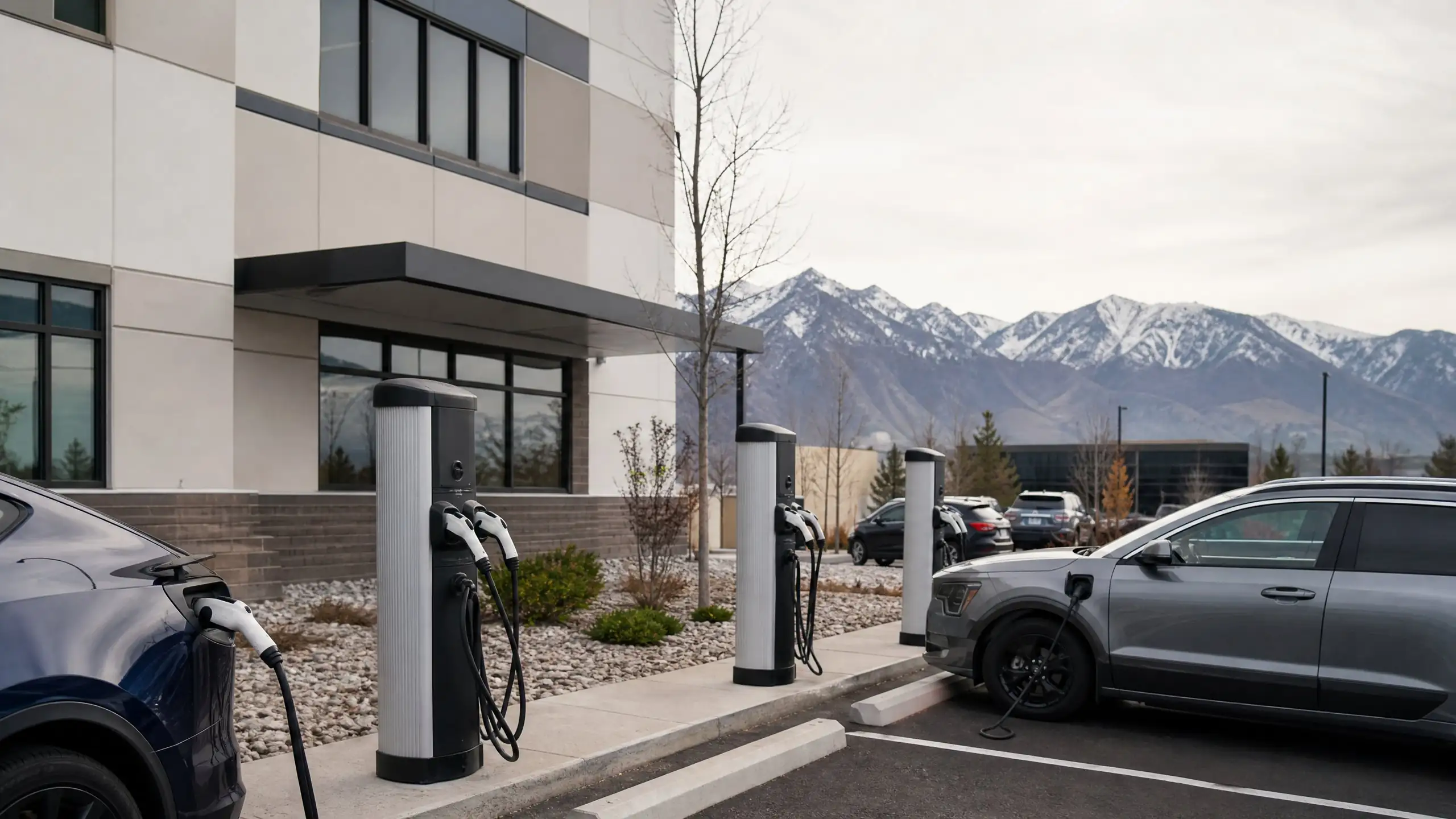
How many charging ports does a workplace need?
Fewer than most employers expect. Cars sit for a full shift, so each port can serve one car all day or two or three cars in rotation. Ask how many staff drive EVs now, how many plan to, and how far they commute. Install ports for today's drivers and run conduit and capacity for the next few years.
A quick survey answers most of it. For each EV driver, the useful numbers are the round-trip commute and whether they can charge at home. Someone with a home charger may never plug in at work; a renter without one may depend on it.
- Number of EV drivers now, and how many expect one within a few years
- Round-trip commute distance for each
- Who can and cannot charge at home
- Shift patterns, since staggered shifts let one port serve more cars
- Any company vehicles that also need to charge on site
Level 1 or Level 2 at work?
Level 1 suits commuters who park eight hours and drive moderate distances: a 120-volt outlet adds about 11 kWh over a shift. Level 2 adds about 7.7 kWh per hour on a 32 amp port, so one port can fill several cars a day in rotation. Many workplaces mix the two.
| Option | Power | Energy over 8 hours | Works best for |
|---|---|---|---|
| Level 1, 120 V outlet | about 1.4 kW | about 11 kWh | One car per outlet, all-day parking |
| Level 2, 32 amp | 7.7 kW | about 61 kWh | Rotating two or three cars per port |
| Level 2, 48 amp | 11.5 kW | about 92 kWh | Fleet vehicles and long commutes |
Output before charging losses. A car only accepts what its onboard charger allows; see the vehicle charging guides.
Level 1 hardware is cheap, but every outlet still needs a suitable circuit, and many 120-volt outlets add up to a lot of wire. Level 2 ports cost more each, yet fewer of them serve the same number of drivers. That math, plus how many cars arrive at once, usually decides it.
What should a workplace charging policy cover?
Who may use the chargers, how long a car may stay plugged in, what happens when it finishes, and whether charging is free or paid. Put it in writing before the first port goes live. Clear rules prevent the most common problem: a few cars occupying the ports all day while others wait.
- Eligibility: employees only, or visitors too.
- Time limits: for example a four-hour session, then move the car.
- Rotation: a shared chat channel or app reservations to hand off ports.
- Etiquette: no parking in a charging space without charging.
- Plug-in hybrids: whether they share the same priority as full EVs.
- Liability and damage: who reports a broken connector, and to whom.
Networked chargers can enforce much of this: access by badge or app, session limits, notifications when a car is full and usage reports by driver.
Free or paid charging for employees?
Free charging is simple and works as a recruiting perk. Paid charging recovers electricity costs and discourages all-day plug-ins. If you charge a fee per kWh, per hour or by subscription, Utah Code 59-30-102 makes you a charging station operator owing a 12.5 percent tax, with an itemized receipt for each sale.
The tax is remitted on the same schedule as your sales tax. If you only plan an idle fee for cars that overstay, ask a tax professional whether the tax applies. Some employers start free, then add a modest price once demand outgrows the ports.
Keeping chargers from setting your demand peak
Cap what the chargers can draw at once. Workplace charging tends to start together when staff arrive, which is exactly the pattern that sets a monthly demand peak. Power sharing or an energy management system spreads that load so the chargers never pull more than a set limit.
Rocky Mountain Power's Schedule 23 bills demand only above 15 kW, and a small account stays on it only while demand is at or under 30 kW in at least 7 of any 12 consecutive months and never above 35 kW. Otherwise it moves to Schedule 6 for at least 12 months. Schedule 6 bills every kilowatt of the highest 15-minute demand at $12.82 to $14.49 per kW. The full breakdown is on the commercial EV charger installation page, and the hardware side on EV charger load management.
Under NEC 625.42, chargers controlled by an energy management system can be sized at the system's limit rather than each charger's full rating, which can avoid a service upgrade.
Workplace charging incentives in Ogden
Live Rocky Mountain Power pays 75 percent of charger cost, up to $1,000 for a single-port or $1,500 for a dual-port Level 2 charger bought on or after January 1, 2026, on a meter not on a residential rate. Checked October 4, 2026; first come, first served and subject to funds.
| Program | Status | Notes |
|---|---|---|
| Rocky Mountain Power business charger incentive | Open | Apply within one year of purchase, after the chargers are energized, with a W-9, itemized invoice and photos |
| Utah DEQ Workplace EV Charging grant | Closed | Out of funds |
| Utah DEQ EV Charger Program | Not open | Applications "to be announced"; workplaces listed as eligible |
Getting workplace chargers installed
Workplace chargers are commercial electrical work, which in Ogden needs a contractor holding a Utah State contractor license to pull the permit. We handle the permit and inspection. A good proposal shows the load calculation, the power-sharing limit and where conduit for future ports will run. The permit guide covers each city's office.
Workplace EV charging questions
Is Level 1 charging enough at work?
Often, for commuters. A standard 120-volt outlet adds about 1.4 kW, or roughly 11 kWh over an 8-hour shift before losses, which covers many daily round trips. It does not work for employees who drive long distances or need a fast top-up, and each outlet still needs a suitable circuit.
Should employers charge employees for workplace charging?
It is a policy choice. Free charging is simpler and a visible perk. Charging a fee recovers the electricity cost but makes your business a charging station operator under Utah Code 59-30-102, which levies a 12.5 percent tax on charging sold per kWh, per hour or by subscription.
Is there a Utah grant for workplace chargers?
The Utah DEQ Workplace EV Charging grant is closed and out of funds. Rocky Mountain Power's business charger incentive is open as of October 4, 2026, paying up to $1,000 per single-port or $1,500 per dual-port Level 2 charger, subject to available funds.
How do we stop chargers from raising our power bill?
Limit how much the chargers can draw at once. Networked chargers with power sharing or an energy management system cap the total, so a morning rush of plugged-in cars does not set the month's 15-minute demand peak on Rocky Mountain Power's Schedule 6 or push a small account off Schedule 23.
Adding charging for your team? Tell us how many drivers and where they park.
Get a workplace charging quote