
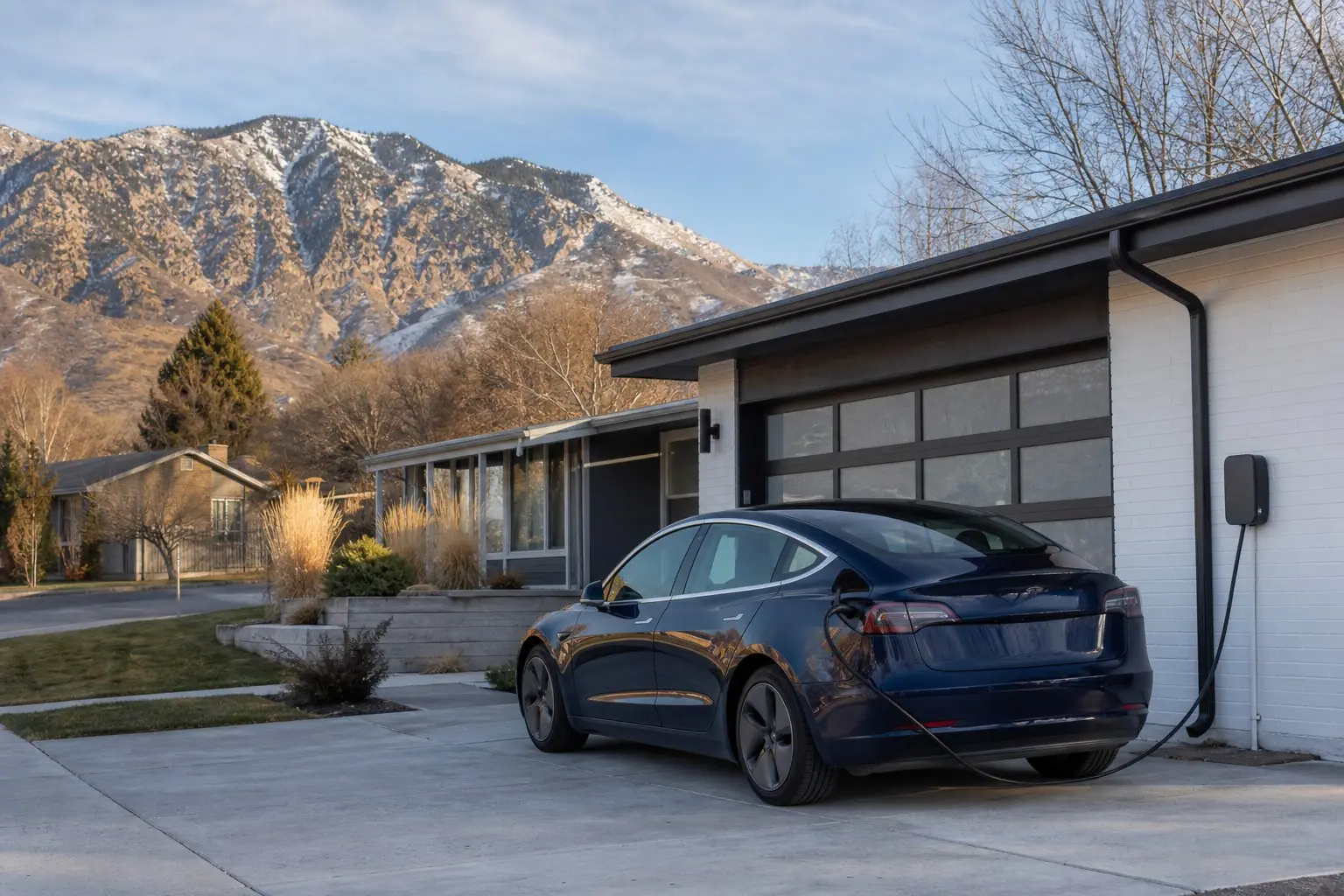
What makes a charger install in Ogden different?
The age of the houses. Census estimates for 2020 to 2024 put Ogden's median home at 1966, the oldest of any city we serve, with about 44 percent built before 1960 and roughly one in five built in 1939 or earlier. Older homes raise the same questions again and again: where the garage sits, how far it is from the panel, and how much room the panel has left.
Ogden City divides itself into official planning communities, each with its own plan. South of downtown on the east side are Mount Ogden, Taylor, T.O. Smith and Southeast Ogden. In the north-east, toward the mountains, are Mount Lewis (formerly Lincoln Edison), Horace Mann, Hillcrest/Bonneville and Canyon Road. The center holds the Central Business District around 25th Street, East Central and Jefferson, and the north and west side has Mountain View, Gibson, Lynn and West Ogden. Three of those plans describe housing in ways that matter for a charger:
- Horace Mann documents late-1940s one-story homes, about half of which have converted their garages into living space, plus 1950s brick ranches with a detached one- or two-car garage.
- Hillcrest/Bonneville says garages on its early-1900s bungalows "were added later but most are located in the rear of the home and in most cases were detached".
- East Central says the majority of its structures were built before World War II.
We have not read every community plan for garage details, so treat these as examples, not a rule for the whole city.
Charging at a detached rear garage
A rear garage means the circuit has to travel from the house panel, across the yard, to the garage. That is usually a trench with conduit, or a route along an existing structure. On a long run the wire may be upsized to keep voltage drop in check, so distance is often the biggest cost variable on an older Ogden lot.
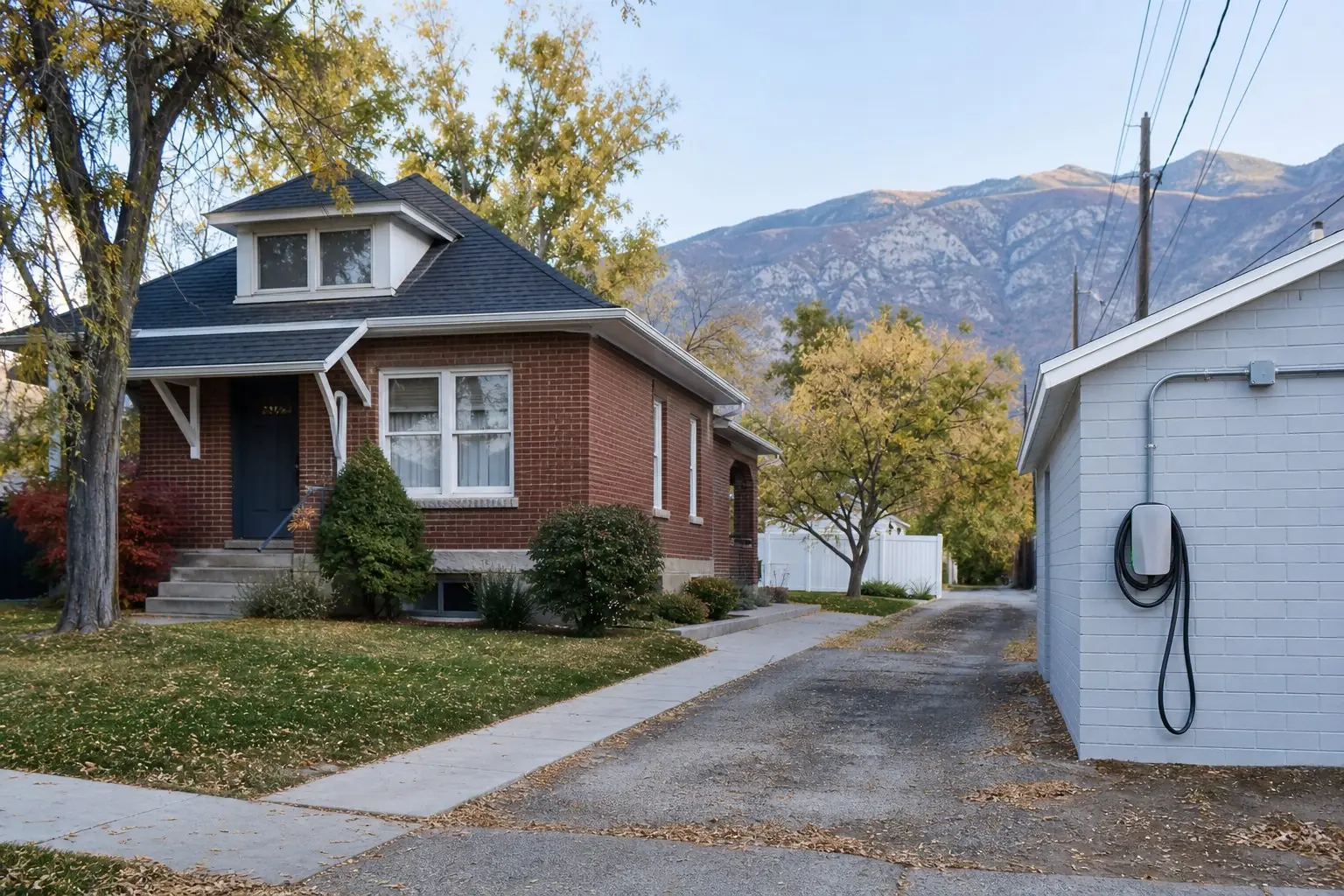
A few options are worth weighing before anyone digs:
- If the garage already has a subpanel with spare capacity, the charger may be fed from it, with no new run from the house.
- If the garage was converted to living space, as many Horace Mann homes were, the charger often goes outside instead. Our outdoor EV charger installation page covers mounting and weather protection.
- If the panel is near capacity, a load management device can sometimes avoid a panel upgrade. Whether yours needs one depends on its rating and your existing loads, not on the age of the house alone.
Photos of the main panel, any garage subpanel and the path between them help size the job. The quote request form takes photo uploads. EV charger installation cost explains how run length and panel work affect price.
How do Ogden City EV charger permits work?
Ogden requires a permit to install, alter, change, extend, repair or replace an electrical system, and a charger circuit is a new installation. Apply in the city's EnerGov Self Service portal under Residential Electrical, after checking that your address is inside Ogden City on the Weber County GIS map. The city says to allow one to three days to process applications.
Who can apply matters here, because about 39 percent of Ogden homes are renter-occupied, by the Census figures. The city's rule is "Residential (owner-occupied): Homeowner or Utah State licensed contractor." Rentals need a licensed contractor, so a landlord adding a charger for a tenant cannot pull the permit personally.
| Item | Ogden City |
|---|---|
| Portal and permit type | EnerGov Self Service, Residential Electrical |
| Fee basis | Project valuation, Ordinance 2024-14; valuations up to $1,200 pay $70.50 |
| Deposit | $70.50 when the application is accepted, credited against the final fee |
| Inspections | Call 801-629-8950; typical inspections include electrical wiring, conduit and final |
Fee figures are from the May 2024 ordinance text; later amendments were not checked. Confirm the current fee with the city.
We apply for the permit and book the inspection. The full fee table and the other cities' rules are on the EV charger permits page.
Historic districts and the Landmarks Commission
Ogden has three local historic districts: 25th Street, Eccles and Jefferson. Work that affects a property on the Ogden City Register needs a Certificate of Historic Appropriateness before any permit is issued. Whether an exterior charger counts as that kind of work is not settled in the city's published policies, so ask before you apply.
The Jefferson district is described in the East Central plan as Victorian homes along Jefferson Avenue between 25th and 27th Streets. Whether an exterior-mounted charger, visible conduit or a charger inside the garage on a registered property needs a certificate is something to confirm with the city. Call Ogden Planning at 801-629-8930 and ask for the Preservation Planner. If the commission itself has to review it, timing matters: applications are due the first Thursday of the month at 5 p.m., and the commission meets on the fourth Thursday, so a certificate can add weeks before the electrical permit issues.
One distinction trips people up. The East Central plan says that area matches the Ogden Central Bench Historic District, which is a National Register listing. The certificate attaches to the local Ogden City Register, so a National Register listing alone does not automatically require one.
Winter and timing in Ogden
Cold is a smaller factor in town than in the mountains. NOAA's 1991 to 2020 normals put downtown Ogden's January average low at 21.9°F, with nights at or below zero rare. A garage install keeps the cable out of snow, and a car left plugged in can precondition before a cold morning drive. For timing, Rocky Mountain Power's optional time-of-use rate makes 6 to 10 p.m. on weekdays on-peak, so a charger scheduled to start at 10 p.m. avoids it. The Ogden EV charging guide has the current rates.
Public charging in Ogden
Home charging covers most daily driving, but three sourced public options exist in town. Ogden City's four J1772 stations in the Municipal Building lot at 2549 Washington Blvd are free for two hours at a time. Historic Union Station at 2501 Wall Ave has eight 350 kW DC fast chargers, owned by Rocky Mountain Power and operated by Electrify America. Weber State lets cars with a valid campus parking permit charge free for up to three hours in listed lots. Details and caveats are in the Ogden EV charging guide.
Ogden EV charger questions
Can I pull my own EV charger permit in Ogden?
Only if you live in the house. Ogden City allows the homeowner or a Utah-licensed contractor to pull residential permits on owner-occupied homes. Rentals, including a single-family house you rent out, and all commercial work need a licensed contractor. Either way, the circuit has to pass inspection.
My Ogden house has a detached garage. Can it still get a Level 2 charger?
Usually, yes. The circuit runs from the house panel to the garage, often underground in conduit, and a long run may need larger wire to limit voltage drop. If the garage already has a subpanel with spare capacity, the charger can sometimes be fed from there instead of from the house.
Does a charger on a historic Ogden home need Landmarks Commission approval?
Possibly. Ogden requires a Certificate of Historic Appropriateness before permits for work that affects a property on the Ogden City Register, which covers the 25th Street, Eccles and Jefferson districts. The commission's policies do not mention EV chargers, so ask Ogden Planning at 801-629-8930 before applying.
Do I need a smart charger to save money in Ogden?
Not necessarily, but you need some way to schedule. On Rocky Mountain Power's optional time-of-use rate, 6 to 10 p.m. on weekdays is on-peak. A charger with a scheduling feature, or a car that schedules its own charging, can start at 10 p.m. and keep nearly all charging off-peak.
Planning a charger in Ogden? Tell us your address and car, and include photos of the panel and the garage or parking spot.
Get an Ogden charger quote