
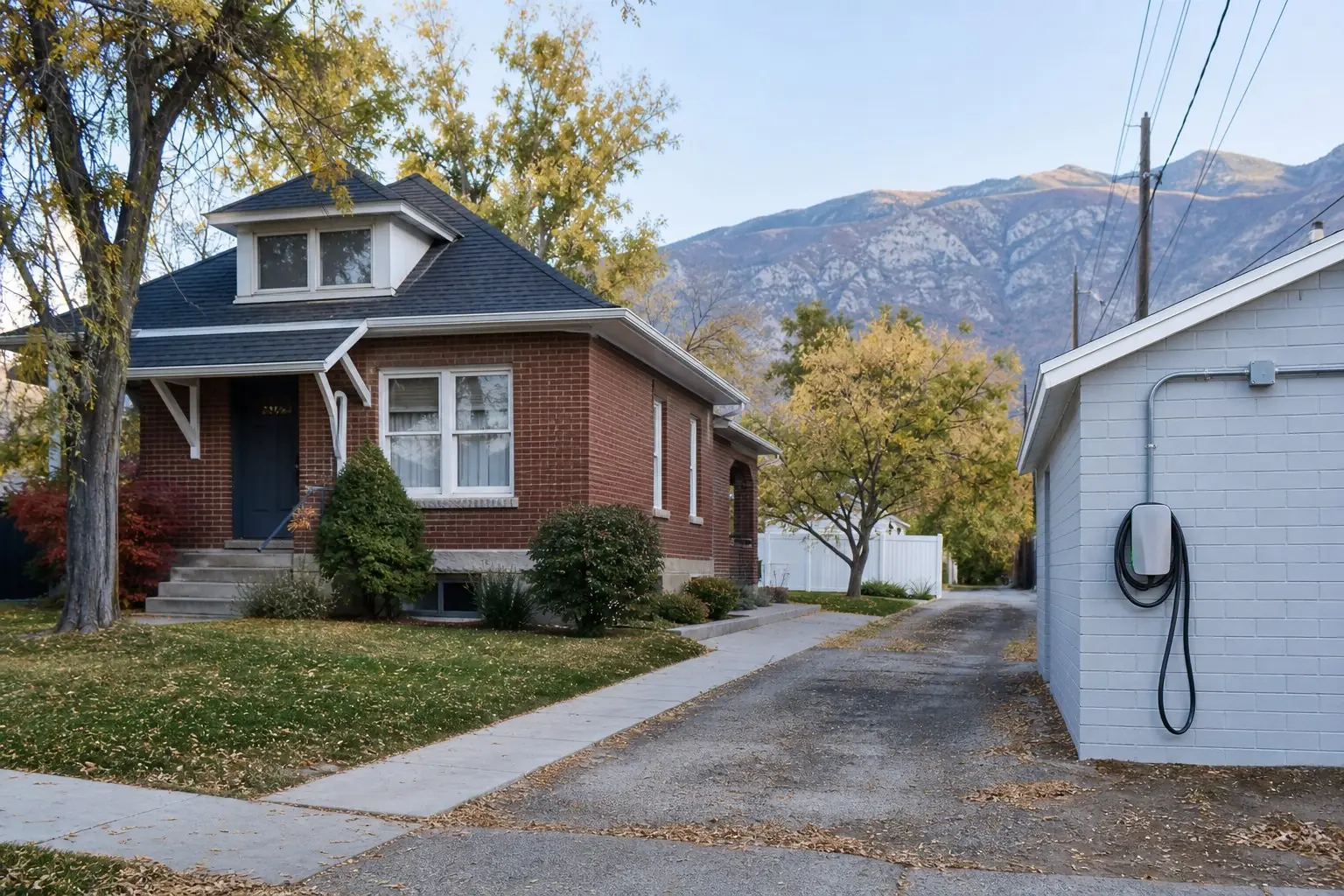
How is an attached garage install different from a detached one?
An attached garage usually means a short indoor run from the panel to the charger, often a single visit. A detached garage needs the circuit carried outside, usually underground, and sometimes a feeder and subpanel. The distance, the trench and what else the garage needs to power drive most of the difference.
| Factor | Attached garage | Detached garage |
|---|---|---|
| Route | Through walls, attic, crawlspace or surface conduit | Out of the house, underground or overhead, into the garage |
| What feeds the charger | A branch circuit from the main panel | A single branch circuit, or a feeder to a garage subpanel |
| Extra work | Drywall, long interior runs if the panel is across the house | Trenching, burial-rated raceway, protection where wiring leaves the ground |
| Wi-Fi | Usually in range | May need an access point or mesh node |
For the overall home process, including amperage, permits and off-peak charging, see home EV charger installation.
Where should the charger go in the garage?
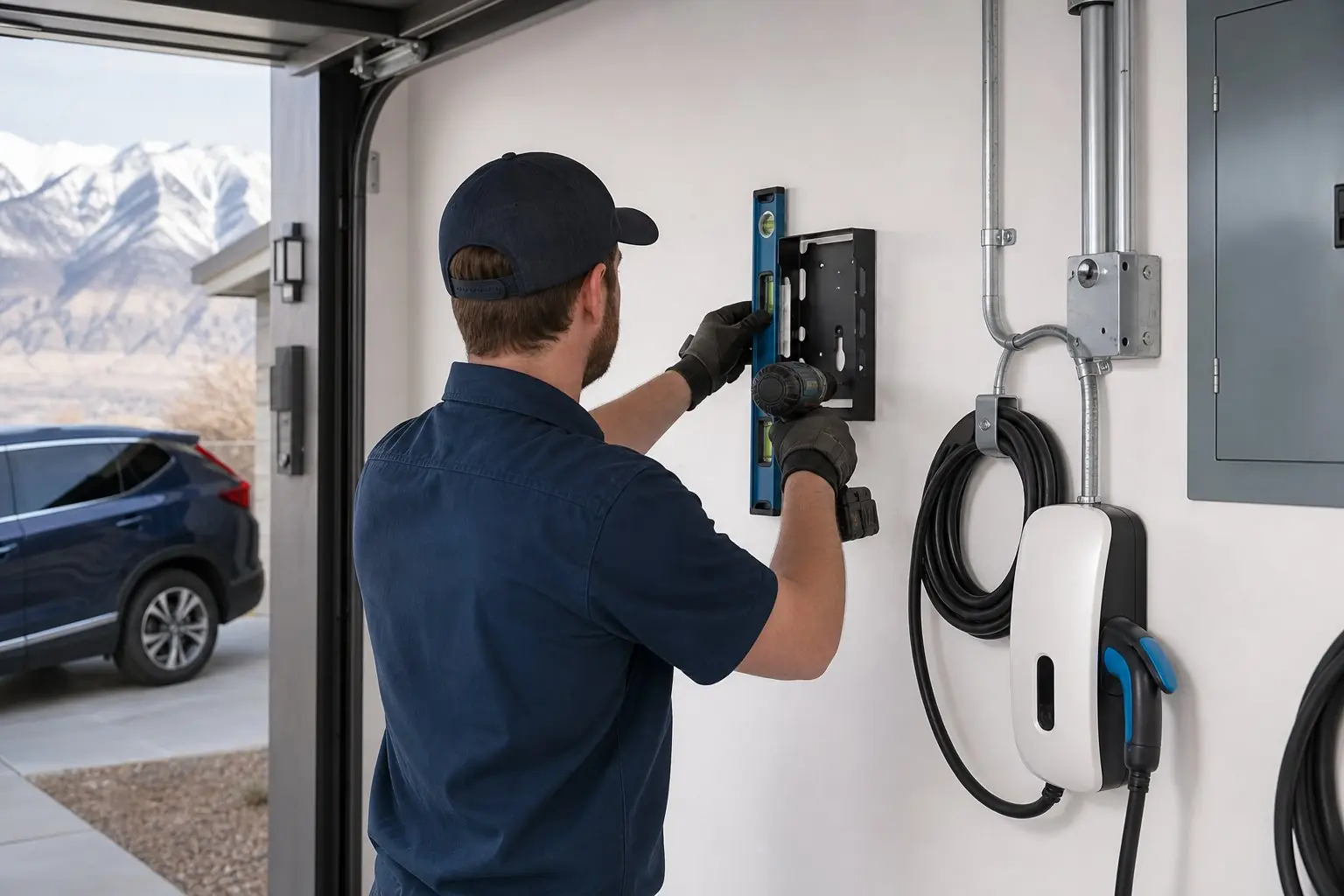
On the wall nearest your car's charge port, with the car parked the way you park it every day. The cable should reach the port without crossing the hood or stretching tight across the floor. Note where the port is on your car, and on any car you expect to own next, before choosing the wall.
Manufacturer install guides set the limits:
- Cable length: Tesla's Wall Connector has a 24 foot cable, ChargePoint's Home Flex 23 feet and Wallbox's Pulsar Plus 25 feet.
- Height: Tesla recommends about 45 inches, no higher than 60 inches and no lower than 18 inches indoors. Wallbox recommends 50 to 67 inches for the Pulsar Plus.
- Clearance: Tesla asks for room for the cable to loop around the unit in loops at least 2 feet across, or a separate cable organizer nearby.
- Strain: Tesla says to mount where the cable reaches the port "without putting strain on the cable."
Two cars in one garage often share a charger mounted between the bays, or two chargers sharing one circuit. That is covered on EV charger load management.
Why are so many Ogden garages detached?
Because of when the houses were built. Census estimates put Ogden's median home at 1966, with about 44 percent built before 1960. Ogden's community plans describe bungalow garages added later at the rear of the lot, usually detached, and 1950s brick ranches with detached one- or two-car garages.
The Hillcrest/Bonneville plan says early-20th-century bungalow garages "were added later but most are located in the rear of the home and in most cases were detached." The Horace Mann plan describes 1950s brick ranches with a detached garage, and notes about half of its late-1940s homes have had their garages converted to living space.
In practice that means a longer run, often from a panel at the front or side of the house to a garage across the back yard. South Ogden's housing is somewhat newer, with a median build year of 1979, and North Ogden's newer still, at 1993.
Single circuit or subpanel for a detached garage?
If the charger is the only new load, one branch circuit from the house panel is usually simplest. If you also want lights, outlets, a heater or a second charger out there, a feeder to a small subpanel is the cleaner job. A feeder brings more requirements at the garage, so the choice affects cost.
Mike Holt's EC&M explanation of the NEC rules for a building supplied from another building:
- Each building's disconnect "must be connected to an electrode of a type identified in 250.52," so a feeder-supplied garage gets its own grounding electrode.
- An equipment grounding conductor runs with the supply conductors.
- "The supply circuit neutral conductor isn't permitted to be connected to the remote building/structure disconnecting means." Neutral and ground stay separate in the garage panel.
- The electrode is not required where the garage is served by a single branch circuit.
That EC&M Q&A dates from 2013; your inspector applies the edition Utah has adopted, the 2023 NEC.
Either way, the charger itself still needs its own individual branch circuit under NEC 625.40. Whether your main panel can spare the capacity for a feeder is a load calculation; see can my panel handle an EV charger and panel upgrades for EV charging.
What does trenching to a detached garage involve?
Digging a trench from the house to the garage, laying conduit or burial-rated cable at the depth NEC Table 300.5 sets for that wiring method, protecting it where it rises out of the ground, and backfilling without damaging it. Mike Holt cites 18 inches of cover for a residential run in rigid nonmetallic (PVC) conduit.
"Cover" is measured from the top of the conduit or cable to finished grade. For your wiring method, your inspector and the adopted code set the depth.
- Where it leaves the ground: direct-buried cable that emerges from grade must be protected from 18 inches below grade up to at least 8 feet above.
- Backfill: must not damage the raceway or cable, so rocky fill gets screened or replaced.
- Wet location: the inside of an underground raceway is treated as a wet location, so the conductors must be rated for it.
- Long runs: distance may call for larger wire to limit voltage drop, which adds cost on long rear-lot runs.
Do not confuse the 30 inch frost depth on South Ogden and North Ogden building pages with electrical burial depth; that figure applies to footings. Mark utility lines before digging, and see EV charger installation cost for how trenching affects price.
What we look at before quoting a garage install
Photos of your panel, the garage wall and the path between them tell us most of what we need. We look at where your car's charge port sits, the distance and route to the garage, whether the garage already has power, and what else you want out there. We pull the electrical permit with your city and schedule the inspection. Ogden City requires a permit to install or extend an electrical system; the EV charger permit guide covers each city.
Garage EV charger questions
Do I need a subpanel in my detached garage for an EV charger?
Not always. One branch circuit for the charger is the simplest route when the garage needs nothing else. A feeder and subpanel make sense when you also want lights, outlets or a second charger out there. A feeder brings extra code requirements at the garage, including its own disconnect and grounding electrode.
How deep does the line to a detached garage have to be buried?
It depends on the wiring method, set by NEC Table 300.5. Mike Holt, writing in EC&M, cites 18 inches of cover for a residential run in rigid nonmetallic (PVC) conduit. Metal conduit and direct-burial cable have different minimums, and your inspector confirms the requirement for your job.
Where should the charger go in the garage?
Where the cable reaches your car's charge port with the car parked normally, without stretching across the floor or the car. Check which side and corner your port is on before choosing the wall. Tesla recommends mounting its Wall Connector about 45 inches high and no lower than 18 inches indoors.
Will the charger's Wi-Fi reach a detached garage?
Not always. Tesla advises against mounting its Wall Connector on the far side of concrete, masonry or metal studs from the router, and notes that if your phone connects to Wi-Fi at the spot, the charger likely will. A detached garage may need a mesh node or access point.
Charging in a detached or attached garage? Send a photo of your panel and the garage wall.
Get a garage charger quote