
How old are Ogden's homes?
Older than its neighbors. The Census Bureau's American Community Survey estimates for 2020 to 2024 put Ogden's median year built at 1966, with about 44 percent of homes built before 1960 and about one in five built in 1939 or earlier. South Ogden's median is 1979, and North Ogden's is 1993.
| City | Median year built | Built before 1960 | Built before 1980 | Built 1939 or earlier |
|---|---|---|---|---|
| Ogden | 1966 | 43.5% | 65.8% | 19.4% |
| South Ogden | 1979 | 25.2% | 52.3% | 4.1% |
| North Ogden | 1993 | 9.9% | 31.5% | 2.1% |
ACS 5-year estimates, 2020 to 2024, tables DP04 and B25035. Shares are sums of the survey's decade bins and carry margins of error. The Eden sample is too small to be reliable, so it is left out.
The Census does not record panel size or service amperage, and we found no local source that does. So nobody can tell you an older Ogden house has a small service from its age alone. The panel itself is the only reliable answer.
Why does the garage matter so much?
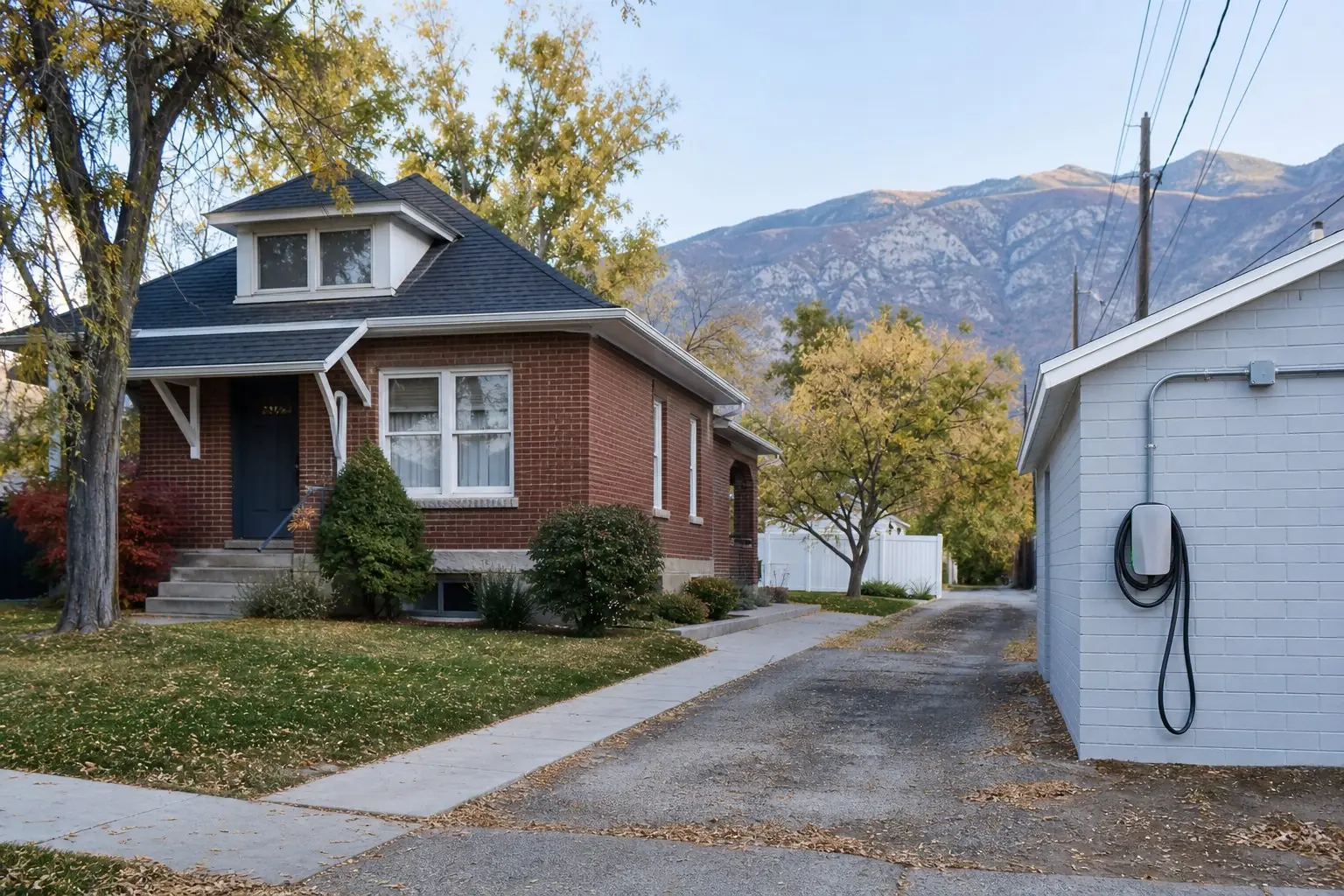
Because many older Ogden lots put it at the back, detached. Ogden's Hillcrest/Bonneville plan says early bungalow garages "were added later but most are located in the rear of the home and in most cases were detached," and the Horace Mann plan describes 1950s brick ranches with detached one- or two-car garages. That turns a short indoor run into an outdoor one.
A detached garage usually means a trench, wiring rated for underground use, and sometimes a subpanel if the garage also needs lights or outlets. A long run can also call for a larger wire size. The Horace Mann plan adds that about half of its late-1940s homes have had their garages converted to living space, which can leave a driveway or carport as the parking spot and make an outdoor-rated charger the better fit. Trenching depth, subpanels and Wi-Fi reach are covered on garage EV charger installation, and exterior installs on outdoor EV charger installation.
Can an older panel handle an EV charger?
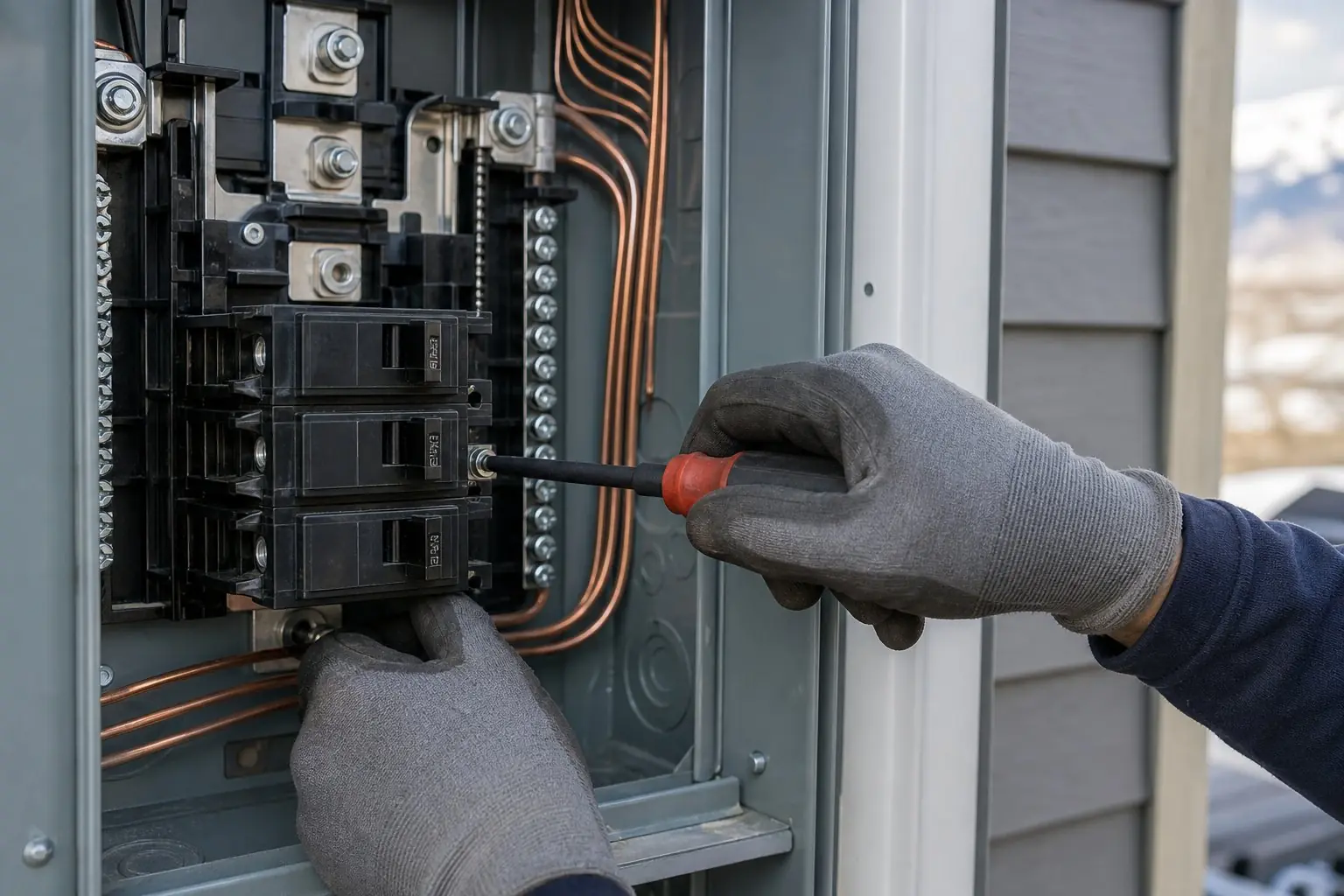
Often it can, and the age of the house does not settle it. A load calculation does: it adds up the home's loads under the 2023 National Electrical Code, which Utah has adopted, and compares the total with the service rating. A charger counts at 7,200 watts or its nameplate rating, whichever is larger. Space for a two-pole breaker is a separate question.
Questions worth answering before anyone quotes the job:
- What is the service rating? It is usually stamped on the main breaker. Ratings seen on houses include 100, 125, 150 and 200 amps.
- Is there room for a two-pole breaker? A full panel is a space problem, which a subpanel can sometimes solve. It is not the same as a capacity problem.
- What big electric loads does the house have? Electric heat, a tank water heater, an electric range, a dryer or a hot tub weigh heavily. About 18 percent of Ogden homes heat mainly with electricity, per the same Census estimates.
- Has the panel been replaced? A newer panel in an older house changes the picture, so note its age if you know it. Any scorching, heat damage or loose parts should be checked by an electrician before adding load.
- How many amps does the car actually need? A 32 amp charger on a 40 amp circuit covers most daily driving overnight and adds less to the calculation than a 48 amp unit.
The step-by-step version is on can my panel handle an EV charger, and what an upgrade involves is on EV charger panel upgrades.
Is load management a good fit for an older house?
Often, yes. Under section 220.70 of the 2023 NEC, when an energy management system limits current, the load calculation can use the system's maximum setpoint instead of the charger's full rating. That can keep a charger on the service you already have, which matters most in houses where the calculation comes up a little short.
Load management watches the home's total draw and slows or pauses charging when the house is busy, such as when the range and dryer run at dinner. Overnight, when most charging happens, the house is usually quiet. Pairing it with a detached-garage run can keep the whole project on the existing service. Devices and tradeoffs are on EV charger load management.
If the service itself does need upgrading, Rocky Mountain Power has to be involved: it asks customers to call 1-888-221-7070 when an electrician needs a utility service upgrade, and only the utility connects or disconnects service.
Does a historic district change anything?
It can. Ogden has three local historic districts: 25th Street, Eccles and Jefferson. A Certificate of Historic Appropriateness from the Landmarks Commission is required before any permit is issued for work affecting a property on the Ogden City Register, and work includes alterations. Whether an EV charger counts is not spelled out.
The commission's published policies do not mention EV chargers or electrical equipment, so whether an exterior-mounted charger, surface conduit or pedestal on a registered property needs a certificate is a question for the city. The certificate attaches to the local Ogden City Register; a property listed only on the National Register is not automatically subject to it. Ask Ogden Planning at 801-629-8930, and ask for the Preservation Planner, before applying for the electrical permit. The application steps are on our EV charger permits page.
What order should you check things in?
- Confirm your address is inside Ogden City and whether the property is on the Ogden City Register.
- Decide where the car parks: attached garage, detached garage, carport or driveway.
- Photograph the panel, its label and the main breaker, and measure the route to the parking spot.
- Pick a charger amperage that fits your daily driving, not the maximum the car accepts.
- Run the load calculation, then compare load management with any upgrade.
- Apply for the permit, plus a historic certificate if Planning says one is needed.
We run the load calculation and look at load management before recommending any panel or service upgrade.
Older Ogden home charging questions
Does an older Ogden home need a panel upgrade for an EV charger?
Not automatically. The age of the house does not decide it; a load calculation does. It compares the home's calculated load, with the charger counted at 7,200 watts or its nameplate rating, whichever is larger, against the service rating. If it falls short, a lower charger setting or load management may close the gap before an upgrade is needed.
Is a detached rear garage a problem for a home charger?
No, but it is usually the longer and more involved job. The circuit has to leave the house, often underground in a trench, and the extra distance can call for larger wire. If the garage also needs lights, outlets or a second charger, a feeder and subpanel in the garage can make more sense than a single circuit.
Do I need historic approval for an EV charger in Ogden?
Possibly, if the property is on the Ogden City Register. A Certificate of Historic Appropriateness is required before any permit for work that affects a registered property, and work includes alterations. The Landmarks Commission policies do not mention EV chargers, so ask Ogden Planning at 801-629-8930 before applying for the electrical permit.
What should I photograph before asking for a quote on an older house?
The panel with its door open, the label inside the door, and the main breaker so its amp rating is readable. Add the spot where you park, the route between the panel and that spot, and the garage wall. For a detached garage, a photo of the yard between the house and garage helps any electrician judge the run.
Older house, detached garage? Send your car model, a panel photo and where you park.
Get a home charger quote