
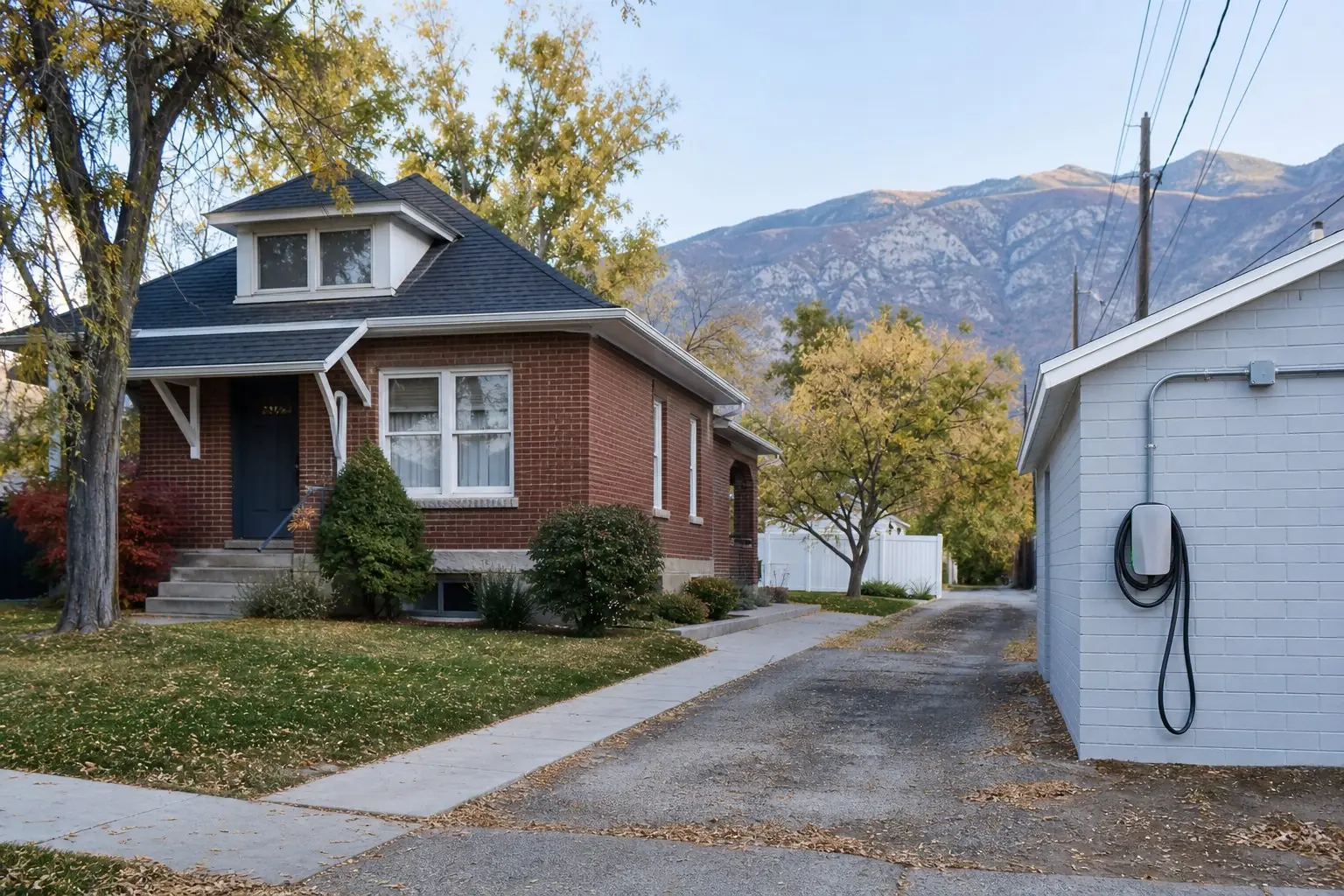
Why does a detached garage cost more to wire for a charger?
Because the circuit has to leave the house, run underground across the yard and rise into a second building. That adds digging, burial-rated conduit or cable, protection where the wiring comes out of the ground and, on long runs, heavier wire. Choosing a subpanel instead of a single circuit adds parts at the garage end too.
Everything else, the charger, its breaker and the permit, works much as it does in an attached garage. The cost overview for a standard install is on EV charger installation cost. This page covers the extra lines a detached garage puts on the quote.
What drives the price of reaching a detached garage?
Trench length and what it crosses come first: lawn is easier than concrete, and a driveway crossing adds work. Next are the wiring method, which sets burial depth, the wire size needed for the amperage and distance, and whether the garage gets one branch circuit or a feeder and subpanel. Panel capacity at the house can add a larger line still.
| Driver | Lower cost | Higher cost |
|---|---|---|
| Trench length | Garage close to the side of the house nearest the panel | Garage across the back yard from a front or basement panel |
| Surface | Lawn or garden bed | Concrete walk, patio or driveway to cross or cut |
| Wiring method | Method allowing shallower cover | Method needing deeper cover, so a deeper trench |
| Wire size | 32 amp charger, short run | 48 amp charger, long run, wire upsized for distance |
| Garage supply | One branch circuit for the charger only | Feeder, subpanel, disconnect and grounding electrode |
| Main panel | Spare spaces and capacity on the load calculation | Load management device or panel upgrade needed |
How does the trench affect the cost?
Depth and length set the labor. NEC Table 300.5 sets minimum cover by wiring method, so the method chosen decides how deep the trench goes. Mike Holt, writing in EC&M, cites 18 inches of cover for a residential run in rigid nonmetallic (PVC) conduit. Cover is measured from the top of the conduit to finished grade.
Ask your electrician and inspector for the cover depth that applies to the wiring method chosen. The trade-off is material against digging, and your electrician weighs the two for your yard.
- Where the wiring rises: direct-buried cable that emerges from grade must be protected from 18 inches below grade to at least 8 feet above.
- Backfill: it must not damage the raceway or cable, so rocky soil may need screened fill.
- Conductors: the inside of an underground raceway counts as a wet location, so the wire must be rated for it.
- Before digging: Rocky Mountain Power's service manual lists calling 8-1-1 to locate buried utilities.
- Restoration: sod, pavers or concrete over the trench are part of the job, and a quote should say who puts them back.
Do not use the 30 inch frost depth on local building pages as a burial depth. That figure is for footings.
Is a single circuit or a subpanel cheaper?
A single branch circuit is usually the cheaper route when the charger is the only new load. A feeder and subpanel cost more, because the garage then needs its own disconnect and grounding electrode and the feeder is sized for everything out there. It can be the better value if you also want lights, outlets or a second charger, since one trench serves all of it.
Mike Holt's EC&M summary of the NEC rules for a building fed from another building explains the extra parts:
- Each building's disconnect "must be connected to an electrode of a type identified in 250.52," so a feeder-supplied garage gets its own grounding electrode.
- That electrode is not required when the garage is served by a single branch circuit.
- An equipment grounding conductor runs with the supply, and the neutral is kept separate from ground at the garage panel.
That Q&A dates from 2013. Utah inspectors apply the 2023 NEC, so your electrician confirms the current rules.
Either way, the charger still gets its own branch circuit. Placement, Wi-Fi reach and the rest of the design are covered on garage EV charger installation.
How much does wire size add over a long run?
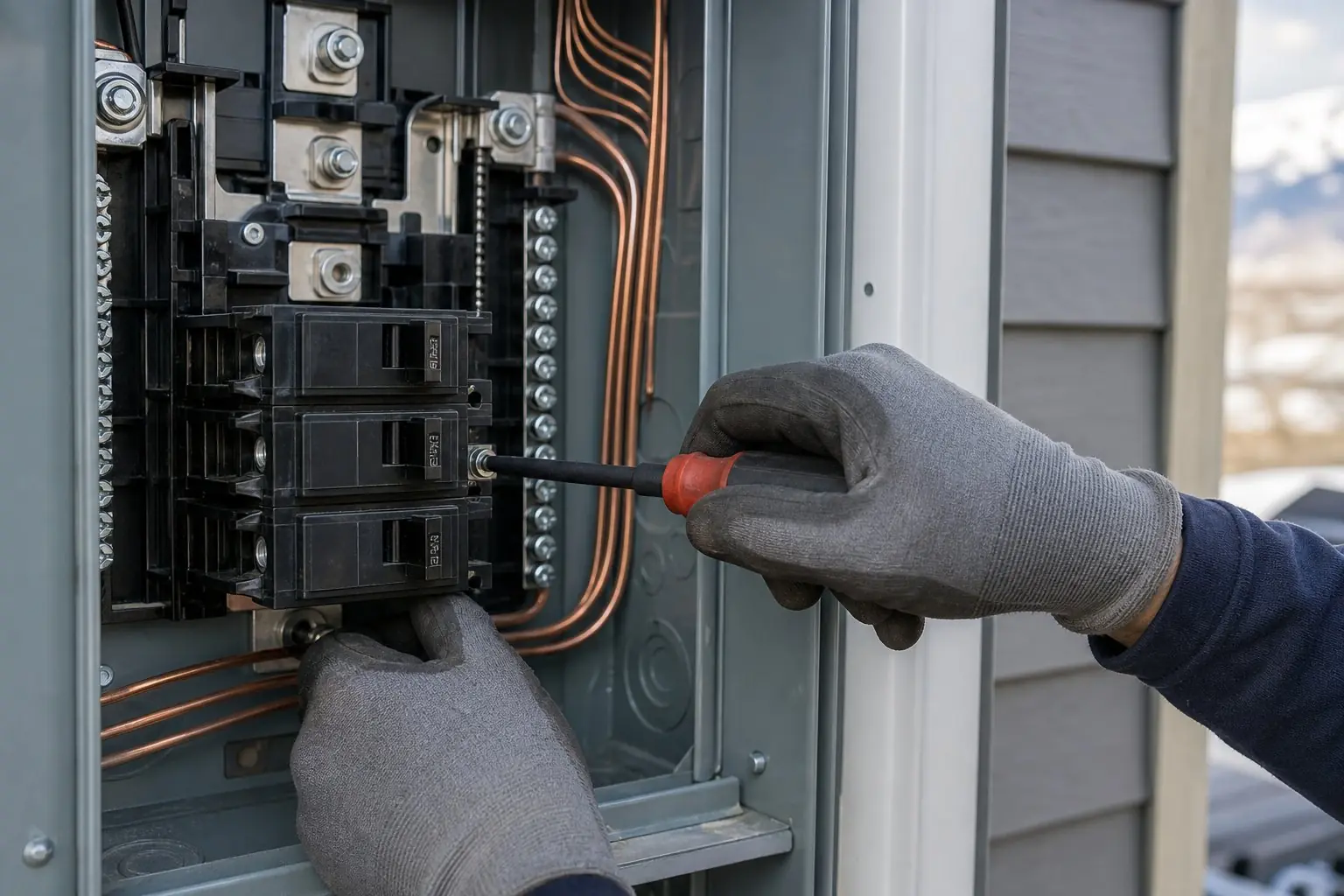
It multiplies with distance. A higher-amp charger needs heavier copper, and a detached garage can mean a run several times longer than an attached one, so the step from 8 AWG to 6 AWG or 4 AWG costs more on every foot. Very long runs can also need a size larger than the minimum to limit voltage drop.
| Charger output | Breaker | Copper in conduit (75°C) | NM-B cable (60°C) |
|---|---|---|---|
| 32 A | 40 A | 8 AWG | 8 AWG |
| 40 A | 50 A | 8 AWG | 6 AWG |
| 48 A | 60 A | 6 AWG | 4 AWG |
From NEC 310.16 ampacities as published by Cerrowire. The breaker must be at least 125 percent of the charger's output. Underground runs use conductors rated for wet locations, not NM-B.
Setting the charger to 32 or 40 amps is one way to keep a long run affordable; see 40 amp vs 48 amp EV chargers.
Will the main panel need work?
Only if the load calculation comes up short. The 2023 NEC counts a charger at 7,200 watts or its nameplate rating, whichever is larger. If that does not fit, an energy management system can be counted at its maximum setpoint instead, which may avoid an upgrade. A panel upgrade is usually the largest single line on any charger job.
Qmerit's March 2026 national guide puts a panel upgrade at $1,500 to $3,000, and HomeAdvisor's June 2026 guide lists $500 to $1,500 for rewiring. These are national figures, not Ogden prices, and neither source prices trenching or a subpanel separately. We did not find a reliable published figure for those, so we do not print one. Compare options on EV charger panel upgrade cost and EV charger load management.
What should a detached garage quote spell out?
The route and length of the trench, the wiring method and depth, wire size and type, single circuit or feeder and subpanel, any panel work and the load calculation behind it, surface restoration, the permit and whether the charger is included. If two quotes differ widely, one usually assumes a different route or a subpanel.
- Trench route, length and depth, and what it crosses
- Conduit or direct-burial cable, and the wire size
- Branch circuit or feeder and subpanel, with grounding electrode if needed
- Panel work, load calculation and whether load management was considered
- Who restores lawn, concrete or pavers
- Permit and inspection, and charger included or not
Permit fees in Ogden scale with the job's valuation under Ordinance 2024-14: $70.50 up to $1,200, then $70.50 plus $2.78 per additional $100 up to $2,000, and $92.75 plus $16 per additional $1,000 from $2,001 to $25,000. Later amendments to that table were not confirmed. Photos of the panel, the yard route and the garage wall let us plan the trench before a visit, and our quote lists each item above. Older Ogden lots are covered in EV charging in older Ogden homes.
Detached garage cost questions
Why does a detached garage cost more than an attached one?
Because the circuit has to leave the house, travel underground and come back up into another building. That adds a trench, burial-rated conduit or cable, protection where the wiring rises out of the ground and, often, larger wire for the longer distance. If you choose a subpanel, the garage also needs its own disconnect and grounding electrode.
Is a subpanel more expensive than a single circuit to the garage?
Usually, because it adds a panel, a disconnect at the garage and a grounding electrode, and the feeder is sized for every load out there, not just the charger. It can still be the better value if you want lights, outlets or a second charger in the garage, since one trench then serves everything.
Can I dig the trench myself to save money?
Ask your electrician and your city first. The depth depends on the wiring method, utility lines must be located before digging, and inspectors often want to see the trench and conduit before it is backfilled. A trench at the wrong depth or with rocky backfill may have to be redone.
What does a detached garage charger installation cost in Ogden?
We do not publish a single number, because trench length, surface type and circuit design vary so much from lot to lot. National guides put a standard Level 2 install at $749 to $2,500 (Qmerit, March 2026), but that assumes a simpler job than most detached garages. A site-specific quote is the only reliable figure.
Garage at the back of the lot? Send a photo of your panel and the path to the garage.
Get a detached garage quote