
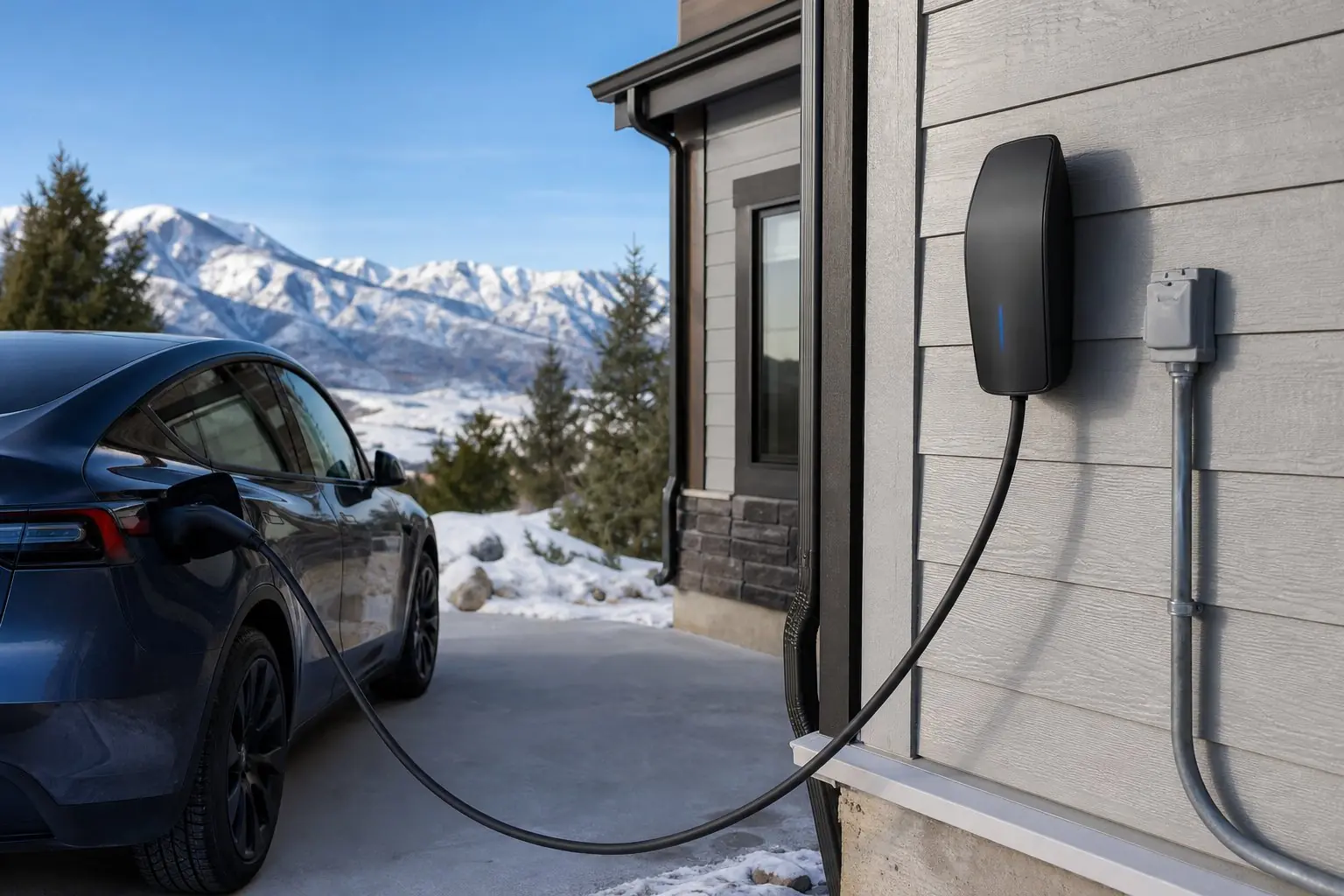
What makes an outdoor charger installation cost more?
Mostly the route and the hardware around the charger, not the charger. Conduit has to come through the wall and run outside with watertight fittings. An outlet needs a weatherproof in-use cover and a GFCI breaker. If no wall is within cable reach of the parking spot, a pedestal and an underground circuit add the largest share.
| Driver | Lower cost | Higher cost |
|---|---|---|
| Mounting spot | Exterior wall beside the parking spot, near the panel | Pedestal at a parking pad, fed underground |
| Route | Panel just inside the wall where the charger mounts | Panel across the house, long exterior conduit run |
| Connection | Hardwired with watertight fittings | NEMA 14-50 with GFCI breaker, in-use cover and weather-resistant receptacle |
| Charger | Model already rated Type 3R or Type 4 | Replacing an indoor-only unit |
| Placement | Covered wall clear of snow shed and plows | Extra height or protection to stay above snow and out of a plow path |
| Approvals | Standard electrical permit | Extra review, such as a historic district or valley lighting question |
For the baseline install and how quotes compare, see EV charger installation cost. Qmerit's March 2026 national guide puts a standard home Level 2 install at $749 to $2,500. That is a national figure, not an Ogden price, and it does not separate outdoor work.
Do you have to pay more for an outdoor-rated charger?
Usually not. The popular home chargers are already rated for outdoor mounting and Utah cold. NEMA Type 3R protects against rain, sleet and snow and is undamaged by ice forming on the enclosure. Type 4 adds windblown dust and hose-directed water. Check the temperature range against where the charger will hang.
| Charger | Enclosure | Operating range | Cable |
|---|---|---|---|
| Tesla Wall Connector (Gen 3) | Type 3R, IP54 | -22°F to 122°F | 24 ft |
| ChargePoint Home Flex | Type 3R | -22°F to 122°F | 23 ft |
| Emporia Pro | Type 4 | -22°F to 122°F | 25 ft |
| Wallbox Pulsar Plus | Type 4 | -22°F to 104°F | 25 ft |
From each manufacturer's install manual or datasheet, checked October 2026. Ratings and placement are explained on outdoor EV charger installation.
Cable length matters for cost too. A charger whose cable reaches the port from the nearest wall can save you a pedestal.
Is an outdoor outlet cheaper than a hardwired charger?
Not automatically. An outdoor EV outlet stacks up three extra parts: a 50 amp two-pole GFCI breaker, an in-use cover that stays weatherproof with the plug inserted, and a weather-resistant receptacle. A hardwired charger needs none of them, only watertight fittings at the charger. ChargePoint recommends hardwiring for outdoor use.
- GFCI breaker: NEC 625.54 requires GFCI protection on every receptacle installed for EV charging. Mike Holt notes the rule applies only to cord-and-plug chargers, so a hardwired unit avoids it.
- In-use cover: as Mike Holt explains the rule in EC&M, a 30 amp or larger receptacle in a wet location feeding an unattended load needs an enclosure weatherproof "with the attachment plug cap inserted or removed." That article predates the 2023 NEC, so confirm with your inspector.
- Receptacle: Leviton's 1450W is the weather-resistant version of its EV-rated 14-50.
- Hardwired: Tesla's manual calls for "watertight fittings when securing feeder wires to the wirebox" outdoors.
The full comparison is on hardwired vs NEMA 14-50, and outlet pricing on NEMA 14-50 installation cost.
How does the wire route change the price?
The shorter and simpler the path from panel to charger, the lower the cost. A panel just inside the wall where the charger mounts is the cheapest case. A panel across the house means a longer run through finished space or along the outside in conduit. Every outdoor fitting and penetration has to be sealed against water.
Amperage multiplies the effect: a 48 amp charger on a 60 amp circuit needs heavier wire than a 32 amp setting, and that difference is paid on every foot. The breaker and wire table is on what size breaker for an EV charger. Panel capacity matters indoors or out; see EV charger panel upgrade cost.
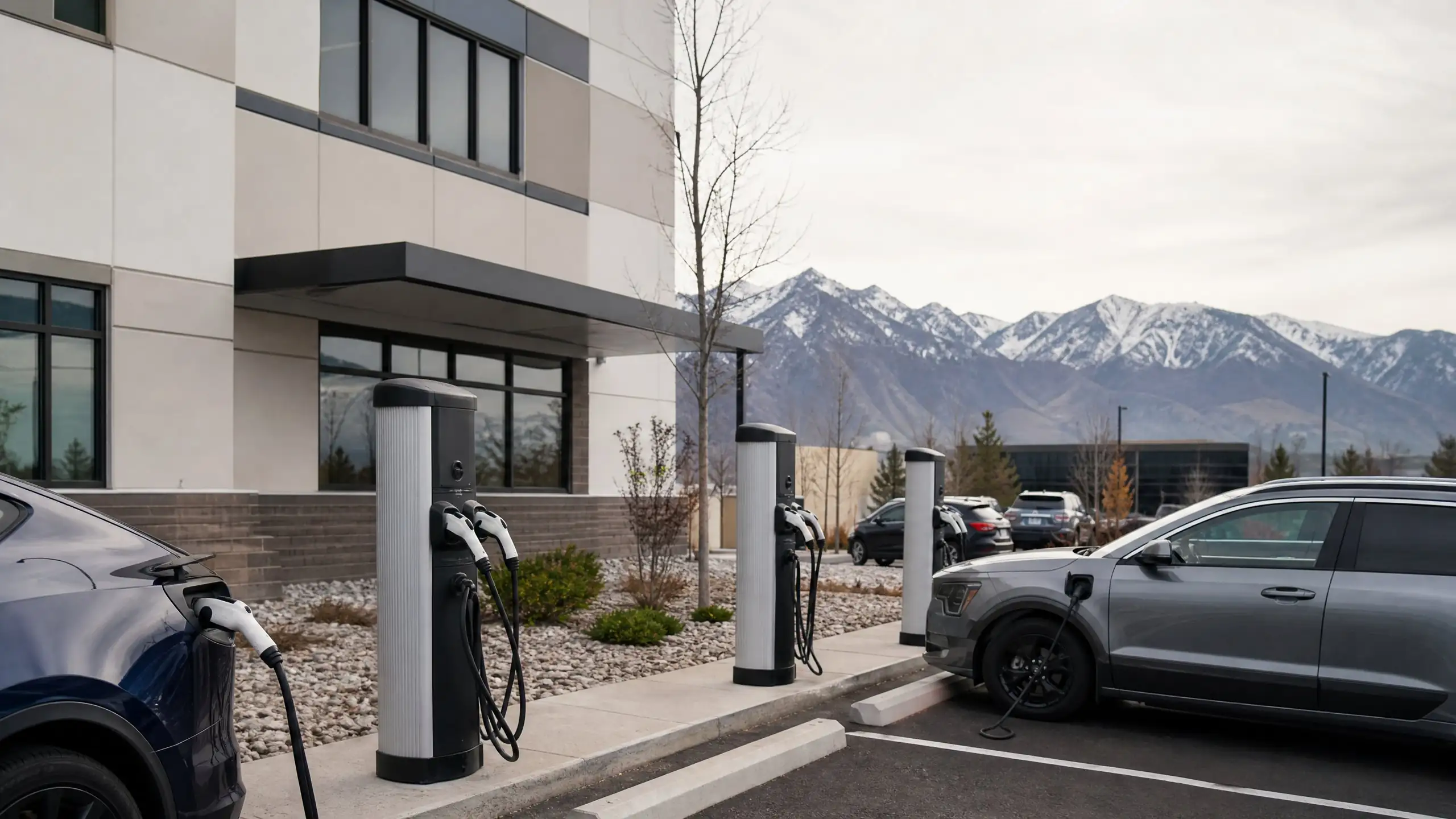
When does a pedestal add to the cost?
When there is no wall within cable reach of where you park, such as a parking pad, a long driveway or a shared lot. You then pay for the pedestal, its footing or mounting and an underground circuit to it. That circuit follows the same trenching and burial rules as a run to a detached garage, so trench length matters as much as the pedestal.
Tesla's manual allows mounting on "a prefabricated pedestal" but says to use fasteners with sealing washers, because "Type 3R rating is only possible when washers have sealing gaskets." Its Universal Wall Connector manual shows two units sharing one pedestal for side-by-side spaces. We did not find a reliable published price for residential pedestals. Trenching costs are explained on detached garage EV charger installation cost.
What does snow and plow protection add?
Mostly planning, sometimes a longer run. Mounting on a covered wall above the shoveled snowbank and out of the plow path may mean a spot a few feet farther from the panel. Tesla allows 24 to 60 inches high outdoors. A cable organizer, sold separately, keeps the cable off the ground.
- Avoid eaves that dump sliding snow onto the charger.
- Keep the charger and conduit out of the plow or blower path.
- Mount on the side where the charge port faces, so the cable never crosses the driveway.
- Check Wi-Fi at the spot with your phone. Tesla notes masonry and metal between charger and router can block it.
Can approvals add cost to an outdoor charger?
Usually only the standard electrical permit, which is valuation-based and small. Two local cases may add a step: a home on the Ogden City Register of historic resources, and a lit charger in Ogden Valley City. Both are unresolved, so ask before you buy.
If your home is on the Ogden City Register, ask Ogden Planning whether an exterior charger, conduit or pedestal needs a Certificate of Historic Appropriateness. In Ogden Valley City, ask the city whether lighting review applies to a charger with indicator lights. Permit steps for each city are on the EV charger permit guide.
Photos of the wall or parking spot, the roofline above it and your panel let us price the route, and our quote lists the charger, conduit, fittings, any pedestal and the permit separately.
Outdoor charger cost questions
Does an outdoor charger cost more than one in the garage?
Often a little, because the conduit runs outside, every fitting has to be watertight and the charger sits where snow and plows can reach it. If the parking spot has no wall within cable reach, a pedestal with an underground feed adds the most. A wall right beside the driveway and close to the panel can cost about the same as an indoor install.
Do I need to buy a special outdoor charger?
Usually not. The common home chargers are already rated for outdoor use: Tesla's Wall Connector and ChargePoint's Home Flex are Type 3R, and Emporia's Pro and Wallbox's Pulsar Plus are Type 4. Check the operating temperature range, especially the top end on a sun-facing wall.
Is an outdoor NEMA 14-50 outlet cheaper than a hardwired charger?
Not necessarily. An outdoor EV outlet needs a 50 amp two-pole GFCI breaker, a cover that stays weatherproof with the plug inserted and a weather-resistant receptacle. A hardwired charger skips all three, and ChargePoint recommends hardwiring for outdoor use.
How much does a charger pedestal cost?
We have not found a reliable published price for residential pedestals, so we do not quote one. The underground circuit to reach it is part of the cost too, and it follows the same trenching and burial rules as a run to a detached garage.
Charging in the driveway? Send a photo of the wall or parking spot and your panel.
Get an outdoor charger quote