
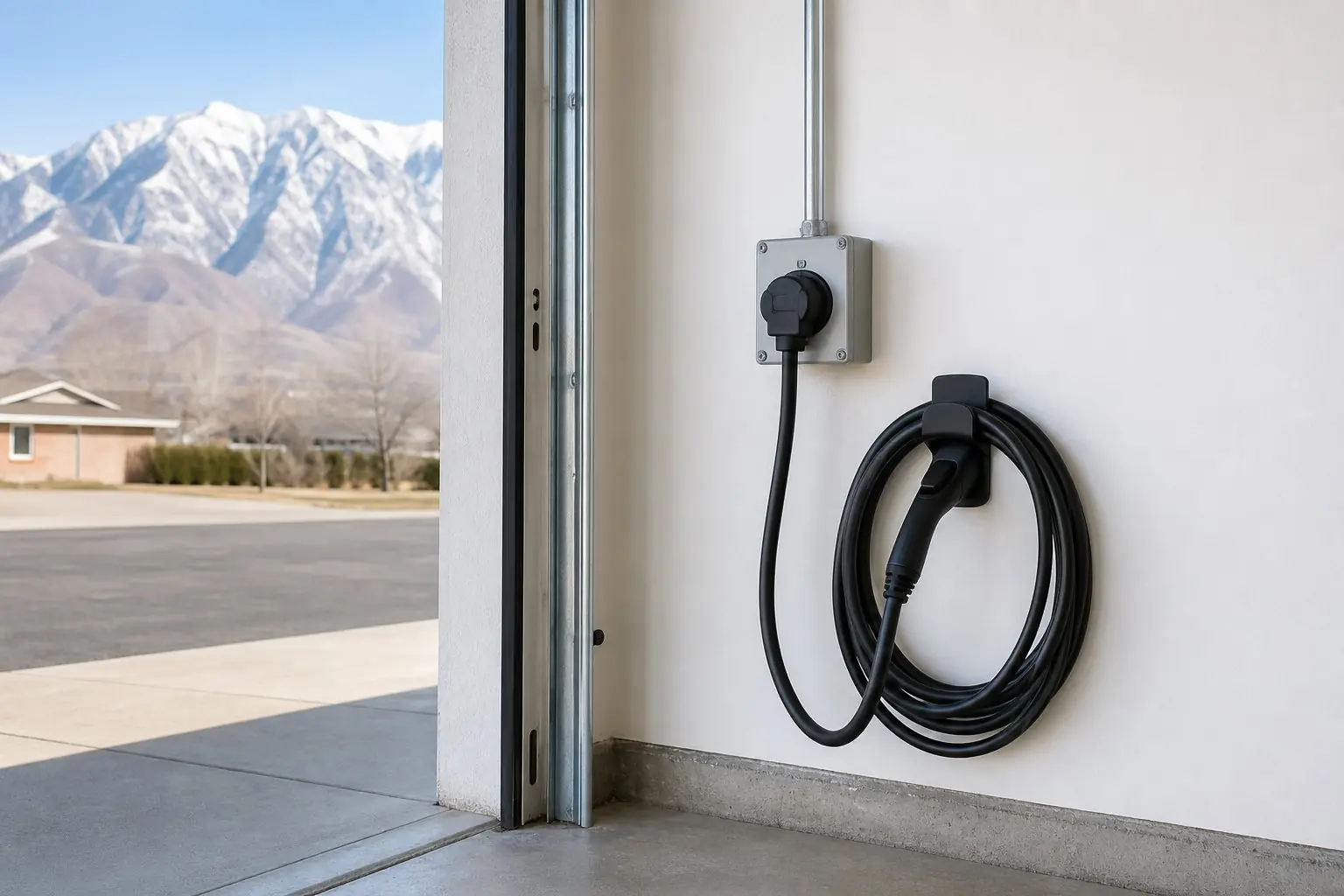
How much does a NEMA 14-50 outlet installation cost?
The circuit costs about what any 50 amp circuit costs: it depends on the distance from the panel, the route and whether the panel has room. What makes an EV outlet different is a short list of parts: a GFCI breaker, an EV-grade receptacle torqued to spec, wire sized for 50 amps and, outside, an in-use cover.
The national cost guides we checked do not price a 14-50 outlet separately from a charger install, so we don't put a national number on it. The dated averages for charger installs, and local permit fees, are on our main EV charger installation cost page. They are averages, not quotes.
Which parts make an EV outlet cost more than a basic one?
Two parts. A two-pole GFCI breaker replaces the standard breaker, because code requires GFCI protection on EV receptacles. And the receptacle should be one built for hours of full load and frequent plugging, with its terminals torqued to the maker's value. Outdoors, add an in-use cover.
| Part | Basic 50 A outlet | EV charging outlet | Why |
|---|---|---|---|
| Breaker | Standard 50 A two-pole | 50 A two-pole GFCI | NEC 625.54, not amended in Utah |
| Receptacle | General duty | EV-rated or industrial grade, such as Hubbell HBL9450A or Leviton 1450R | Hours of full load and frequent plugging |
| Wire | 8 AWG copper in conduit, or 6 AWG NM-B cable | Rated for the 50 A breaker | |
| Outdoors | Standard cover | In-use (bubble) cover; weather-resistant receptacle such as Leviton 1450W | Car plugged in unattended in the weather |
Receptacle details from Hubbell and Leviton product pages. Wire from the NEC 310.16 table published by Cerrowire. NEC 110.14(D) requires a calibrated torque tool where the maker lists a value, 75 in-lb on the Leviton 1450R.
The GFCI breaker
Utah removed 240 volt receptacles from the general GFCI rule, but an outlet installed for a car still falls under NEC 625.54. A quote for an EV outlet with a standard breaker is missing a required part. Breakers are panel-specific, so ask for the breaker to be named on the quote.
There is a second cost to plan for. Most chargers and portable cords have ground-fault protection built in, and some makers warn that a GFCI breaker can cause nuisance trips. ChargePoint says it can, "especially with a plug-in installation," and Emporia says "redundant GFCI protection will cause nuisance tripping." If that happens, the fix they point to is hardwiring the charger, which is a second visit. Removing the GFCI breaker is not a legal fix. See EV charger GFCI tripping.
The receptacle
Hubbell describes the HBL9450A as "designed for plug-in EV charging applications," with 50 percent greater contact force. Leviton says its 1450R "can sustain the necessary extended charge time and high frequency of insertions EV chargers require." Tesla's Mobile Connector manual warns not to plug into a "damaged, loose or worn power outlet." A worn or under-torqued receptacle is a heat risk, so it is a poor place to economize; see NEMA 14-50 outlet getting hot.
What do you get for a 50 amp circuit?
At most 40 amps of charging, because EV charging is a continuous load held to 80 percent of the breaker. Many portable cords draw less: Tesla's Mobile Connector 32 amps and Ford's Mobile Power Cord 30 amps. You pay for a 50 amp circuit either way, so the outlet's value depends on the cord or charger you plug in.
A plug-in wall charger such as the ChargePoint Home Flex runs at 32 or 40 amps on a 14-50. If your car accepts 48 amps and you want all of it, the outlet can't deliver that; you need a hardwired charger on a 60 amp circuit. Compare the two routes on hardwired vs NEMA 14-50 and the hardwired side on Level 2 charger installation cost.
Should the outlet be wired for a hardwired charger later?
It is worth asking, especially on a long run. Wire sized for a 60 amp circuit, 6 AWG copper in conduit or 4 AWG NM-B, costs more now. Later, switching to a 48 amp hardwired charger then means a new breaker and the charger, not new wire. The outlet stays on its 50 amp GFCI breaker until then.
Check that the receptacle accepts the bigger wire. Leviton lists the 1450R for #4, #6 or #8 copper only, and Hubbell lists the HBL9450A for #12 to #4. The breaker-to-wire table is in what size breaker for an EV charger.
What about outdoor outlets and outlets you already have?
Outdoors adds an in-use cover and a weather-resistant receptacle, and many owners hardwire instead. An existing outlet, such as a dryer or RV outlet, can sometimes avoid a new circuit, but it should be checked for receptacle grade, wire size and GFCI protection before nightly charging.
As Mike Holt explains the NEC wet-location rule, a 30 amp or larger receptacle outdoors feeding an unattended load needs an enclosure that is weatherproof "with the attachment plug cap inserted or removed." Tesla also warns against using its Mobile Connector in severe rain or snow. The cost of exterior installs is on outdoor EV charger installation cost. Dryer outlets and other 240 volt receptacles are covered on 240V EV charger outlet installation.
What should a 14-50 quote list?
The breaker type and size, the receptacle make and model, the wire gauge and route, the cover for outdoor outlets, and the permit. If you asked for wire sized for later hardwiring, that should be written down too, so a future installer knows the wire is sized for 60 amps.
- 50 amp two-pole GFCI breaker, named by brand to match your panel
- Receptacle make and model, EV-rated or industrial grade
- Terminals torqued to the maker's value
- Wire gauge and type, and whether it is sized for a future 60 amp circuit
- In-use cover and weather-resistant receptacle for outdoor locations
- Permit and inspection, and who applies for them
Our quotes list the breaker, receptacle, materials, labor and permit as separate lines. The installation itself is described on NEMA 14-50 outlet installation.
NEMA 14-50 installation cost questions
Why does a 14-50 quote for an EV include a GFCI breaker?
Because NEC 625.54 requires GFCI protection on receptacles installed for EV charging, and Utah did not amend that section. For a 14-50 that means a 50 amp two-pole GFCI breaker instead of a standard one. A quote for an EV outlet without one is missing a required part.
Is a 14-50 outlet cheaper than a hardwired charger?
The circuit is similar, so the gap is in the parts and the charger. The outlet adds a GFCI breaker and an EV-grade receptacle; a hardwired charger needs neither. A portable cord you already own can make the outlet the cheaper route overall. Compare both on one quote.
Can I save money with a basic 14-50 receptacle?
It is not a good place to save. Hubbell and Leviton sell 14-50 receptacles designed for plug-in EV charging, with more contact force and higher insertion ratings, and Tesla warns not to plug its Mobile Connector into a damaged, loose or worn outlet. A loose receptacle is a heat risk.
Do I need a permit for a 14-50 outlet?
Yes. A new 240 volt circuit is permitted electrical work in Ogden, South Ogden, North Ogden and Ogden Valley City. The fee is based on the project's valuation, and the work is inspected. Fee rules for each city are on our EV charger installation cost page.
Want a 14-50 priced for your garage? Tell us your car, the cord or charger you plan to use, and where you park.
Get a 14-50 outlet quote