
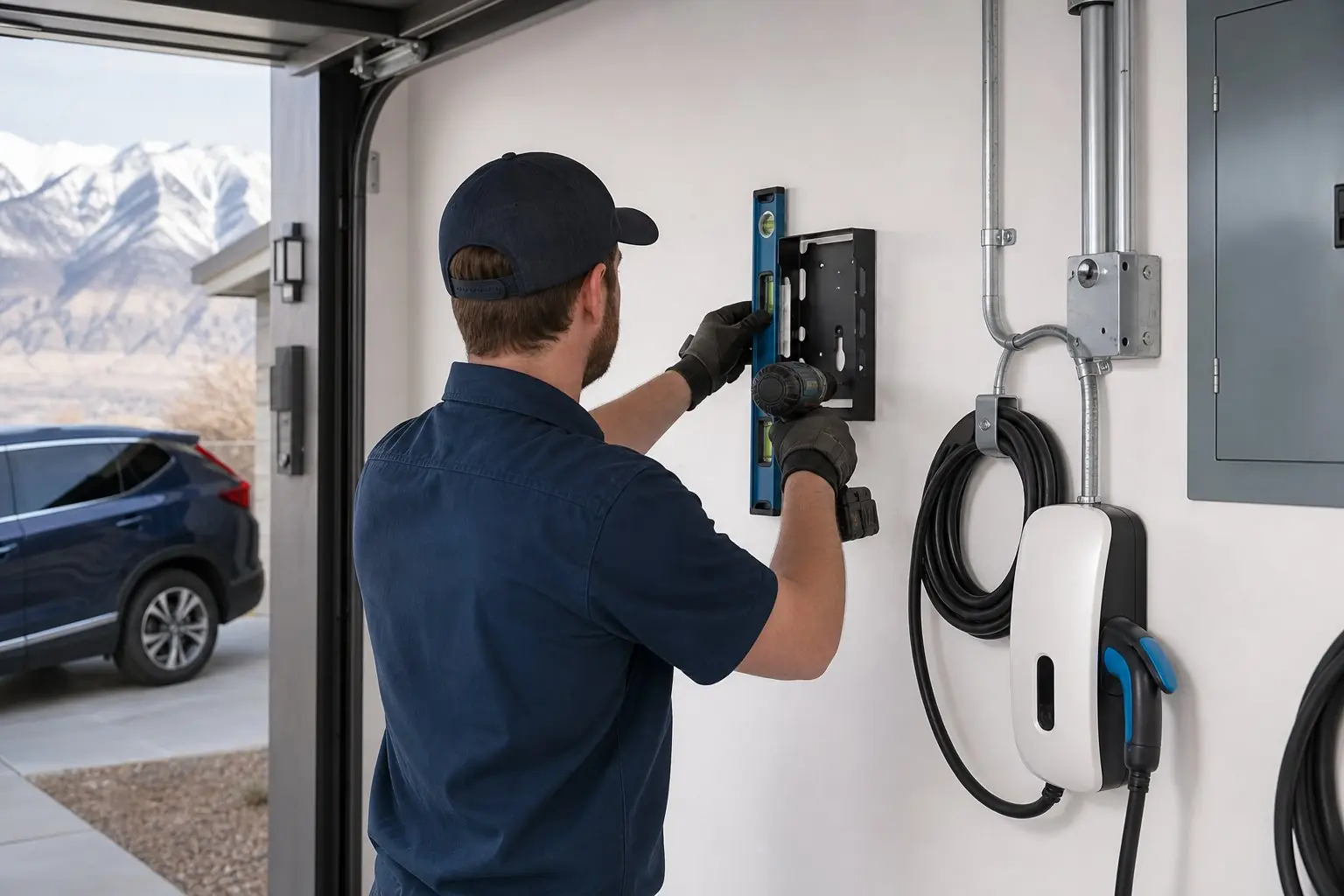
How much does EV charger installation cost?
It depends mostly on two things: how far the circuit runs from your panel to the parking spot, and whether the panel has room for the charging load. A short run in an attached garage with panel capacity to spare is the low end. Long runs, trenching, finished walls and panel or service upgrades push it up. The charger may or may not be in the number.
To see which of these factors apply to you, try the installation complexity estimator.
National cost guides give a rough frame. These are national averages, not a quote, and not Ogden prices:
- Qmerit (March 18, 2026): a home Level 2 install ranges from $749 to $2,500, with an average of $1,700. Its breakdown lists hardware at $300 to $900, labor and permitting at $500 to $1,200, and materials (conduit, wire, breaker) at $200 to $500. It puts a panel upgrade at $1,500 to $3,000.
- HomeAdvisor (updated June 20, 2026): an average of $967, with a typical range of $554 to $1,380, from a survey of its customers. The page does not clearly say whether that figure includes the charger, and the same page lists $700 to $2,000 for a Level 2 unit, so treat it with care.
Local advertised ranges vary just as widely, partly because some include the charger and some do not. The useful question is not "what's the average" but "which of the variables below apply to my house."
What makes one installation cost more than another?
Distance, panel capacity and amperage set most of the price. After that come the route the wire takes, whether the garage is detached, outdoor-rated parts, hardwired versus outlet, and whether load management or a panel upgrade is needed. Permit fees are a small, fixed part of the total.
| Variable | Lower cost | Higher cost |
|---|---|---|
| Distance from panel | Panel in the garage or just behind the wall | Panel in a basement across the house, or a long run to the far end of the garage |
| Panel capacity | Space for a two-pole breaker and spare capacity on the load calculation | Full panel, short capacity, subpanel or service upgrade |
| Amperage and wire | 32 amp charger on a 40 amp circuit (8 AWG) | 48 amp charger on a 60 amp circuit (6 AWG in conduit or 4 AWG NM-B) |
| Route | Open studs, unfinished garage, surface conduit | Finished drywall, attics, crawlspaces, patching |
| Detached garage | Not needed | Trenching, burial-rated conduit, sometimes a garage subpanel |
| Location | Indoor garage wall | Outdoor, with weather-rated charger, fittings and cover |
| Connection | Hardwired charger on a standard breaker | NEMA 14-50 outlet, which in Utah needs a GFCI breaker |
| Permit | Small valuation-based fee | Extra plan review or re-inspection fees |
Amperage and wire size
A charger needs a breaker at 125 percent of its output, and the wire must be rated for that breaker. Going from a 40 amp to a 60 amp circuit moves the copper from 8 AWG to 6 AWG in conduit, or from 8 AWG to 4 AWG in NM-B cable. Over a long run, that difference adds up. See what size breaker for an EV charger for the full table.
Detached garages and outdoor installs
Ogden City's plans for older neighborhoods describe garages set at the back of the lot and often detached. Reaching them usually means a trench, conduit rated for burial and sometimes a subpanel. Outdoor chargers need weather-rated equipment and a protected spot. Details on garage EV charger installation and outdoor EV charger installation.
Hardwired or NEMA 14-50
An outlet is not automatically cheaper. In Utah, a receptacle installed for EV charging needs GFCI protection, which means a 50 amp two-pole GFCI breaker, and some charger makers recommend hardwiring to avoid nuisance trips. Compare both on the NEMA 14-50 installation page.
Load management versus a panel upgrade
A panel or service upgrade is usually the largest line on a charger job. The 2023 NEC (220.70) lets a load calculation count an energy management system's maximum setpoint instead of the charger's full rating, which can keep a charger inside the capacity you already have. Read EV charger load management and EV charger panel upgrade cost before agreeing to a new panel. If the service itself needs upgrading, Rocky Mountain Power has to be involved (1-888-221-7070).
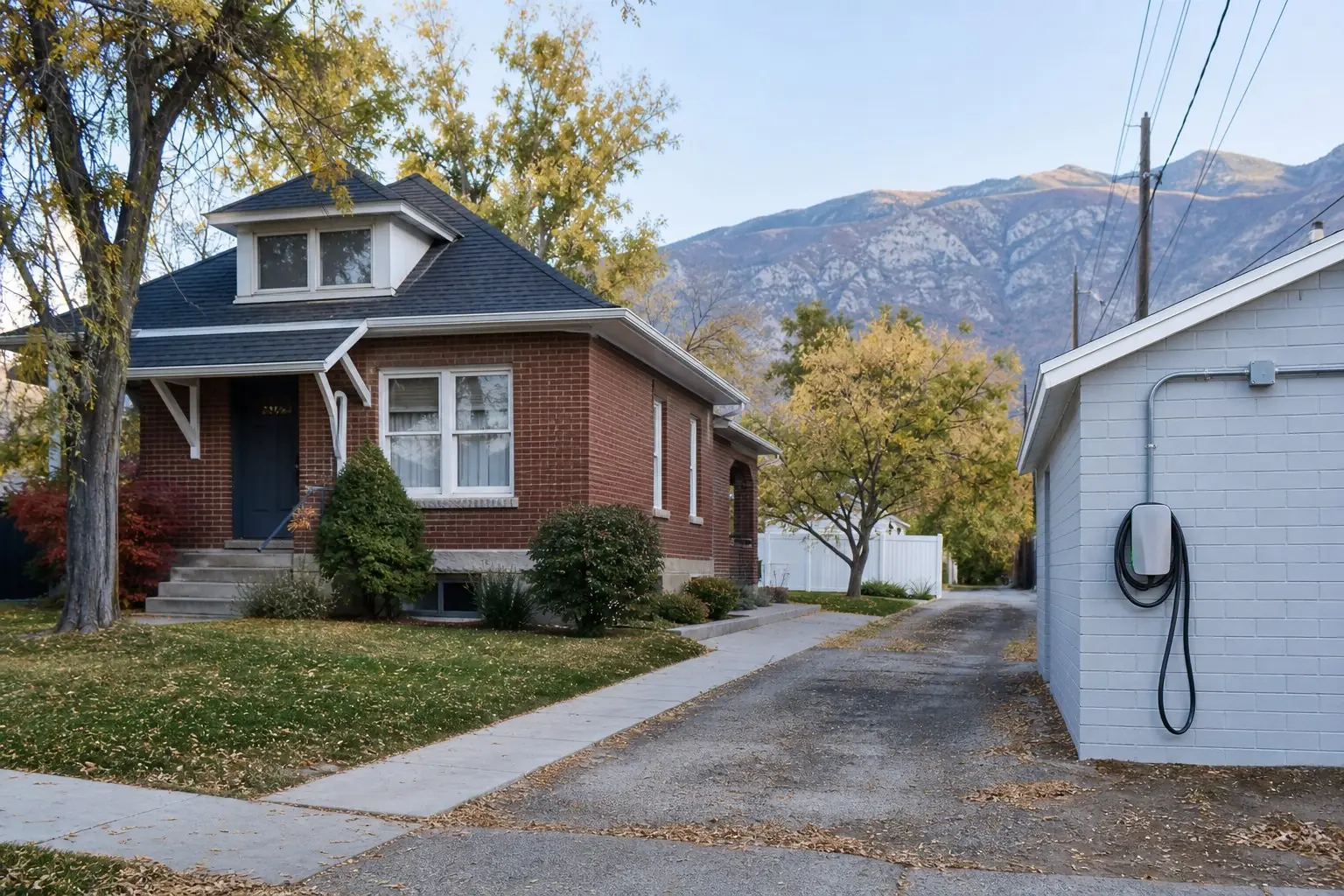
How much are permit fees?
Permit fees are based on the project's valuation and are a small part of the total. Ogden City's minimum is $70.50 for valuations up to $1,200 under Ordinance 2024-14. North Ogden's minimum building permit fee is $56.40 plus a 1 percent state fee under Resolution 05-2026. Fees change, so check with the city.
- Ogden City: Ordinance 2024-14 (May 2024) lists $70.50 for valuations from $1 to $1,200, then $70.50 plus $2.78 for each additional $100 up to $2,000, with plan review charged separately where it applies. Ogden collects a $70.50 deposit at application that is deducted from the final permit price. Later amendments to the fee table were not confirmed.
- North Ogden: Resolution 05-2026 (effective May 13, 2026) sets a minimum building permit fee of $56.40, a re-inspection fee of $56.40 and a state fee of 1 percent of the permit fee.
- South Ogden and Ogden Valley City (Eden): no published fee schedule was found online. Call the building office for the current amount.
Process and contacts for each city are in our Ogden EV charging guide.
What should a quote include?
A useful quote names the circuit size, the charger setting, the wire size and route, the breaker type, any panel work, the permit and whether the charger itself is included. If a quote recommends a panel upgrade, it should say why, based on a load calculation.
The biggest source of confusion is the charger. Some installers price labor and materials only and expect you to bring the charger; others include one. Our quotes list the charger, materials, labor, permit and any panel work as separate lines, so you can see what you are paying for.
How do you compare three quotes?
Put them side by side and check that they price the same job: same charger setting and breaker, same route, same panel plan, permit included or not, charger included or not. Most big gaps come from one quote assuming a panel upgrade or a different route.
- Is the charger included? Which model and output?
- What breaker size, and what charger amperage setting?
- What wire size and type, and what route from the panel?
- Hardwired or NEMA 14-50? If an outlet, is a GFCI breaker included?
- Is a panel or service upgrade included? Is there a load calculation behind it, and was load management considered?
- Trenching, subpanel, drywall patching: included or extra?
- Is the permit and inspection included, and who applies for it?
- What happens if conditions differ from what the quote assumed?
Are there rebates or tax credits?
For homes, not on the charger. Rocky Mountain Power removed its residential charger rebate effective January 1, 2026, and the federal 30C credit does not apply to chargers placed in service after June 30, 2026. Rocky Mountain Power's commercial, workplace and multifamily charger incentives are open, subject to available funds.
Ended Rocky Mountain Power residential charger rebate (effective January 1, 2026). Federal 30C credit for chargers placed in service after June 30, 2026. If your charger was in service by June 30, 2026, ask your tax professional.
Open Rocky Mountain Power's Utah commercial incentives list up to $1,000 per single-port Level 2 charger and $1,500 per dual-port charger (up to 75 percent of charger cost), for chargers bought on or after January 1, 2026 and installed behind a meter that is not on a residential rate. See commercial EV charger installation.
For households, Rocky Mountain Power's Wattsmart Drive pays enrolled EV owners up to $100 in the first year and up to $50 a year after that for managed charging. It is a bill credit, not an installation rebate.
EV charger installation cost questions
Why are EV charger installation quotes so different?
Because they often price different jobs. One quote may include the charger and another may not. One may assume a short run in an attached garage, another a trench to a detached garage or a panel upgrade. Comparing the circuit size, run length, panel work, permit and hardware line by line usually explains the gap.
Does the installation cost include the charger?
Sometimes. Some installers quote labor and materials only and expect you to supply the charger, others include a charger they supply, and advertised local ranges mix both. Ask every installer to state in writing whether the charger is included, and which model, before you compare totals.
Is there still a rebate for a home EV charger in Utah?
Not from Rocky Mountain Power. Its residential charger rebate was removed effective January 1, 2026, and the federal 30C credit does not apply to chargers placed in service after June 30, 2026. Rocky Mountain Power's Wattsmart Drive program does pay a managed-charging bill credit to enrolled EV owners.
How much is an electrical permit for an EV charger in Ogden?
Ogden City's permit fees are based on project valuation. Under Ordinance 2024-14 the minimum electrical permit fee is $70.50 for valuations up to $1,200, and Ogden collects a $70.50 deposit at application that is credited to the final fee. Fees change, so confirm with the city before budgeting.
Will I need a panel upgrade?
Not necessarily. A load calculation shows whether your panel can carry a charger. When capacity is short, a lower charger setting or a load management device can often avoid a panel or service upgrade, which is usually the largest single cost on a charger job.
Want a number for your house? Your car model, a panel photo and where you park are the best start.
Get an installation quote