
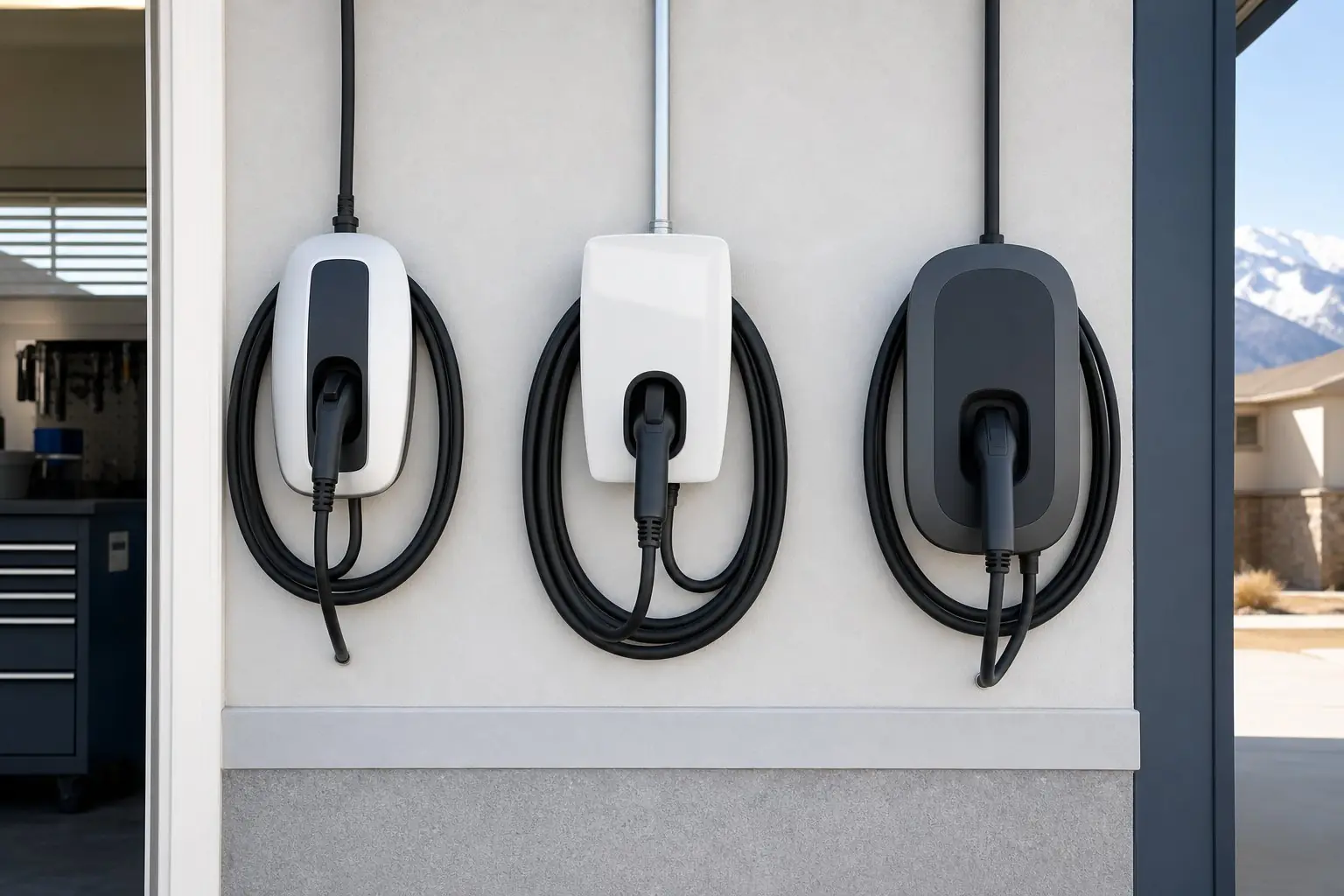
When does replacing an EV charger make sense?
Four situations cover most replacements: the charger has failed and is out of warranty, its maker no longer supports it, a new car can charge faster than the old unit allows, or a mixed garage needs a different connector. In each case the first question is the same: can the existing circuit stay?
If you are not sure the charger is the problem, diagnose before you buy. A loose connection, worn receptacle or wrong breaker can make a good charger look dead. See EV charger repair for how that gets sorted out.
If you are unsure whether your charger's maker still supports it, check its support status with the maker. A charger in that position may keep charging as a basic unit, but when it fails there may be no warranty path left.
Can the new charger reuse the existing circuit?
Yes, when three things match: the breaker is at least 125 percent of the new charger's output, the wire is rated for that breaker, and the circuit serves only the charger. A like-for-like swap, such as a 40 amp charger replacing a 40 amp charger on a 50 amp circuit, often reuses everything up to the wall.
EV charging is a continuous load, so NEC 625 sets the breaker at no less than 125 percent of the charger's rating, and a charger rated over 16 amps needs its own branch circuit. Most current chargers let the installer set the output, so a new unit can be dialed to suit the circuit you already have. Tesla's Gen 3 and Universal Wall Connectors, for example, are set to the breaker size in software during commissioning, while the older Gen 2 used an internal rotary switch.
What gets checked before reuse:
- The breaker rating and type, and its condition. ChargePoint's installer guidance says to use only new breakers when one is replaced.
- The wire size and type, read from the cable jacket or conductor markings.
- Whether the new charger's terminals accept that wire. Tesla's terminals take 12 to 4 AWG copper only.
- The mounting spot and cable reach, since the new unit's cable length and wire entry may differ.
- The connections, re-terminated and torqued to the new charger's specification.
When does the wire have to change?
When the new charger needs a bigger breaker than the wire can carry. Going from 40 to 48 amps of charging means a 60 amp breaker, and that needs at least 6 AWG copper in conduit with 75°C terminations, or 4 AWG NM-B cable. A circuit run in 6 AWG NM-B tops out at 55 amps.
| Charger output | Breaker | Copper in conduit (75°C) | NM-B cable (60°C) |
|---|---|---|---|
| 32 A | 40 A | 8 AWG | 8 AWG |
| 40 A | 50 A | 8 AWG | 6 AWG |
| 48 A | 60 A | 6 AWG | 4 AWG |
Ampacities from NEC Table 310.16 as published by Cerrowire. Long runs may need larger wire for voltage drop, and the charger maker's manual can set its own minimum.
Before paying for new wire, check whether more amps help at all. Many cars cap Level 2 charging at a set current, and a charger above that cap adds nothing. Our vehicle charging guides list what each model accepts, and 40 amp vs 48 amp chargers covers the trade-off. A bigger circuit may also need a load calculation; load management is often an alternative to a panel upgrade.
Can you convert a plug-in charger setup to hardwired?
Usually, on the same circuit. The 14-50 receptacle is removed and the wire lands directly on the charger. Because NEC 625.54 requires GFCI only on receptacles for EV charging, the GFCI breaker can typically become a standard breaker, which several charger makers specify for hardwired installs.
Two common reasons to convert: nuisance tripping from a GFCI breaker stacked on the charger's own ground-fault protection, and a worn receptacle. Emporia says to "always use a standard non-GFCI breaker" when hardwiring, and ChargePoint recommends hardwiring "if local codes require a GFCI breaker for plug-in installation." A plug-in install is also capped by the receptacle circuit: a 14-50 on a 50 amp breaker allows 40 amps, and ChargePoint lists the plug-in Home Flex at 32 or 40 amps only. The full comparison is on hardwired vs NEMA 14-50.
Going the other way, from a hardwired unit to a 14-50 receptacle, means adding a GFCI breaker and an EV-rated receptacle. Tesla's Wall Connectors are hardwired only, so they cannot be converted to plug-in. See hardwired EV charger installation for the hardwired side.
What happens on replacement day?
The breaker is switched off and the circuit tested dead before the old unit comes off the wall. Its wire is checked for heat damage at the terminals, since a failed charger sometimes failed because of a bad connection. If the new unit has a different footprint or wire entry, the box or conduit fitting may change. The new charger is mounted, the conductors are landed and torqued, and the output is set to match the breaker. Then comes a test charge, and app or Wi-Fi setup if the charger has them. For a mixed garage, this is also the moment to pick the connector: see home EV chargers compared.
Replacing a Tesla Wall Connector
A Gen 2 or early Gen 3 unit can often be replaced by a current Gen 3 or Universal Wall Connector on the same circuit if the breaker is 60 amps or less and the wire suits it. Older Gen 3 units may have an 8.5 or 18 foot cable against today's 24 feet, so the mounting spot may move. Details are on Tesla Wall Connector installation and the Wall Connector specs page.
Does replacing a charger need a permit?
Ogden City lists permits as required to "Alter, Change, Extend, Install, Repair, Replace" an electrical system, and South Ogden's rule names replacing electrical systems too. A new breaker, new wire or a receptacle removal fits those lists. Swapping a charger onto an unchanged circuit is less clear-cut, so check with your city.
We apply for the permit when one is needed and schedule the inspection. If you already bought the new charger, say so when you request a quote; we can install a charger you supply.
EV charger replacement questions
Can a new charger use my old charger's circuit?
Yes, when the ratings line up. If the new charger runs at the same or lower current and the breaker and wire are rated for it, the swap is mostly removing one unit and mounting the other. The charger's amperage must then be set to match the breaker, at no more than 80 percent of it.
I want 48 amps instead of 40. What changes?
The breaker goes from 50 to 60 amps, and the wire must be rated for 60. In conduit with 75°C terminations that means at least 6 AWG copper. In plastic-sheathed NM-B cable it means 4 AWG, because 6 AWG NM-B is rated 55 amps. Also check that your car can accept 48 amps.
Can I switch from a plug-in charger to a hardwired one?
Usually, on the same circuit. The receptacle comes out, the wire is landed directly on the charger, and the GFCI breaker that the receptacle required can typically be replaced with a standard one, since hardwired chargers have ground-fault protection built in and several makers call for a non-GFCI breaker.
Do I need a permit to replace a charger?
Ogden City lists electrical permits as required to alter, change, extend, install, repair or replace an electrical system, and South Ogden's rule also names replacing. Changing a breaker or wire falls under that wording; for a straight swap on an unchanged circuit, check with your city.
Replacing a charger? Tell us the old and new models and send a photo of the breaker, and we can tell you what can stay.
Get a charger replacement quote