
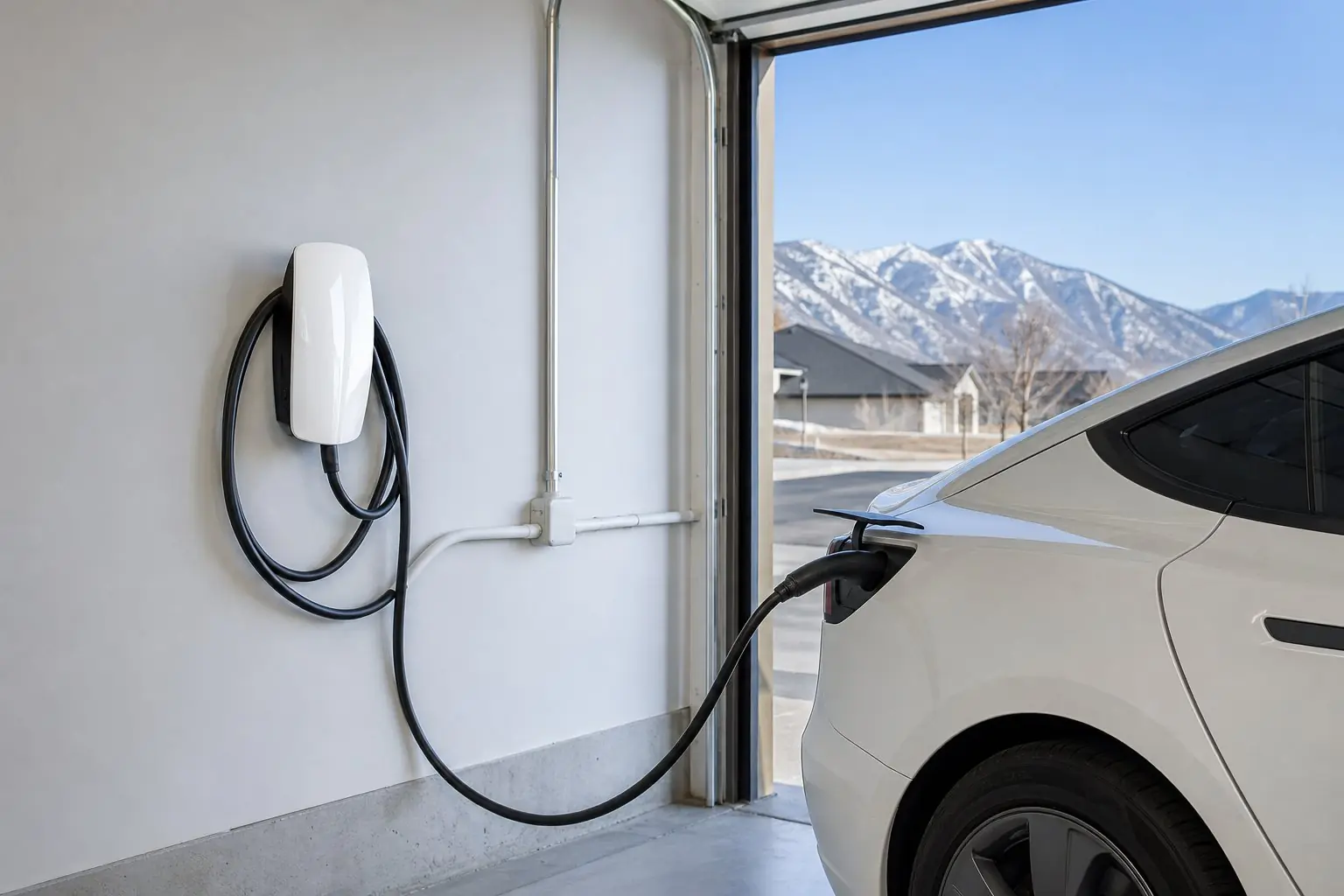
What is the difference between the Tesla Wall Connector and the ChargePoint Home Flex?
Both are 240 volt Level 2 chargers rated for outdoor use. The Wall Connector is hardwired only and tops out at 48 amps; the Universal version adds a J1772 adapter for non-Tesla cars. The Home Flex reaches 50 amps hardwired, comes in plug-in versions capped at 40 amps, and is sold with either a J1772 or a NACS connector.
| Spec | Tesla Wall Connector (Gen 3 and Universal) | ChargePoint Home Flex (CPH50) |
|---|---|---|
| Max output | 48 A, 11.5 kW | 50 A, 12 kW (hardwired) |
| Breaker at max output | 60 A | 70 or 80 A |
| Power connection | Hardwired only | Hardwired, NEMA 14-50 or NEMA 6-50 |
| Plug-in limit | No plug-in version | 32 or 40 A |
| Connector | Gen 3: NACS. Universal: NACS plus docked J1772 adapter | J1772 or NACS (one per unit) |
| Cable | 24 ft | 23 ft |
| Enclosure | Type 3R, IP54 | Type 3R |
| Operating temperature | -22°F to 122°F | -22°F to 122°F |
| Wireless | 2.4 GHz Wi-Fi | 2.4 and 5 GHz Wi-Fi, plus Bluetooth |
| Weight | 10 lb (Gen 3); about 13 lb (Universal) | 13.8 lb |
| Wire terminals | 12 to 4 AWG copper | Max 6 AWG |
| Warranty | 48 months personal use | 3 years parts |
Tesla figures are from its current Gen 3 and Universal Wall Connector manuals; ChargePoint figures from its April 2025 Home Flex datasheet and installation pages. Prices are left out because they change often.
Full specs are on our Tesla Wall Connector and ChargePoint Home Flex pages.
Which one charges faster?
For most cars, neither. A charger cannot push more current than the car's onboard charger accepts, and both units deliver 48 amps on a 60 amp breaker. The Home Flex's extra step to 50 amps needs a 70 or 80 amp breaker and only helps a car that accepts more than 48 amps.
Below the top, either can run at 32 or 40 amps on a smaller breaker. Check your car's rating in our vehicle charging guides, and see 40 amp vs 48 amp EV charger before paying for the larger circuit.
Do you want a plug-in charger?
If so, the Home Flex is the only one of the two that offers it. Tesla's manuals say: "Hardwire branch circuits to disconnects or circuit breakers. Do NOT install cord-and-plug type connections." The Home Flex comes in NEMA 14-50 and 6-50 versions, limited to 32 or 40 amps, that you can unplug and take with you.
There is a catch in Utah. The 2023 NEC that Utah adopted requires GFCI protection on receptacles installed for EV charging, and ChargePoint warns a GFCI breaker "can cause nuisance breaker tripping." Its own advice where code requires one is "a hardwire installation." Hardwired, both chargers use a standard breaker: ChargePoint says to use a non-GFCI breaker, and Tesla's 2020 Gen 3 manual says not to install a GFCI breaker ahead of the unit. The wider trade-off is on hardwired vs NEMA 14-50.
Which works better in a garage with a Tesla and another EV?
The Universal Wall Connector, if one car has a J1772 port. It carries a NACS handle and a docked J1772 adapter, so both cars plug in without a loose adapter. A Home Flex comes with one connector, J1772 or NACS, so one of the two cars would need an adapter rated for Level 2 AC charging.
Check any adapter's rating first. Ford lists its NACS adapter for the F-150 Lightning as "not compatible with Level 1 or Level 2 AC chargers," so a Lightning needs a J1772 Home Flex or a Universal Wall Connector. ChargePoint also sells a kit that converts an existing J1772 Home Flex to NACS. The Tesla choice between its two units is on Universal Wall Connector vs Wall Connector.
What changes for the electrician?
Three things: how the amperage is set, wire size at the terminals, and Wi-Fi. Tesla's breaker size is entered in the Tesla One installer app during commissioning. The Home Flex is set in the ChargePoint app, or over Bluetooth if there is no Wi-Fi. Tesla's terminals take up to 4 AWG copper; ChargePoint's take no larger than 6 AWG.
ChargePoint requires a new, dedicated two-pole breaker and warns a wrong setting can trip it mid-session. On Wi-Fi, the Wall Connector uses 2.4 GHz only, while the Home Flex supports 2.4 and 5 GHz, two bands to try in a garage with a weak signal.
What about two EVs on one panel?
Tesla's manuals describe power sharing for up to six Wall Connectors over Wi-Fi, each on its own circuit of up to 60 amps, plus daisy chaining on one 60 amp circuit for Universal units only. The Home Flex documents we reviewed did not cover sharing between units, so ask ChargePoint before planning on it.
Check ChargePoint's documentation for power-sharing options before planning on a second unit. See EV charger load management.
Which is better outdoors in Ogden Valley?
They are rated the same: Type 3R enclosures and an operating range of -22°F to 122°F, which covers Eden winters and Ogden summers. The difference is the power connection. Outdoors, a hardwired unit avoids an exposed plug, and ChargePoint says hardwiring "is recommended for outdoor use." Both Tesla units are hardwired anyway.
More on placement and snow on outdoor EV charger installation.
Pros and cons side by side
| Factor | Tesla Wall Connector | ChargePoint Home Flex |
|---|---|---|
| Top output | 48 A on a 60 A breaker | 50 A, but needs a 70 or 80 A breaker |
| Plug-in option | None; hardwired only | NEMA 14-50 or 6-50, up to 40 A |
| Mixed garage | Universal unit has both connectors | One connector per unit |
| Multiple units | Power sharing for up to six | Not confirmed in documents we read |
| Wi-Fi | 2.4 GHz only | 2.4 and 5 GHz, plus Bluetooth setup |
| Warranty | 48 months personal use | 3 years parts |
Choose a Tesla Wall Connector if
- You drive a Tesla or a native NACS car, or need both connectors on one unit (Universal).
- You plan a second unit later and want Tesla's power sharing.
- A hardwired install suits you and your car accepts no more than 48 amps.
Choose a ChargePoint Home Flex if
- You want a plug-in charger you can take with you, and your car is fine at 40 amps or less.
- Your car accepts more than 48 amps and your panel can spare a 70 or 80 amp circuit.
- You want the electrician to be able to set the amperage over Bluetooth, even with no Wi-Fi in the garage.
Tesla Wall Connector vs Home Flex questions
Is the ChargePoint Home Flex faster than a Tesla Wall Connector?
Only for a car whose onboard charger accepts more than 48 amps. The Home Flex reaches 50 amps (12 kW) hardwired on a 70 or 80 amp breaker, while the Wall Connector tops out at 48 amps (11.5 kW) on a 60 amp breaker. A car limited to 48 amps or less charges at the same speed on either.
Can a non-Tesla EV use a Tesla Wall Connector?
A J1772-port car can use the Universal Wall Connector, which has a J1772 adapter docked on the unit. The Gen 3 Wall Connector has only a NACS handle, so it suits Teslas and cars with native NACS ports. Ford's NACS adapter for the F-150 Lightning is DC only and will not work on either Tesla unit's NACS handle.
Which one can plug into a NEMA 14-50 outlet?
Only the Home Flex. ChargePoint sells NEMA 14-50 and NEMA 6-50 versions limited to 32 or 40 amps. Tesla's Gen 3 and Universal manuals say to hardwire the branch circuit and not to install cord-and-plug connections.
Which has the longer warranty?
Tesla's manuals give the Wall Connector 48 months for normal personal use and 12 months for commercial use. ChargePoint's datasheet lists a three-year parts warranty for the Home Flex. Read each company's current terms before you buy.
Still deciding? Tell us your car, where it parks and send a photo of your panel.
Get a charger installation quote