
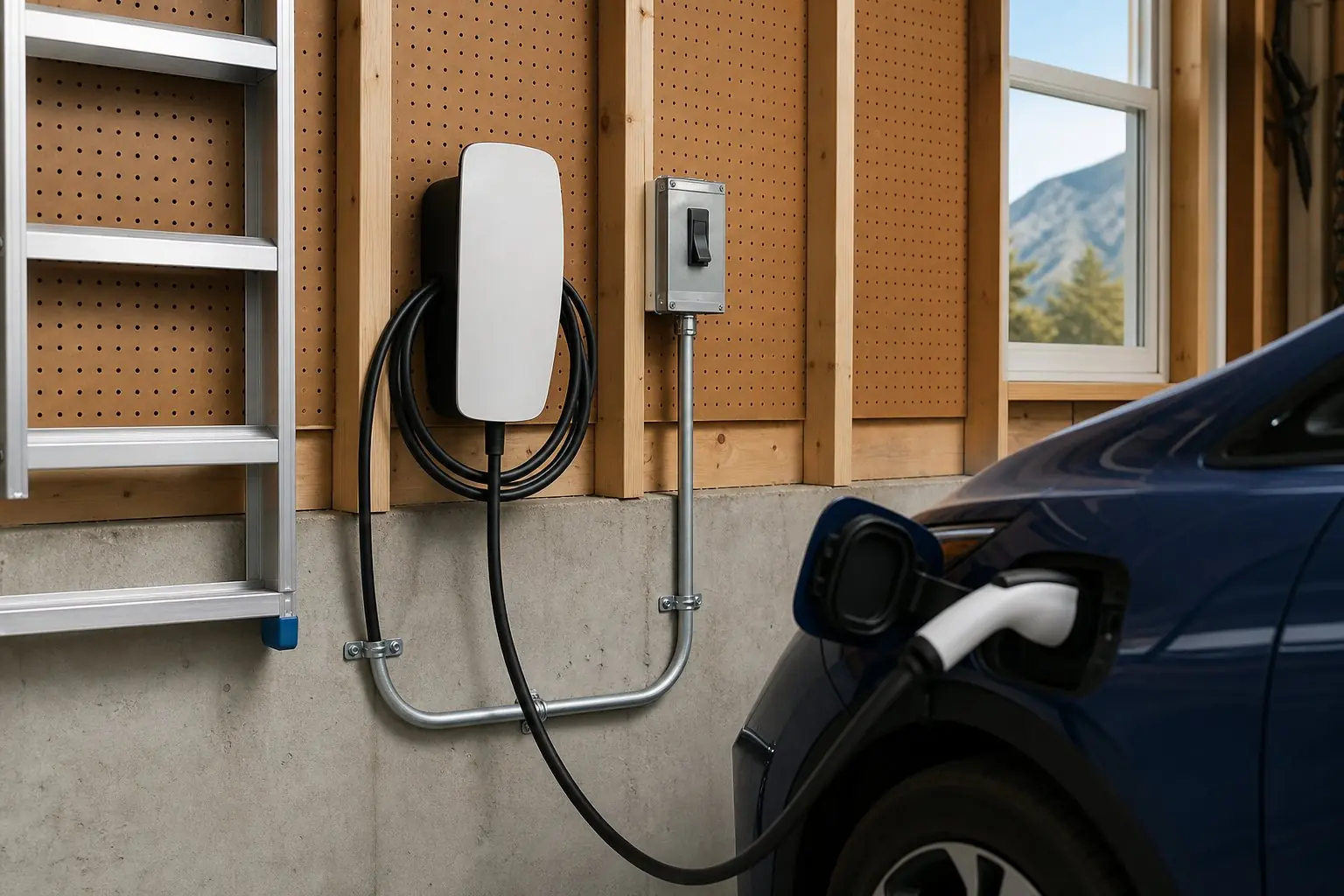
What are the ChargePoint Home Flex specs?
The Home Flex (model CPH50) charges at up to 50 amps, or 12 kW at 240 volts, when hardwired. Plug-in versions are capped at 40 amps. It has a 23 foot cable, a Type 3R enclosure, an operating range of -22°F to 122°F, and comes with a J1772 or NACS connector. ChargePoint lists a three-year parts warranty.
| Spec | ChargePoint Home Flex (CPH50) |
|---|---|
| Versions | J1772 or NACS, each as hardwired, NEMA 14-50 or NEMA 6-50 |
| Output | 16, 24, 32, 40, 48 or 50 A; up to 12 kW |
| Plug-in limit | 32 or 40 A |
| Input wiring | L1, L2 and ground; no neutral |
| Cable | 23 ft |
| Enclosure | Type 3R (UL 50E) |
| Operating temperature | -22°F to 122°F |
| Ground fault | 20 mA CCID with auto retry |
| Wi-Fi | 2.4 and 5 GHz, plus Bluetooth |
| Weight | 13.8 lb |
All six order codes in ChargePoint's April 2025 datasheet are the same 50 amp station. What differs is the connector and how it gets power. That matters because the power connection, not the box, decides how fast it can charge. For other brands, see our home EV charger comparison.
Which amp setting and breaker does the Home Flex need?
Match the setting to the breaker. ChargePoint pairs 16 amps with a 20 amp breaker, 24 with 30, 32 with 40, 40 with 50, 48 with 60, and 50 amps with a 70 or 80 amp breaker. The setting is chosen in the ChargePoint app during setup. Only the 32 and 40 amp settings are allowed on a plug-in install.
| Setting | Breaker | Plug-in allowed | Power at 240 V |
|---|---|---|---|
| 16 A | 20 A | No | 3.8 kW |
| 24 A | 30 A | No | 5.8 kW |
| 32 A | 40 A | Yes | 7.7 kW |
| 40 A | 50 A | Yes | 9.6 kW |
| 48 A | 60 A | No | 11.5 kW |
| 50 A | 70 or 80 A | No | 12 kW |
Settings, breakers and plug-in limits are from ChargePoint's Home Flex installation page and datasheet. Power is amps times 240 volts.
ChargePoint's electrician notes add three details that shape the job. The breaker must be new: "Used breakers can damage equipment and introduce the potential for an electrical fire." The field terminal accepts wire no larger than 6 AWG. And the setting must match the breaker, because ChargePoint warns that a wrong amperage setting can trip the breaker mid-session.
The 50 amp setting only helps a car whose onboard charger accepts more than 48 amps. Most do not, so 48 amps on a 60 amp circuit, or 40 on a 50, is the usual pick. Check your car in our vehicle charging guides and the general rules in what size breaker for an EV charger.
Hardwired, NEMA 14-50 or NEMA 6-50?
Hardwired if you want more than 40 amps, an outdoor mount or no GFCI conflict. Plug-in if you want to unplug and take it with you. The 14-50 and 6-50 versions charge identically because the Home Flex uses no neutral; the 6-50 is simply a three-wire receptacle. Either way, plug-in tops out at 40 amps on a 50 amp circuit.
For a plug-in install, ChargePoint puts the outlet 20 to 26 inches above the floor beside the stud the station mounts on, because the station's input cord is only 12 inches long. An existing outlet in the wrong spot often means moving it. The wider trade-offs are on our hardwired vs NEMA 14-50 page.
Does the Home Flex need a GFCI breaker?
ChargePoint says not when hardwired: use a non-GFCI breaker, because the station has its own 20 mA ground-fault protection and an external GFCI "may conflict" with it. A plug-in Home Flex in Utah is different. The 2023 NEC requires GFCI protection on receptacles installed for EV charging, and ChargePoint's answer to that is to hardwire.
ChargePoint's consumer installation page says that if local codes require a GFCI breaker for a plug-in install, "ChargePoint recommends a hardwire installation," because a GFCI breaker "can cause nuisance breaker tripping." Utah removed some GFCI rules for 240 volt garage outlets, but it did not amend NEC 625.54, the EV receptacle rule. So removing the GFCI from a 14-50 is not a legal fix. If a plug-in station already trips, read EV charger keeps tripping the breaker.
Do not swap a GFCI breaker for a standard one on an EV charging receptacle. If the Home Flex nuisance-trips on a plug-in circuit, the manufacturer's own fix is converting to a hardwired connection.
Is there a NACS version of the Home Flex?
Yes. ChargePoint's April 2025 datasheet lists NACS versions in all three power connections, and a self-install kit that converts an existing J1772 Home Flex with a 23 foot, 50 amp NACS cable and a new holster insert. On the NACS handle, a button opens the car's charge port door.
Buy the connector that matches the car you plug in most. A Tesla, or a newer car with a native NACS port such as the 2025 Kia EV6, suits the NACS version. Older J1772 cars suit the standard one. In a garage with both, a single-connector Home Flex means an adapter for one car; Tesla's dual-connector unit is compared in Tesla Wall Connector vs ChargePoint Home Flex.
Outdoor mounting and app setup
The Type 3R enclosure and -22°F rating cover an exterior wall in Ogden or Eden. The datasheet's outdoor note is the catch: a plug-in station outside needs a weatherproof receptacle and an outdoor rated GFCI breaker upstream. ChargePoint also says hardwiring "is recommended for outdoor use." See outdoor EV charger installation.
ChargePoint "strongly" recommends Wi-Fi for scheduling and updates. Without it, the electrician can still set the amperage over Bluetooth. The station holds up to 90 days or 100 sessions of data if the network drops, and supports both 2.4 and 5 GHz Wi-Fi, which gives two bands to try in a garage with a weak signal.
Panel and installation notes
Under the 2023 NEC, a load calculation counts an EV charger at 7,200 watts or its nameplate, whichever is larger. A Home Flex at its full 50 amps is 12 kW, so a tight panel may be better served by a lower setting or EV charger load management than a panel upgrade. ChargePoint says "any licensed electrician" can install its home chargers. If you already bought the station, we can install a Home Flex you supply. Costs are on EV charger installation cost, and permit steps on EV charger permits in Ogden.
ChargePoint Home Flex questions
What breaker does a ChargePoint Home Flex need for 50 amps?
ChargePoint's installation page pairs the 50 amp setting with a 70 or 80 amp breaker, and that setting is hardwired only. For 48 amps it lists a 60 amp breaker. Every setting needs a new, dedicated two-pole breaker rated at least 125 percent of the charging current.
Can the Home Flex plug into a NEMA 14-50 outlet?
Yes, there are NEMA 14-50 and NEMA 6-50 versions, but ChargePoint limits plug-in installs to 32 amps on a 40 amp breaker or 40 amps on a 50 amp breaker. In Utah the receptacle needs GFCI protection, and ChargePoint recommends hardwiring where code requires a GFCI breaker.
Is there a NACS ChargePoint Home Flex?
Yes. ChargePoint's April 2025 datasheet lists NACS order codes in hardwired, NEMA 14-50 and NEMA 6-50 versions, plus a self-install NACS conversion kit with a 23 foot cable for existing Home Flex units.
Can the Home Flex be installed outside?
Yes. It has a Type 3R enclosure and is rated to operate from -22°F to 122°F. ChargePoint's datasheet says an outdoor plug-in install needs a weatherproof receptacle and an outdoor rated GFCI breaker upstream, so hardwiring is the simpler outdoor option.
Installing a Home Flex? Tell us your car, the version you have and where it will mount.
Get a Home Flex installation quote