
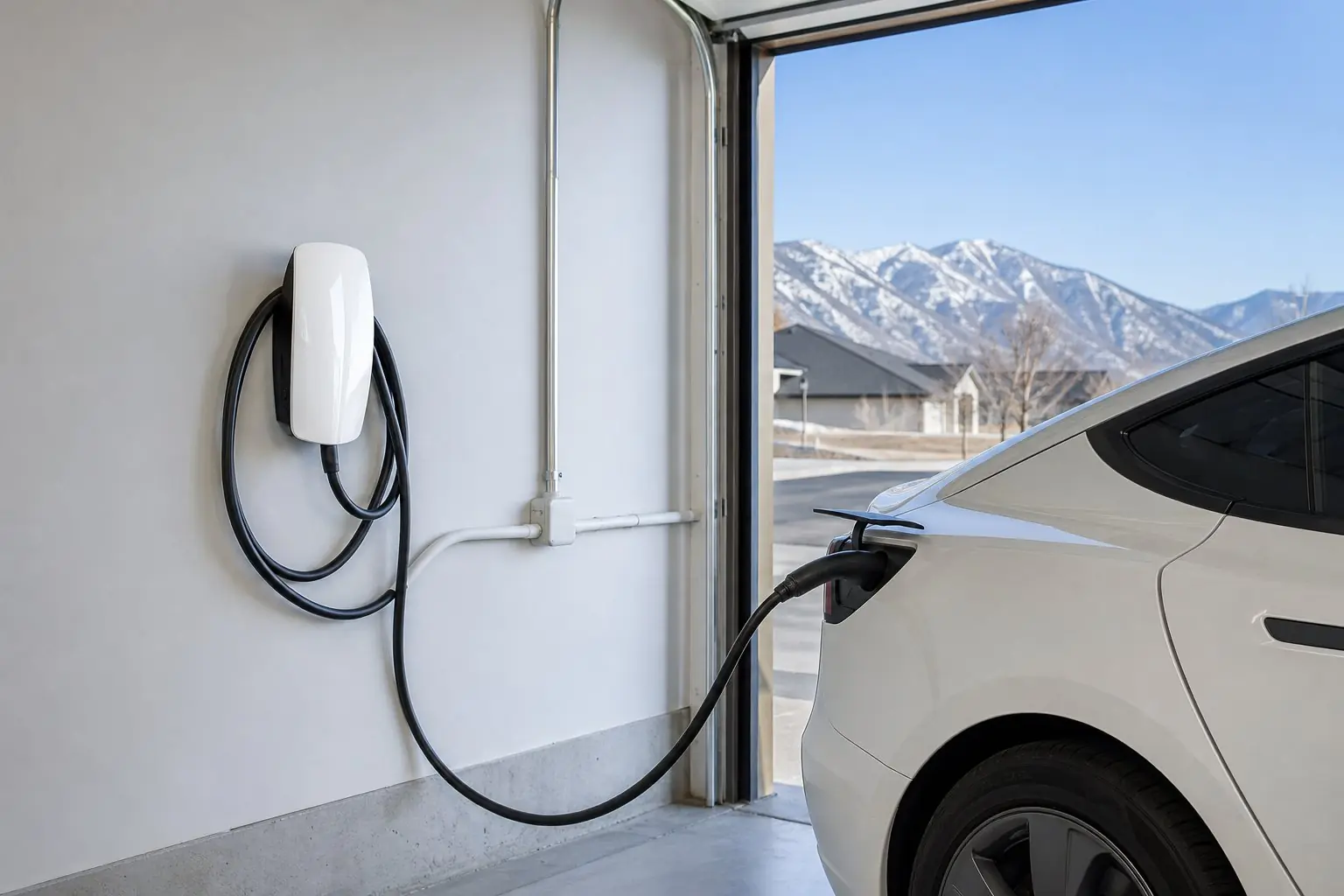
Which Model 3 do I have, and what can it accept?
Tesla splits the Model 3 into two groups. Model 3 Rear-Wheel Drive has a 32 amp (7.7 kW) onboard charger, and Tesla recommends a 40 amp breaker for its Wall Connector. Model 3 Long Range and Performance accept 48 amps (11.5 kW) on a 60 amp breaker. To confirm, tap the lightning bolt icon on the touchscreen, which shows the car's maximum.
| Model 3 (Tesla's naming) | Onboard charger | Circuit that uses it fully |
|---|---|---|
| Rear-Wheel Drive | 32 A (7.7 kW) | 40 A circuit with a Wall Connector, or 50 A NEMA 14-50 with the Mobile Connector |
| Long Range | 48 A (11.5 kW) | 60 A circuit with a hardwired Wall Connector |
| Performance | 48 A (11.5 kW) | 60 A circuit with a hardwired Wall Connector |
From Tesla's Onboard Charger and Home Charging support pages, read through Internet Archive captures because tesla.com blocks automated checks. Tesla's Model 3 2024+ service manual separately says the car "accepts up to 48A when equipped with the Long Range Battery."
Tesla now sells the car as Model 3 Standard, Premium and Performance, while its charging pages still use Rear-Wheel Drive and Long Range. Read the maximum from the car before the circuit is sized. The same goes for a used Model 3 of any year.
What is the best setup for a Model 3 Rear-Wheel Drive?
Either of two, at the same speed. Tesla's FAQ says a Wall Connector on a 40 amp breaker and a Mobile Connector on a NEMA 14-50 outlet with a 50 amp breaker both deliver the car's 32 amp maximum. Tesla notes that an existing 240 volt outlet your installer approves avoids most installation cost, while the Wall Connector adds scheduling, charging statistics and other-EV compatibility.
Tesla's current Mobile Connector bundle includes a 20 foot cable with NEMA 5-15 and NEMA 14-50 adapters, and draws 32 amps on the 14-50. In Utah, a receptacle installed for EV charging needs GFCI protection under NEC 625.54, and that applies even though Utah's amendments exempt other 240 volt garage receptacles. Tesla's Gen 3 Wall Connector manual lists built-in ground-fault protection, so the hardwired route avoids that GFCI breaker. Our hardwired vs NEMA 14-50 comparison covers the trade-offs, and home EV charger installation explains what each route involves.
If a second EV or a 48 amp Tesla might follow, wiring for 60 amps now is worth pricing. The Wall Connector's output follows the breaker size entered at commissioning, and a 32 amp car simply draws 32 amps from it.
What does a Model 3 Long Range or Performance need?
A hardwired 48 amp charger on a 60 amp two-pole breaker. That is Tesla's recommendation and the only setup that reaches the car's 11.5 kW. A NEMA 14-50 outlet caps the Mobile Connector at 32 amps, which by Tesla's up-to-30-miles-per-hour figure is about 240 miles of range over eight hours, a third slower than the car allows.
EV charging is a continuous load, so the breaker must be at least 125 percent of the charger's output: 48 amps needs 60. Tesla's Wall Connector manuals call for minimum 6 AWG copper with a 75°C rated breaker at full power. Our guide to what size breaker an EV charger needs explains the math, and Level 2 EV charger installation covers the circuit itself.
How fast does a Model 3 charge at home?
Tesla quotes speed as miles of range added per hour of charging, not hours to full. Its home charging page lists 2 to 3 miles per hour on a 120 volt outlet, up to 30 on a 32 amp 240 volt connection, and up to 44 on a Wall Connector. A 32 amp car tops out at the 30 figure on either charger.
| Connection | Current | Tesla's charge speed |
|---|---|---|
| Mobile Connector, NEMA 5-15 (120 V) | 12 A | 2 to 3 miles per hour |
| Mobile Connector, NEMA 14-50 (240 V) | 32 A | up to 30 miles per hour |
| Wall Connector, 40 A breaker | 32 A | up to 30 miles per hour |
| Wall Connector, 60 A breaker | 48 A | up to 44 miles per hour (48 A cars) |
Speeds from Tesla's Home Charging and Mobile Connector support pages. Tesla does not publish usable battery capacity or Level 2 full-charge times for the Model 3 in the documents we read, so none are estimated here.
When should a Model 3 charge in Ogden?
Outside Rocky Mountain Power's peak window if you are on its time-of-use option. The Utah Schedule 1 TOU tariff, effective August 10, 2026, sets on-peak at 6 to 10 p.m. on weekdays, with every other hour off-peak. A Model 3 can be scheduled from its own Charging screen, so no smart charger is needed for this.
The owner's manual also has a Charge Current at This Location setting. If the circuit is shared with other equipment, you can turn the current down and the car remembers it for that spot. Tesla also "strongly recommends" leaving the car plugged in when parked, so a convenient outlet location matters more than peak speed for most Model 3 drivers.
What plug and adapters does a Model 3 use?
A NACS charge port on the left rear, built into the tail light assembly. Tesla's manual says every Tesla can charge on a Supercharger, Wall Connector or Mobile Connector. For J1772 or CCS public stations you need an adapter, and the manual says only that "the most commonly used adapter(s) for each market region are provided."
For home use the port is not a concern: any Tesla charger fits, as our Tesla home charging overview explains for the whole lineup. The port's position does matter when you pick a mounting spot, and the Wall Connector's 24 foot cable gives some room. If the garage also holds a J1772-port EV, the Tesla Wall Connector guide explains why the Universal Wall Connector is the one to choose.
Panel and load notes
Under the 2023 NEC, which Utah has adopted, a load calculation counts an EV charger at 7,200 watts or its nameplate, whichever is larger. A Rear-Wheel Drive car on a 32 amp setting is a lighter addition than a 48 amp Long Range setup, which is one practical reason not to oversize. On a tight panel, a lower Wall Connector setting or EV charger load management may avoid a panel upgrade. If the panel is tight, we check whether load management solves it before talking about an upgrade.
Tesla Model 3 home charging questions
Is my Model 3 a 32 amp or a 48 amp car?
Tesla's onboard charger table lists Model 3 Rear-Wheel Drive at 32 amps (7.7 kW) and Model 3 Long Range and Performance at 48 amps (11.5 kW). The fastest check is Tesla's own: tap the lightning bolt icon on the touchscreen to see the car's maximum amperage.
Does a Model 3 Rear-Wheel Drive need a Wall Connector?
Not for speed. Tesla's home charging FAQ says the Wall Connector and the Mobile Connector give a Model 3 Rear-Wheel Drive the same 32 amp maximum: the Wall Connector on a 40 amp breaker, or the Mobile Connector on a NEMA 14-50 outlet with a 50 amp breaker. Tesla notes the Wall Connector adds scheduling, charging statistics and other-EV compatibility.
What breaker does a Model 3 Long Range need?
A 60 amp two-pole breaker with a hardwired Wall Connector, which Tesla lists as the setup for the car's full 48 amps. A NEMA 14-50 outlet limits the Mobile Connector to 32 amps, so it works but charges more slowly than the car can accept.
How fast does a Model 3 charge at home?
Tesla quotes charge speed in miles of range added per hour: 2 to 3 on a standard 120 volt outlet, up to 30 on a 32 amp 240 volt connection, and up to 44 on a Wall Connector. Tesla does not publish Level 2 full-charge times for the Model 3, so we do not estimate them here.
Can I lower my Model 3's charging current on a shared circuit?
Yes. The owner's manual describes a Charge Current at This Location setting on the touchscreen. You can reduce it, for example if the circuit is shared with other equipment, and the car remembers the setting for that location. It cannot be set above what the connected charge cable allows.
Know which Model 3 you have? Add the max amps from the charging screen and a panel photo to your quote request.
Get a Model 3 charger quote