
Is Tesla still building the Model S?
No. Tesla's April 22, 2026 shareholder update said its first Optimus robot line "will replace the Model S and Model X lines in Fremont," and the July 22, 2026 update said Tesla had "decommissioned the Model S & X lines." So from here on, Model S owners in Ogden are driving cars that are already built, new or used.
Tesla splits its owner's manuals into Model S 2012 to 2020 and Model S 2021 and later. That split matters for home charging, because the older cars are where onboard charger differences show up.
How many amps can a Model S take at home?
Tesla's onboard charger table lists Model S at 11.5 kW, or 48 amps, and recommends a 60 amp circuit breaker for a Wall Connector. Tesla has shown that same figure for Model S in every version of the table we could retrieve, back to 2019. To confirm your own car, tap the lightning bolt icon on the touchscreen, which shows its maximum amperage.
| Wall Connector breaker | Output | Power at 240 V | Model S, miles per hour |
|---|---|---|---|
| 60 A | 48 A | 11.5 kW | 41 |
| 50 A | 40 A | 9.6 kW | 34 |
| 40 A | 32 A | 7.7 kW | 27 |
| 30 A | 24 A | 5.7 kW | 21 |
From Tesla's Wall Connector support page (Internet Archive capture of April 2025). Tesla notes that "All charge speeds are approximate." Tesla does not publish usable battery capacity or full-charge times for Model S in the sources we read, so we do not quote hours.
What about a 2012 to 2020 Model S?
Check before you size anything. Tesla's 2012 to 2020 Model S service manual says a Wall Connector can supply "up to twice the amperage as the Mobile Connector if the vehicle is equipped with dual chargers." Some older cars, in other words, were built to take more than a single-charger car. The touchscreen shows which yours is.
If the screen shows more than 48 amps, the current Gen 3 and Universal Wall Connectors will not deliver it: Tesla's manuals rate both at 12 to 48 amps. Tesla's older Gen 2 Wall Connector could be set as high as 80 amps through an internal rotary switch, and its manual notes that "actual amperage draw will depend on the on-board charger of the vehicle." Read the maximum from your car's touchscreen rather than assuming a number.
Which home setup suits a Model S?
For full speed, a Tesla Wall Connector or Universal Wall Connector hardwired on a 60 amp circuit. If your daily driving is modest or the panel is tight, a NEMA 14-50 outlet with Tesla's Mobile Connector at 32 amps, or a Wall Connector on a 40 or 50 amp breaker, still refills a typical day's driving overnight.
| Setup | Breaker | Good fit when |
|---|---|---|
| Wall Connector at 48 A | 60 A | You want the car's full Level 2 speed and the panel has room. |
| Wall Connector at 32 or 40 A | 40 or 50 A | The load calculation is tight but a hardwired unit is still wanted. |
| NEMA 14-50 and Mobile Connector | 50 A GFCI | Lower mileage, or you want a plug you can use with other equipment. |
Tesla's Gen 3 Mobile Connector draws 32 amps from a 14-50. Why 48 amps needs a 60 amp breaker is explained in what size breaker for an EV charger, and the outlet route is covered under Level 2 EV charger installation. In Utah, a receptacle installed for EV charging needs GFCI protection; a hardwired Wall Connector has its own built-in ground fault protection.
Sharing the garage with a non-Tesla EV? Tesla's Universal Wall Connector has a docked J1772 adapter, so one unit charges both. Two Wall Connectors can also share one site's power. Specs and power sharing rules are on our Tesla Wall Connector guide.
Where is the Model S charge port, and does it matter?
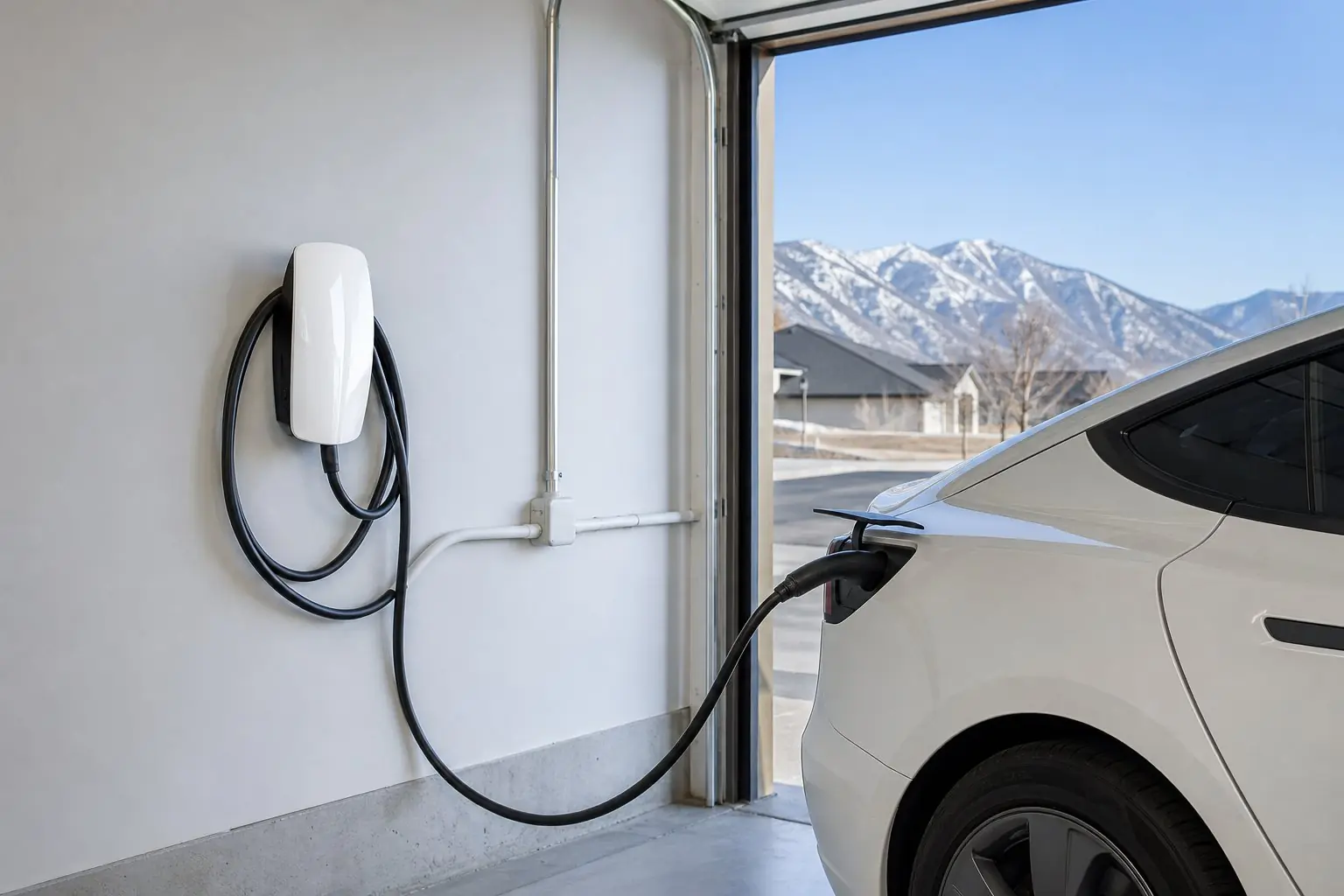
Tesla's manuals place it on the left side of the car, behind a door in the rear tail light assembly, on both 2012 to 2020 and 2021 and later cars. Mount the Wall Connector so its 24 foot cable reaches that rear corner however you usually park, nose in or backed in.
Every Model S has Tesla's NACS port. Tesla's manual says "the most commonly used adapter(s) for each market region are provided," without listing them, so check what came with a used car. For third-party DC fast chargers, the car may also need CCS support enabled, which the touchscreen shows under Additional Vehicle Information.
Panel and load notes
Under the 2023 NEC, which Utah has adopted, a load calculation counts an EV charger at 7,200 watts or its nameplate, whichever is larger. A Wall Connector set for 48 amps is about 11.5 kW. If the calculation comes up short, a lower Wall Connector setting or EV charger load management is often the alternative to a panel upgrade. We check load management before recommending a panel upgrade. Our home EV charger installation page walks through the full process.
Tesla Model S home charging questions
What breaker does a Tesla Model S need for the fastest home charging?
A 60 amp two-pole breaker feeding a Wall Connector set for that breaker. Tesla's onboard charger table lists Model S at 11.5 kW (48 amps) and recommends a 60 amp circuit breaker for the Wall Connector installation. A larger circuit adds nothing for a car that accepts 48 amps.
How many miles per hour does a Model S add on a Wall Connector?
Tesla's Wall Connector table gives a Model S about 41 miles of range per hour at 48 amps on a 60 amp breaker, 34 at 40 amps and 27 at 32 amps. Tesla describes all of these as approximate.
Is a NEMA 14-50 outlet enough for a Model S?
For many owners, yes. Tesla's Gen 3 Mobile Connector charges at up to 32 amps from a NEMA 14-50 on a 50 amp breaker, which Tesla's table puts at about 27 miles of range per hour for a Model S. The receptacle needs GFCI protection when it is installed for EV charging.
My Model S is a 2012 to 2020 car. Is it different?
It can be. Tesla's 2012 to 2020 Model S service manual describes cars equipped with dual chargers that can take up to twice the Mobile Connector's amperage from a Wall Connector. Check the maximum amps on your car's touchscreen before choosing a circuit, rather than assuming 48.
Can a Model S power my house during an outage?
Not through Tesla's Powershare Gateway system. Tesla's Powershare installation manual lists Cybertruck as the compatible vehicle. A Model S owner who wants backup power would look at a home battery or a generator instead.
Know your Model S's maximum amps? Add it to the quote request with a photo of your panel.
Get a Model S charger quote