
What is the difference between the Emporia Pro and Classic?
The Pro is sold as a bundle with the Vue 3 Energy Monitor, so PowerSmart load management works from day one, and it charges at up to 48 amps. The Classic leaves the Vue out; Emporia offers PowerSmart for it as a paid upgrade. Both have a 25 foot cable, a NEMA 4 enclosure and a three-year warranty, per Emporia's March 2026 comparison.
| Spec | Emporia Pro |
|---|---|
| Output | 48 A hardwired (11.5 kW); 40 A on NEMA 14-50 (9.6 kW) |
| At 208 V | 10 kW at 48 A; 8.3 kW at 40 A |
| Connector | J1772 or NACS, 25 ft cable |
| Power connection | NEMA 14-50 plug (28 in cord), hardwired whip (3 ft conduit) or rear-entry hardwire |
| Enclosure | Type 4, indoor or outdoor |
| Operating temperature | -22°F to 122°F |
| Wi-Fi band | Not stated for the charger in the documents we read (the 2.4 GHz figure on the sell sheet is for the Vue monitor) |
| Included monitor | Vue 3 Energy Monitor, two 200 A main sensors |
The NACS version has a sensor in the handle that opens a Tesla's charge port, according to Emporia's sell sheet. If you are choosing between brands, our home EV charger comparison lines the Pro up with the others.
What breaker sizes does the Emporia Pro accept?
Any of nine, from 15 to 60 amps. Emporia's guide pairs each breaker with a charge rate at 80 percent of it: 60 amps gives 48, 50 gives 40, and so on down to 15 amps for 12. The Pro ships set to 40 amps for the plug version or 48 hardwired, and the installer changes it in the app behind a PIN.
| Breaker | Max charge rate | Power at 240 V |
|---|---|---|
| 60 A | 48 A (hardwired only) | 11.5 kW |
| 50 A | 40 A | 9.6 kW |
| 45 A | 36 A | 8.6 kW |
| 40 A | 32 A | 7.7 kW |
| 35 A | 28 A | 6.7 kW |
| 30 A | 24 A | 5.8 kW |
| 25, 20, 15 A | 20, 16, 12 A | 4.8, 3.8, 2.9 kW |
From the breaker table in Emporia's Pro installation guide.
The finer steps are handy when a panel has room for, say, a 45 amp circuit but not 50. For a 48 amp hardwired install, the guide calls for 6 AWG copper rated 90°C. It also says to mount the charger with its bottom at least 24 inches above the floor. General sizing rules are in what size breaker for an EV charger.
How does PowerSmart load management work?
The Vue 3 monitor clamps onto the home's service conductors in the panel and measures whole-house use. PowerSmart then raises or lowers the charger so total draw stays under a service rating set in the app. If the monitor goes offline, the charger falls back to a guaranteed rate that the electrician calculates in advance.
Emporia's guide asks for three numbers during setup, and two of them are explicitly the electrician's job:
- Service Rating: the most current PowerSmart will allow in the panel. "A licensed electrician shall determine the Service Rating from inspecting the electrical panel."
- Maximum Charge Rate: set by the charger's breaker, from the table above.
- Guaranteed Charge Rate: the spare capacity the panel had before the charger, which is always available. The electrician determines it "using load calculation methods in NEC Article 220."
The 2023 NEC, adopted in Utah, recognizes this kind of system in 220.70, which lets a load calculation use the energy management system's setpoint instead of the charger's full nameplate. That is the basis for avoiding some service upgrades; the details are on our EV charger load management page. PowerSmart needs the Emporia app and an internet connection.
What does installing the Vue 3 involve?
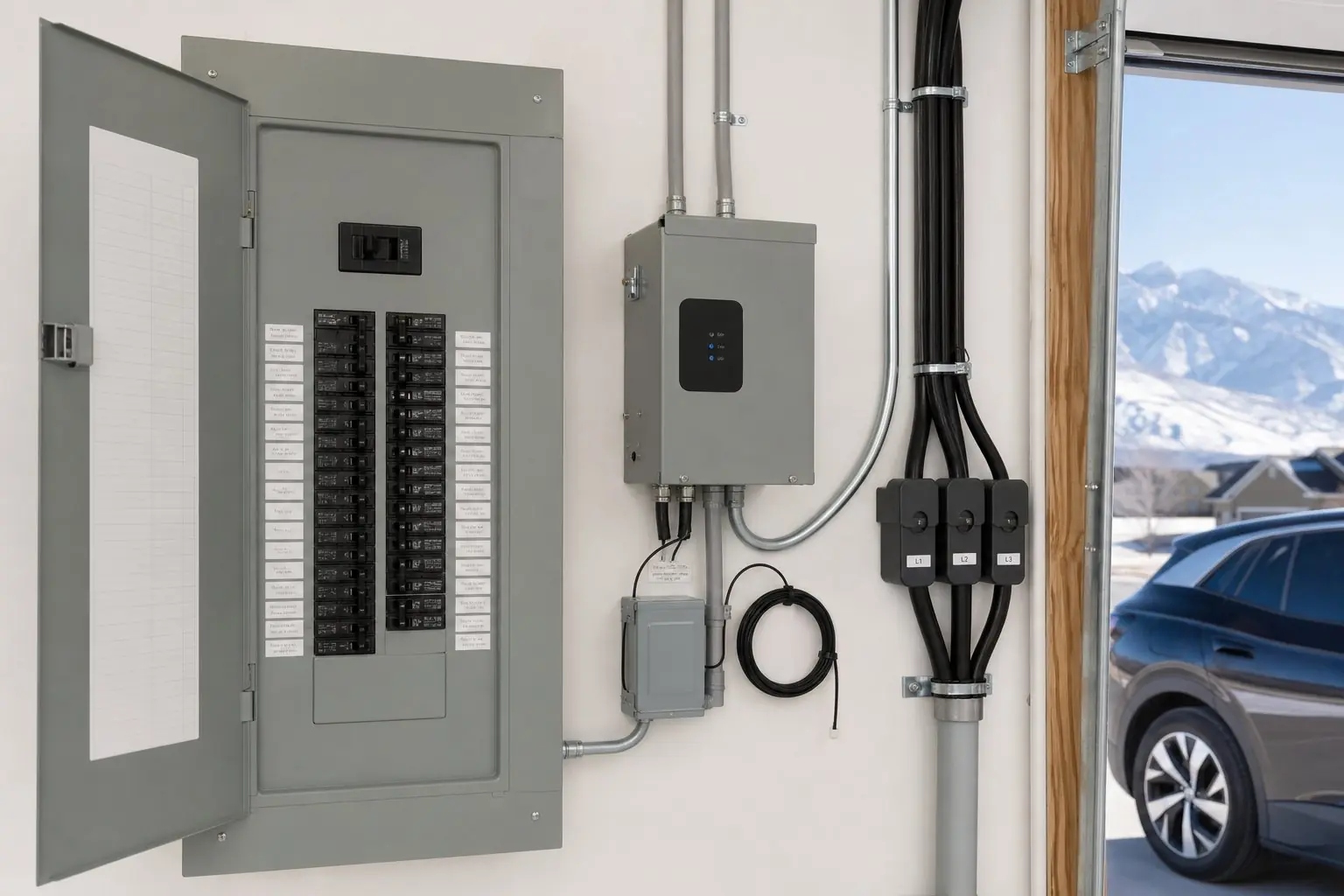
Work inside the main panel with the cover off. The two main sensors clamp around the service conductors, which stay energized even with the main breaker off, and the monitor is powered from breakers in the panel. Emporia's guide directs this to a licensed electrician or other qualified person and treats it as part of the charger install.
The monitor's wire harness lands on one or two breakers. Emporia's guide covers three cases: two empty spaces, one empty space, or none, where it splices onto existing circuits. The Vue connects over Wi-Fi or a wired Ethernet cable, and prefers Ethernet when both are present. Homes with solar need the sensors placed differently depending on whether the system is breaker-fed or a line-side tap. A garage far from the router may need the Ethernet option.
Solar and off-peak charging
Because the Vue sees the whole house, the Pro can do more than avoid overloads. Emporia's guide describes charging from surplus solar and charging "when grid electricity is least expensive." On Rocky Mountain Power's optional time-of-use plan, weekday on-peak hours run 6 to 10 p.m., so a start time after 10 p.m. set in the car does the job, and Emporia's cost optimization is meant to handle the same thing from the charger side. Solar charging depends on the Vue's sensors being placed the way the guide specifies for your type of solar connection, described above, so that step is worth getting right at install time.
GFCI, outdoor mounting and two EVs
Emporia says its charger has built-in ground-fault protection and that a redundant GFCI breaker "will cause nuisance tripping." For hardwired installs: "Always use a standard non-GFCI breaker." If code requires a GFCI breaker on a NEMA 14-50 circuit, as Utah's adopted code does for EV charging receptacles, Emporia recommends the hardwire version. See EV charger keeps tripping the breaker.
The Type 4 enclosure and -22°F to 122°F range suit an exterior wall, covered on outdoor EV charger installation. For two EVs, Emporia's Load Sharing, announced in October 2025, splits power between two or more Emporia chargers on one shared circuit or separate ones, with at least 6 amps each. If you already bought an Emporia, we can install the unit you supply.
Emporia EV charger questions
What comes in the box with the Emporia Pro?
Emporia's installation guide says the Pro ships with the charger and a Vue 3 Energy Monitor with two 200 amp main sensors, which is what PowerSmart load management needs. The Classic charger does not include the Vue; Emporia sells PowerSmart for it as a paid upgrade.
What breaker does an Emporia Pro need?
A dedicated 60 amp two-pole breaker for the full 48 amps hardwired, or 50 amps for 40 amps on a NEMA 14-50. Emporia's guide also lists smaller breakers from 15 to 45 amps with matching charge rates, set in the Emporia app and locked with a PIN.
Does PowerSmart mean I can skip a panel upgrade?
Sometimes. PowerSmart slows charging when the whole house approaches the service rating your electrician enters, which can let a charger fit on a panel that looks full. Emporia's guide still asks the electrician to calculate a guaranteed fallback rate using NEC Article 220.
Should an Emporia charger be hardwired or plugged in?
Hardwired if you want 48 amps or are in Utah and want to avoid a GFCI breaker. Emporia recommends the hardwire version when local code requires a GFCI breaker on a NEMA 14-50 circuit, which Utah's adopted code does for EV charging receptacles.
Installing an Emporia Pro? Tell us your car, your panel's main breaker size and where the charger will go.
Get an Emporia installation quote