
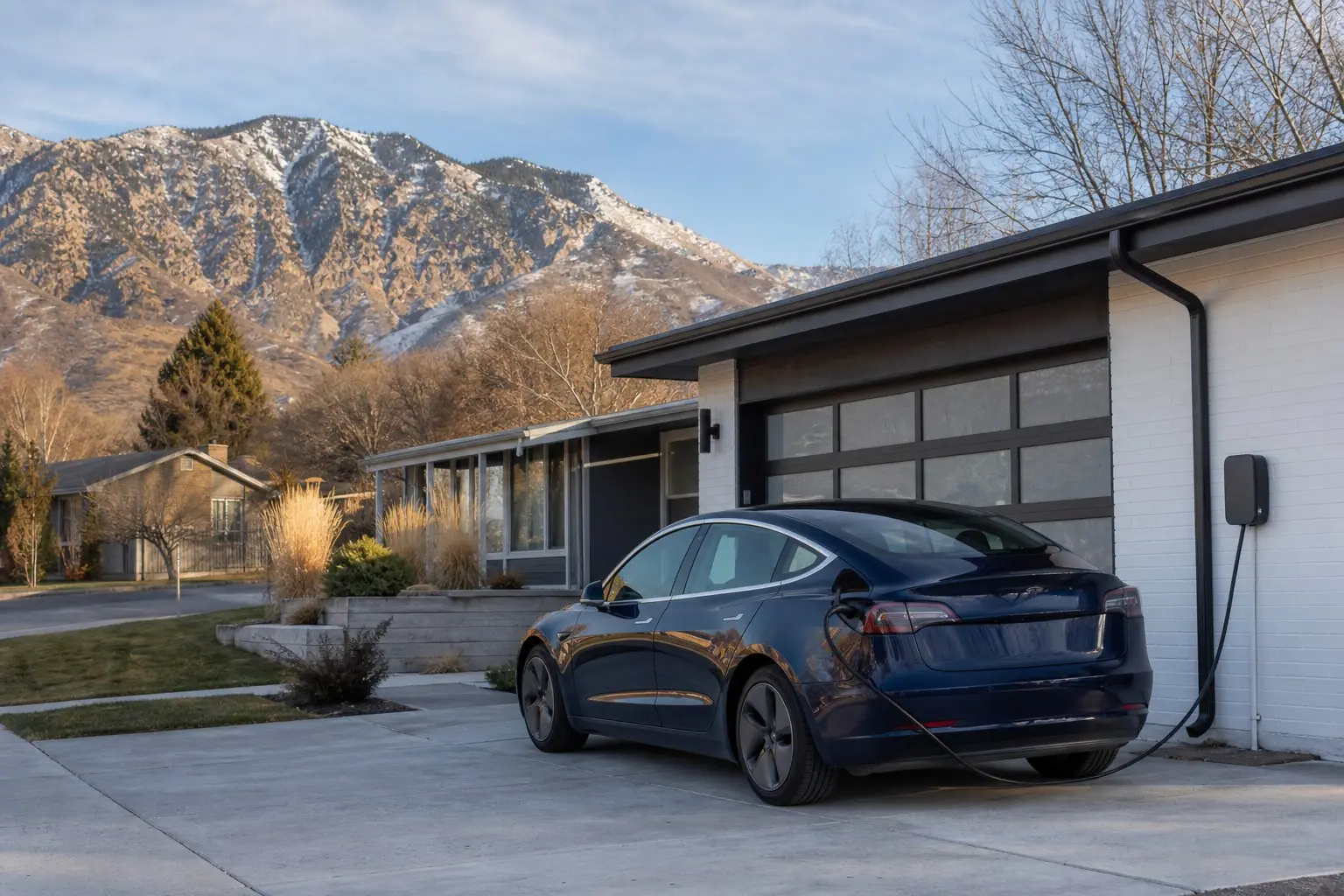
Is home charging cheaper than public charging in Ogden?
Yes, by a wide margin for fast charging. On Rocky Mountain Power's time-of-use option, off-peak home energy costs 6.6111 to 7.4705 cents per kWh. The utility's own public fast chargers cost 27 cents per kWh for enrolled Rocky Mountain Power customers and 45 cents for everyone else, plus a $1 session fee.
| Where you charge | Energy price | Extra charges |
|---|---|---|
| Home, time-of-use off-peak | 6.6111¢ (Oct to May), 7.4705¢ (Jun to Sep) | None per session |
| Home, time-of-use on-peak (6 to 10 p.m. weekdays) | 29.7498¢ (Oct to May), 33.6173¢ (Jun to Sep) | None per session |
| Home, standard tiered rate | About 8.7¢ to 12.5¢ | None per session |
| RMP fast charger, enrolled RMP customer | 27¢ | $1 session fee |
| RMP fast charger, everyone else | 45¢ | $1 session fee |
| RMP Level 2 station | 8¢ | $1 session fee |
Home rates: Schedule 1 energy charges, effective August 10, 2026. Public rates: Schedule 60, effective January 1, 2026, which also gives a 5 cent per kWh credit off-peak and an idle fee of $0.40 a minute starting ten minutes after the car is full. Energy charges only, before taxes and other bill charges.
Schedule 60 also says prices will move toward cost of service in later years of the utility's EV program, so check the current tariff before planning around it.
What does a typical refill cost each way?
Take 60 kWh, a large refill for most cars. At the winter off-peak home rate that is about $3.97 in energy charges. At a Rocky Mountain Power fast charger it is about $17.20 for an enrolled customer and $28.00 for a non-customer, including the $1 session fee.
| 60 kWh at | Energy cost |
|---|---|
| Home off-peak, October to May | $3.97 |
| Home off-peak, June to September | $4.48 |
| RMP fast charger, enrolled, on-peak | $17.20 |
| RMP fast charger, enrolled, with off-peak credit | $14.20 |
| RMP fast charger, not enrolled | $28.00 |
Our arithmetic from the tariff rates above. Excludes taxes, other bill charges and charging losses, which apply in both cases.
Home charging has an up-front cost the per-kWh numbers leave out: the charger and its circuit. What drives that cost is covered in EV charger installation cost. The time-of-use option also carries a one-year commitment and a 12-month bill guarantee if the year costs more than 10 percent above the standard rate; details on Rocky Mountain Power EV programs.
How does the Rocky Mountain Power fast-charging discount work?
Enroll in the Electrify America app with the code DISCOUNT and your 12-digit Rocky Mountain Power account number. The utility says the discount applies only at Rocky Mountain Power's own stations, not every Electrify America charger. Its station list includes Union Station in Ogden, and it points to Schedule 60 for pricing.
Confirm the price in the app before you plug in. Ogden City notes that it does not set prices at Union Station, which Rocky Mountain Power owns and Electrify America operates. Rocky Mountain Power's web page also describes off-peak hours for the credit that differ from the tariff, which defines on-peak as 6 to 10 p.m. on weekdays. We use the tariff.
Which home setup gets the most from off-peak rates?
A Level 2 charger scheduled to start at 10 p.m. or later. Off-peak is every hour outside 6 to 10 p.m. on weekdays, including weekends and holidays, so a 7 to 11 kW charger fits a full day of driving into cheap hours with time to spare. Either the car or the charger can hold the schedule.
Level 1 on a 120-volt outlet adds only about 5 miles of range per hour, per the DOE, so a big refill can run into the 6 to 10 p.m. window. Charger features that help with scheduling are compared on our home EV chargers page.
What about time and convenience?
Home charging takes almost none of your day: plug in when you park, unplug in the morning. Public charging means driving to the station, waiting while the car charges and moving it promptly to avoid idle fees. For daily driving, that time adds up faster than the energy cost.
- Home Level 2: the DOE says a typical residential unit can charge a typical EV battery overnight. You start every day full.
- Public fast charging: the quickest way to add range away from home, but you stay with the car, and the idle fee starts ten minutes after it is full.
- Free public Level 2: Ogden City's Municipal Building stations are free for two hours, and Weber State's are free for up to three hours with a campus parking permit. Handy while parked anyway.
Locations, connector types and local details are on public vs home charging in Ogden.
When does public charging make sense?
On road trips, when you cannot charge where you park, and as a free top-up while parked at work or on campus. If you rent or live in a building without charging, public stations may be the main option until the property adds charging.
For apartments and condos, see apartment EV charger installation. If you own your home, the per-kWh gap above usually makes home charging the default.
Charge at home if
- You have a garage, carport or driveway where a circuit can reach.
- You can schedule charging after 10 p.m. on weekdays or any time on weekends.
- You drive daily and want a full battery every morning.
Lean on public charging if
- You have no off-street parking or cannot add a circuit.
- You mostly need range on long trips.
- You can top up for free while parked at work or on campus.
Home vs public charging questions
Is it cheaper to charge at home or at a public charger in Ogden?
At home, by a wide margin. Rocky Mountain Power's off-peak home rate is about 6.6 to 7.5 cents per kWh on the time-of-use option, while its own public fast chargers cost 27 cents per kWh for enrolled customers and 45 cents for others, plus a $1 session fee. Free Level 2 stations exist but have time limits.
How do I get the Rocky Mountain Power discount at public fast chargers?
Rocky Mountain Power says to download the Electrify America app and enroll with the code DISCOUNT and your 12-digit Rocky Mountain Power account number. The discount applies only at Rocky Mountain Power's own charging stations, not every Electrify America location.
What is the idle fee at Rocky Mountain Power fast chargers?
Schedule 60 sets an idling fee of $0.40 per minute starting ten minutes after the car reaches full charge. Move the car once the session ends to avoid it.
Do I still need public charging if I charge at home?
Mostly for long trips. A Level 2 charger at home refills a typical day of driving overnight, so daily public charging becomes unnecessary. DC fast chargers remain useful on road trips, and free Level 2 stations can top up while you are parked anyway.
Ready to charge at home? Start with your car model and a photo of your panel.
Get a home charger quote