
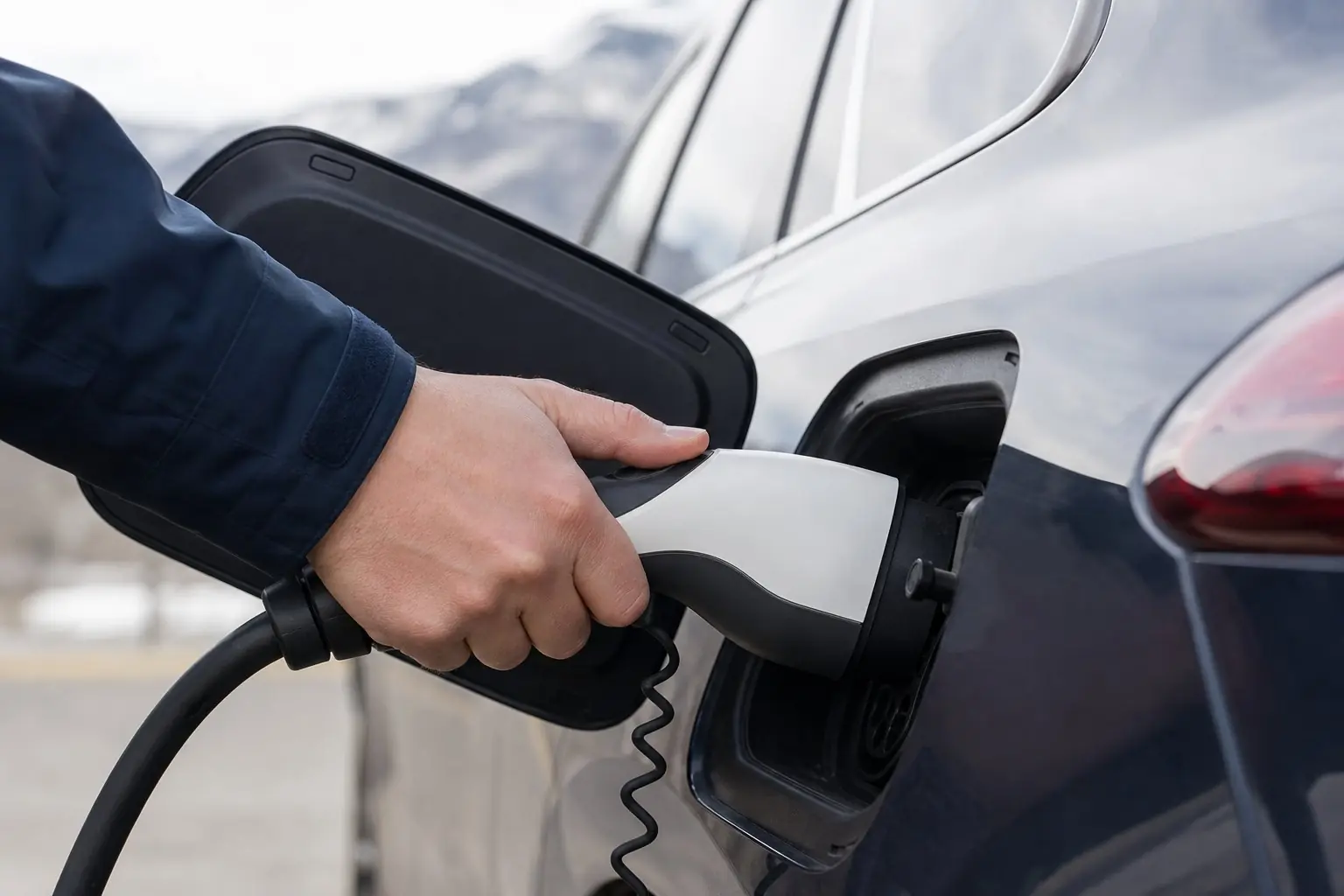
Which charge port does my IONIQ 5 have?
It depends on the model year. 2022 to 2024 IONIQ 5s have a CCS1 port, which takes a normal J1772 plug for Level 2. Hyundai's September 2024 release says the 2025 IONIQ 5 is "the first Hyundai model to come equipped with the Tesla North American Charging Standard (NACS) port," and it ships with a CCS adapter for other fast chargers.
| Model year | Charge port | Adapter Hyundai supplies |
|---|---|---|
| 2022 to 2024 | CCS1 (J1772 for Level 2) | Free CCS to NACS DC adapter for owners who bought by Jan 31, 2025 |
| 2025 to 2027 | NACS (SAE J3400) | CCS DC adapter included |
| 2025 IONIQ 5 N | CCS1 | On Hyundai's free NACS adapter list |
From Hyundai's 2025 debut and pricing releases and its December 2024 adapter release. Hyundai calls the 2025 IONIQ 5 "the first non-Tesla vehicle on sale to feature a factory-installed native NACS port." Hyundai's spec sheets and its FAQ disagree on which rear side the port is on, so check your car before choosing where the charger goes.
How fast can an IONIQ 5 charge at home?
Every IONIQ 5 from 2022 through 2027 has the same onboard charger. Each year's Hyundai spec sheet lists "Max Capacity (kW) 10.9" for all models. At 240 volts, 10.9 kW is roughly 45 amps, so a charger that delivers 48 amps lets the car pull its full rate. Nothing above that speeds it up.
What changed in 2025 was the battery, and with it the charge time.
| Model year | Battery (Hyundai "system capacity") | Level 2, 10 to 100 percent |
|---|---|---|
| 2022 | 58.0 / 77.4 kWh | not published / 6 h 43 min |
| 2023 and 2024 | 58.0 / 77.4 kWh | 5 h 50 min / 7 h 10 min |
| 2025 to 2027 | 63.0 / 84.0 kWh | 5 h 40 min / 7 h 20 min |
Hyundai's times are on a "Standard 240V" Level 2 charger, and its 2025 release labels the column "North America 240V (10.9 kW)." Times vary with temperature and state of charge. Hyundai does not label these capacities as usable.
What circuit and charger should I install?
For full speed, a hardwired 48 amp charger on a 60 amp circuit. Most owners would barely notice the difference with a 40 amp charger on a 50 amp circuit or a NEMA 14-50 outlet, which gives about 9.6 kW. On a busy panel, a 32 amp charger on a 40 amp circuit still refills an average day's driving overnight.
| Setup | Breaker | Power at 240 V | Fit for an IONIQ 5 |
|---|---|---|---|
| 48 A hardwired charger | 60 A | 10.9 kW (car's limit) | Full speed |
| 40 A hardwired or on a NEMA 14-50 | 50 A | 9.6 kW | About 12 percent slower |
| 32 A charger | 40 A | 7.7 kW | Fine for most commutes |
Power is amps times 240 volts, capped at the car's 10.9 kW. Real household voltage varies.
The breaker must be at least 125 percent of the charger's continuous output, which is why 48 amps needs 60. Our breaker sizing guide walks through the table, and hardwired vs NEMA 14-50 covers the outlet trade-offs. In Utah, a receptacle installed for EV charging needs GFCI protection under NEC 625.54. For the install itself, see Level 2 EV charger installation.
What does the NACS port change at home?
It changes which cable you want on the wall. Hyundai's documents list a CCS DC adapter for 2025 and newer cars, not a J1772 to NACS adapter for AC charging. So on a 2025 or newer IONIQ 5, the cleanest new install is a charger with a NACS (J3400) cable, or a unit with both NACS and J1772 connectors.
If you already have a J1772 charger, an AC adapter may let you keep it, but ask Hyundai or your dealer which AC adapter it supports before relying on one for daily charging.
Tesla's Wall Connector uses a NACS handle, and the Universal Wall Connector adds a docked J1772 adapter, which suits a garage with a 2025 IONIQ 5 and an older J1772 car. Confirm non-Tesla support with Tesla before buying. See the Tesla Wall Connector guide and our home charger guides.
Does the IONIQ 5 come with a home charging cord?
Newer ones do. Hyundai's October 2025 release says a "Dual amperage Level 1 / Level 2 combination charger" is "now included with all models" for 2026, and the 2027 price sheet lists a "Dual Voltage ICCB charging cable" as standard. Hyundai's general charging page says its EVs include a Level 1 cable but not a Level 2 cable, which fits earlier years.
Hyundai does not publish the 2026 cord's Level 2 amperage in the documents we read. Check its label before adding a NEMA 14-50 just for that cord.
What if two EVs share the garage?
Plan for both ports. A 2025 or newer IONIQ 5 and a Tesla can share a NACS charger. An older IONIQ 5 or a J1772 car next to a NACS car calls for a dual-connector charger or two chargers. Two 48 amp circuits is a lot to add, so power sharing or load management is often the better route.
Read more on EV charger load management and panel upgrades for EV charging. A panel upgrade is our last suggestion, not our first: load management gets checked first.
IONIQ 5 home charging questions
Does my IONIQ 5 have a NACS port or a J1772 port?
2022 to 2024 IONIQ 5 models have a CCS1 port, which takes a standard J1772 plug for Level 2 charging. Hyundai switched the 2025 IONIQ 5 to a native NACS port and includes a CCS DC adapter for non-Tesla fast chargers. The 2025 IONIQ 5 N kept the CCS port.
What is the IONIQ 5's maximum home charging rate?
Hyundai lists a 10.9 kW onboard charger for every IONIQ 5 model year from 2022 through 2027. At 240 volts that works out to roughly 45 amps, so a 48 amp charger on a 60 amp circuit lets the car charge at its full rate. A faster charger adds nothing.
How long does an IONIQ 5 take to charge at home?
Hyundai's spec sheets give 10 to 100 percent on a 240 volt Level 2 charger in 5 hours 40 minutes for the 63 kWh battery and 7 hours 20 minutes for the 84 kWh battery (2025 to 2027). The 2023 and 2024 figures are 5 hours 50 minutes and 7 hours 10 minutes.
Can a 2025 or newer IONIQ 5 use my J1772 charger?
Not directly, because the car has a NACS port. Hyundai's documents list a CCS adapter for DC fast charging; ask Hyundai or your dealer whether a J1772 to NACS adapter is approved for AC charging. If you are installing a new charger, a unit with a NACS (J3400) cable or one with both connectors avoids the question.
Is a NEMA 14-50 outlet enough for an IONIQ 5?
Yes for most drivers. A plug-in charger on a 14-50 can draw at most 40 amps, which is about 9.6 kW at 240 volts, a little under the car's 10.9 kW onboard charger. The outlet needs GFCI protection when installed for EV charging.
Planning a charger for your IONIQ 5? Include the model year and a photo of your panel on the quote request.
Get an IONIQ 5 charger quote