
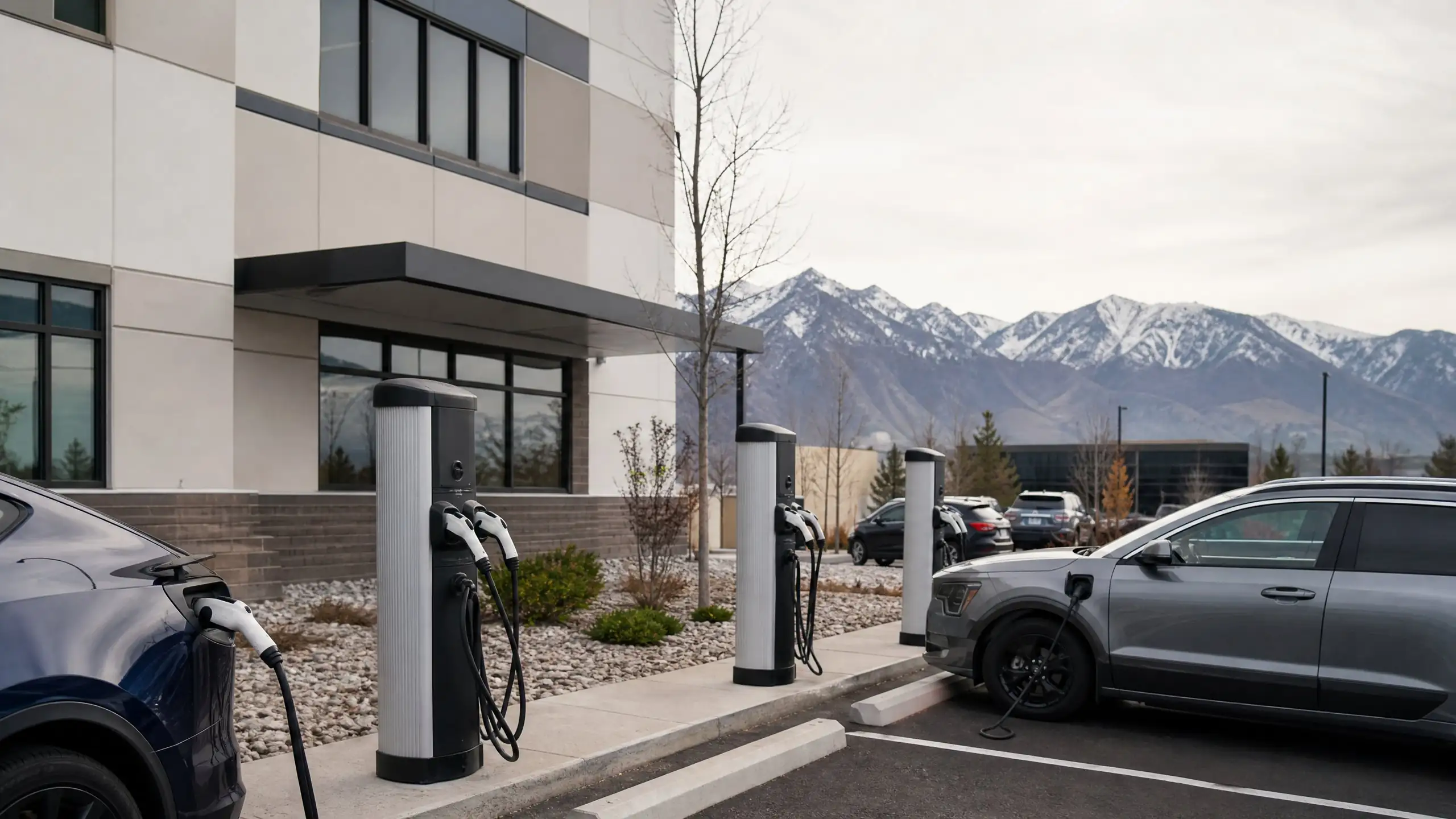
What drives the cost of commercial EV charging?
The number and type of ports, the distance from your electrical service to the parking spaces, and whether that service has room for the load. Trenching through asphalt, accessible layout and permits add to the one-time cost. After install, demand charges, network software and, if you sell charging, Utah's charging tax keep costing money every month.
| Cost line | One-time or ongoing | What moves it |
|---|---|---|
| Chargers | One-time | Level 2 or DC fast, single or dual port, networked or not |
| Make-ready | One-time | Distance to spaces, trenching and paving, panels and conduit for future ports |
| Utility service | One-time | Whether the site needs more capacity or three-phase power |
| Layout and permits | One-time | Accessible spaces, plan review, inspections |
| Demand charges | Ongoing | How many ports charge at the same time |
| Network software | Ongoing | Vendor plan, needed for access control and billing |
| Charging tax | Ongoing | Applies only if you charge drivers a fee |
Choosing chargers, port counts and accessible layout is covered on commercial EV charger installation.
How much does DC fast charging change the budget?
A great deal. Rocky Mountain Power says commercial Level 2 chargers draw up to 19.2 kW, while DC fast chargers need 480-volt three-phase power and typically draw 50 to 350 kW. Many sites do not have that service, so DC fast projects often start with a utility service request before any charger is bought.
Rocky Mountain Power's service requirements say nonresidential sites "shall provide the Power Company with the expected new load and charging frequency." Its service manual adds that the company "may require the applicant to enter into a line extension contract" before added load, and asks for a 60-day minimum lead time on service applications.
What is make-ready, and is there still an incentive for it?
Make-ready is the electrical work that gets power to the parking space: service capacity, panels, conduit, trenching and wiring, everything but the charger. Ended Rocky Mountain Power's make-ready incentives were discontinued in the 2025 settlement, so this part is now paid by the site owner.
The settlement states "the make-ready incentives will be discontinued, and no additional funding will be allocated," with previously committed projects paid if completed on time. The practical saving is timing: run conduit to future spaces while the lot is already open, rather than cutting asphalt twice.
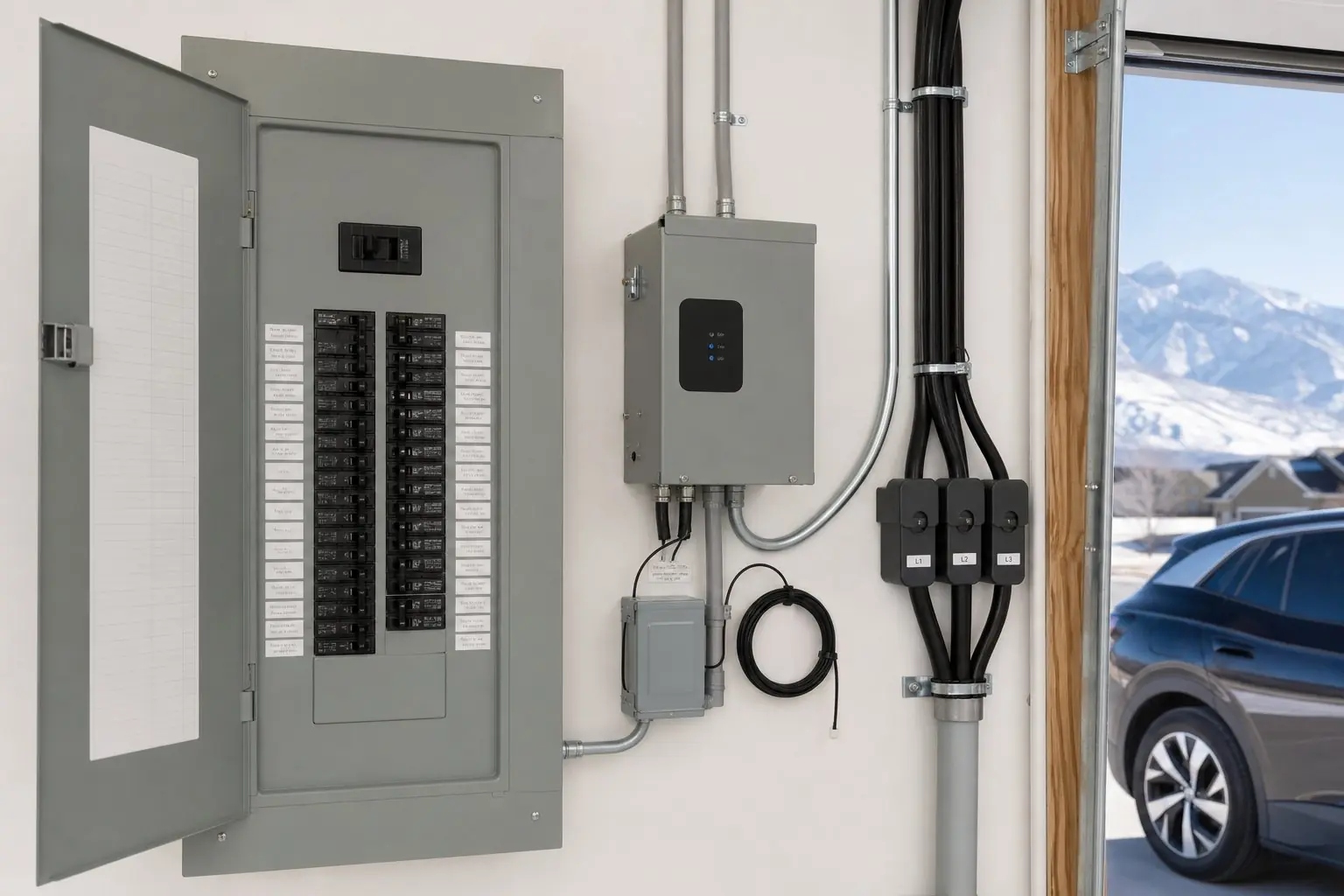
What does the Rocky Mountain Power rebate pay?
Live As of October 4, 2026, Rocky Mountain Power pays 75 percent of total charger cost, up to the per-charger amounts below, for non-residential and multifamily sites. Chargers must be new, listed by UL or an equivalent lab, bought on or after January 1, 2026, and installed behind a meter not on a residential rate plan.
| Charger | Single port, up to | Dual port, up to |
|---|---|---|
| AC Level 2 | $1,000 | $1,500 |
| DC fast, under 150 kW per port | $15,000 | $21,000 |
| DC fast, 150 kW or more per port | $30,000 | $42,000 |
- The rebate is based on charger cost, so budget installation and make-ready without it.
- Caps: $200,000 per non-dealership location and $60,000 per dealership location, which the utility "may, at its discretion, increase."
- "Dual port" means two vehicles charging at once. A charger with two cable types that charges one car at a time counts as single port.
- DC fast chargers need pre-approval before purchase. Level 2 applications go in after the chargers are installed and energized, within one year of purchase.
- Documents: IRS Form W-9, an itemized invoice showing charger make, model and count, and photos of the energized chargers.
The page showed "over $1.5 million" remaining when checked, and that changes as funds are claimed. The Schedule 120 tariff also says chargers "must be approved by the Company" and requires DC fast sites to consent to sharing usage data, so confirm the model before ordering.
How do demand charges affect the running cost?
Many small businesses are on Schedule 23, which bills demand only above 15 kW. A site qualifies only while its demand stays at or under 30 kW in at least 7 of any 12 consecutive months and never tops 35 kW. Exceed that and the account moves to Schedule 6, where every kilowatt of peak demand is billed, for at least 12 months.
| Rate (effective August 10, 2026) | Demand billing |
|---|---|
| Schedule 23, small general service | Power charge on kW above 15 kW: $9.54 per kW June to September, $8.44 October to May |
| Schedule 6, general service | Power charge on all kW: $14.49 per kW summer, $12.82 winter, plus a $4.36 per kW facilities charge and a $58 customer charge |
Demand is the highest 15-minute interval of the month. Example arithmetic, power charge only: 23 kW of extra coincident charging on Schedule 6 is 23 × $12.82 to $14.49, or about $295 to $333 a month before facilities charges.
Three 48 amp ports charging together draw about 34.5 kW on top of the building's own load. Power sharing or an energy management system caps that total, and can also keep the service upgrade smaller.
What about network software fees?
Networked chargers usually carry a recurring software cost on top of the hardware. You need the network to control access, set prices, share power and produce the receipts required when you sell charging. We have not verified published fee figures, so get each vendor's ongoing cost and term in writing before comparing bids.
Free sites may skip billing, but power sharing and usage reports still need the network. Free and paid models for employees are compared on workplace EV charging, and for residents on multifamily EV charger installation.
Does Utah tax charging you sell?
Yes, when you charge a fee. Under Utah Code 59-30-101 and 59-30-102, in effect since January 1, 2024, a charging station operator selling electricity per kilowatt hour, per hour or by subscription owes a 12.5 percent tax, filed on the same schedule as its sales tax, with an itemized invoice for each sale.
The statute defines a charging station as equipment that delivers energy "for a fee," so free charging does not match that wording. Confirm your setup with a tax professional.
Are there other incentives or credits?
Not many right now. The federal 30C credit has ended for new installs, and Utah DEQ's EV Charger Program has not opened. Rocky Mountain Power's charger rebate is the live program for Ogden businesses and multifamily properties as of October 4, 2026.
- Ended Federal 30C: business chargers placed in service after June 30, 2026 do not qualify. Earlier installs in eligible census tracts could claim 6 percent, or 30 percent with prevailing wage and apprenticeship, up to $100,000 per item. Ask your tax professional.
- Not open Utah DEQ EV Charger Program: rebates "may cover up to $7,000" for businesses, with applications "to be announced."
How much are commercial permit fees?
They scale with the project's valuation. Under Ogden's Ordinance 2024-14, a valuation from $2,001 to $25,000 costs $92.75 for the first $2,000 plus $16 for each additional $1,000, with plan review at 65 percent of the base fee where it applies. Later amendments were not confirmed, so check with the city.
In Ogden, only a contractor holding a Utah State contractor license may pull a commercial permit. Our commercial quotes list chargers, make-ready, permit and any utility work separately, and we assemble the invoice and photos Rocky Mountain Power asks for. See the EV charger permit guide.
Commercial charging cost questions
Does the Rocky Mountain Power rebate cover installation?
Its Utah rebate page describes the incentive as 75 percent of total charger cost, up to a cap per charger, so plan on it offsetting the hardware rather than trenching, wiring or service work. As of October 4, 2026 the caps were $1,000 per single-port and $1,500 per dual-port Level 2 charger, subject to available funds.
Is there still a make-ready incentive in Utah?
Not from Rocky Mountain Power. The 2025 settlement in Docket 20-035-34 discontinued its make-ready incentives with no additional funding, while honoring projects already committed. The charger rebate under Schedule 120 remains open.
Will adding chargers raise my monthly power bill beyond the energy used?
It can, through demand charges. On Schedule 6, every kilowatt of the month's highest 15-minute demand is billed. A small Schedule 23 account that goes over its demand limits moves to Schedule 6 for at least 12 months. Load management caps how much the chargers can draw at once.
Do I owe tax if I charge drivers for charging?
If you sell charging by the kilowatt hour, by the hour or by subscription, Utah Code 59-30-102 levies a 12.5 percent tax, remitted on your sales tax schedule with an itemized invoice for each sale. Ask a tax professional how it applies to your setup.
Budgeting chargers for your lot? Tell us the site, the ports you want and who will use them.
Get a commercial charging quote