
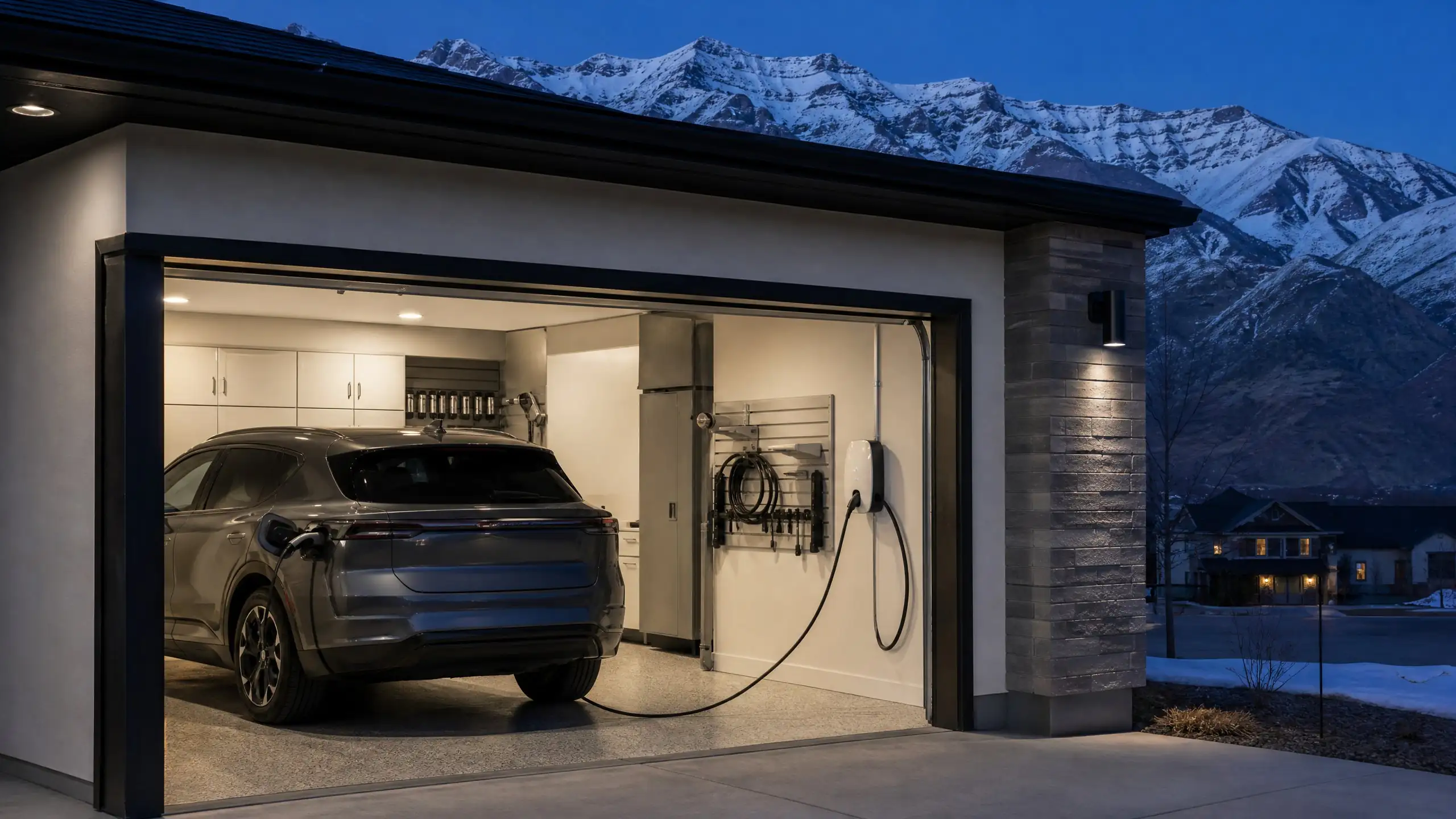
Is my R1S a NACS or a CCS1 model?
Rivian draws the line at model year 2026. A new R1S on sale now (rivian.com shows 2027 models) and any 2026 R1S have a NACS charge port. A used 2022 to 2025 R1S has a CCS1 port, which takes a J1772 plug at home. The Gen 2 badge does not settle it: Rivian labels Gen 2 as 2025 and later.
| R1S you own or are buying | Port | Rivian charger that plugs straight in |
|---|---|---|
| Used 2022 to 2025 | CCS1 | Wall Charger, J1772 |
| New or used 2026 and later | NACS | Wall Charger, NACS |
Port years from Rivian's charging network and NACS vehicle support pages. Both Wall Charger versions are 48 amps and $800 on Rivian's Gear Shop as of October 4, 2026.
Buying a new R1S: which charger fits?
The NACS Wall Charger is the direct match, and Rivian says it suits "2026+ Rivian vehicles." Rivian also says R1 orders include a J1772 AC charging adapter, so a new R1S can use any J1772 Level 2 charger, including one already on your wall. That matters if you are replacing an older Rivian or another J1772 EV.
Rivian rates its J1772 AC Adapter at 80 amps and 250 volts, for "Level 2 AC chargers only." That comfortably covers a 48 amp home unit. Rivian's DC adapters are a separate thing for public fast charging and must not be used on AC chargers.
If you are starting from scratch with only NACS cars in the garage, the NACS version avoids keeping an adapter on the handle. If a J1772 car will stay, the J1772 version covers everyone. Full specs are in our Rivian Wall Charger guide.
Buying a used 2022 to 2025 R1S: what to check
Plan on a J1772 charger. Rivian says the NACS Wall Charger "is not compatible with a J1772 port without a separate adapter," and Rivian's Gear Shop lists no AC adapter for that direction. Rivian's NACS DC Adapter for these SUVs is for DC fast chargers such as Tesla Superchargers only, not home charging.
Ask the seller whether a Rivian Wall Charger or Portable Charger comes with the sale. A J1772 Wall Charger moved from another house needs a fresh hardwired install on a circuit sized to its dip switch setting, which the installer checks against the new breaker. Any J1772 charger from another brand works too; compare them on home EV chargers.
What circuit does an R1S need?
A 60 amp circuit with a 48 amp hardwired charger gives full speed. Rivian says the onboard charger provides 11.5 kW to the R1S battery, with no split by model year, and 48 amps at 240 volts is 11.5 kW. The home EV charger installation page covers the rest of the job. Going bigger adds cost, not speed. A NEMA 14-50 with Rivian's 32 amp Portable Charger is the slower alternative.
| Setup | Breaker | Rivian's quoted range per hour |
|---|---|---|
| 48 A hardwired charger | 60 A | Up to 25 mi |
| Portable Charger, NEMA 14-50 | 50 A GFCI | Up to 16 mi (32 A, 7.6 kW) |
The 125 percent continuous-load rule sets these pairs: 48 amps needs 60, and a 50 amp outlet circuit supports at most 40. A receptacle installed for EV charging needs GFCI protection under NEC 625.54. Hardwiring avoids that, and Rivian's Wall Charger is hardwired only. More on Level 2 charger installation, breaker sizing and hardwired vs NEMA 14-50.
How do two Rivians share one garage?
The simplest route is one J1772 Wall Charger: an older CCS1 Rivian plugs in directly, and a 2026 or later Rivian uses its J1772 AC Adapter. For both cars to charge at once, you need two circuits, or one circuit plus an energy management system that divides the current.
Rivian's 2022 installation guide does not describe sharing power between two Wall Chargers. Under NEC 220.70, an energy management system lets the load calculation count its setpoint rather than two full chargers, which can keep a second circuit from forcing a panel upgrade. See EV charger load management.
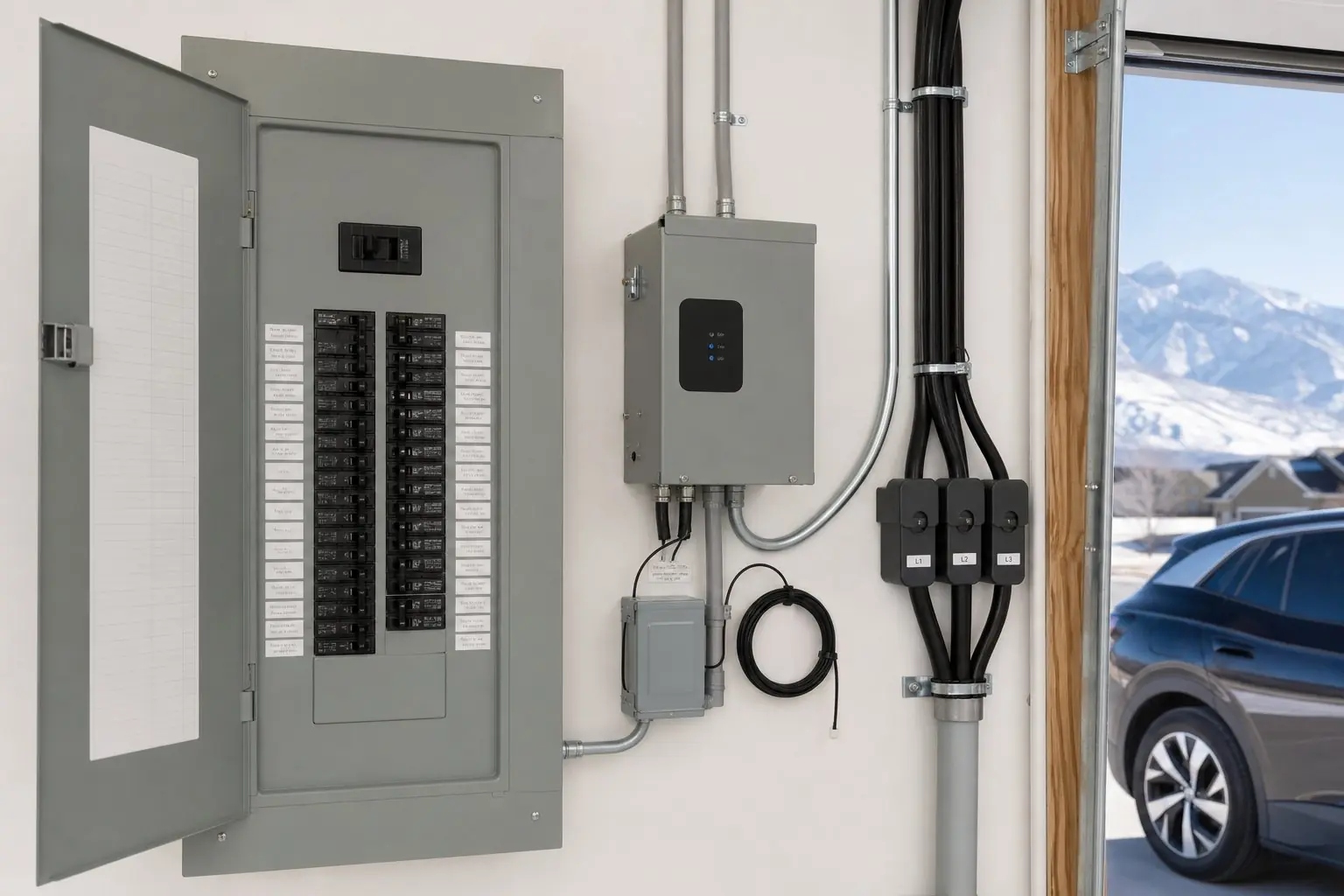
Before any install, check the electrician's license on the Utah DOPL lookup: Rivian's 4 year Wall Charger warranty requires a licensed electrician. A panel upgrade is our last suggestion, not our first: load management gets checked first.
R1S home charging questions
I'm buying a new R1S. Which Rivian Wall Charger do I order?
A 2026 or later R1S has a NACS port, so the NACS Wall Charger plugs straight in. If an older Rivian or another J1772 car shares the garage, the J1772 Wall Charger plus Rivian's J1772 AC Adapter serves both. Rivian says R1 orders include that adapter.
Will the charger from my old R1S work on my new one?
Yes, if it is the J1772 Wall Charger. A 2026 or later R1S uses Rivian's J1772 AC Adapter, rated 80 amps and 250 volts for Level 2 AC chargers. It does not work the other way: the NACS Wall Charger will not charge a 2022 to 2025 R1S without an adapter Rivian does not list.
How long does an R1S take to charge at home?
Rivian publishes speed, not full charge times: up to 25 miles of range per hour on its 48 amp Wall Charger and up to 16 miles per hour on the Portable Charger from a NEMA 14-50. Rivian cites an average daily distance of 30 to 37 miles, which is under two hours on the Wall Charger at that rate.
Does a used R1S need a different circuit than a new one?
No. Rivian lists one onboard charger figure, 11.5 kW, for the R1S without a split by year. Both a used 2022 to 2025 R1S and a new 2027 R1S use a 48 amp charger on a 60 amp circuit for full speed. Only the plug differs.
Can two Rivians share one 60 amp circuit?
Rivian's 2022 Wall Charger guide does not describe power sharing between units, so plan for one charger per circuit or a separate energy management system. Alternating nights on one charger also works: at Rivian's quoted 25 miles per hour, an 8 hour night adds up to about 200 miles.
New R1S on order, or a used one in the driveway? Tell us the model year on the quote request.
Get an R1S charger quote