
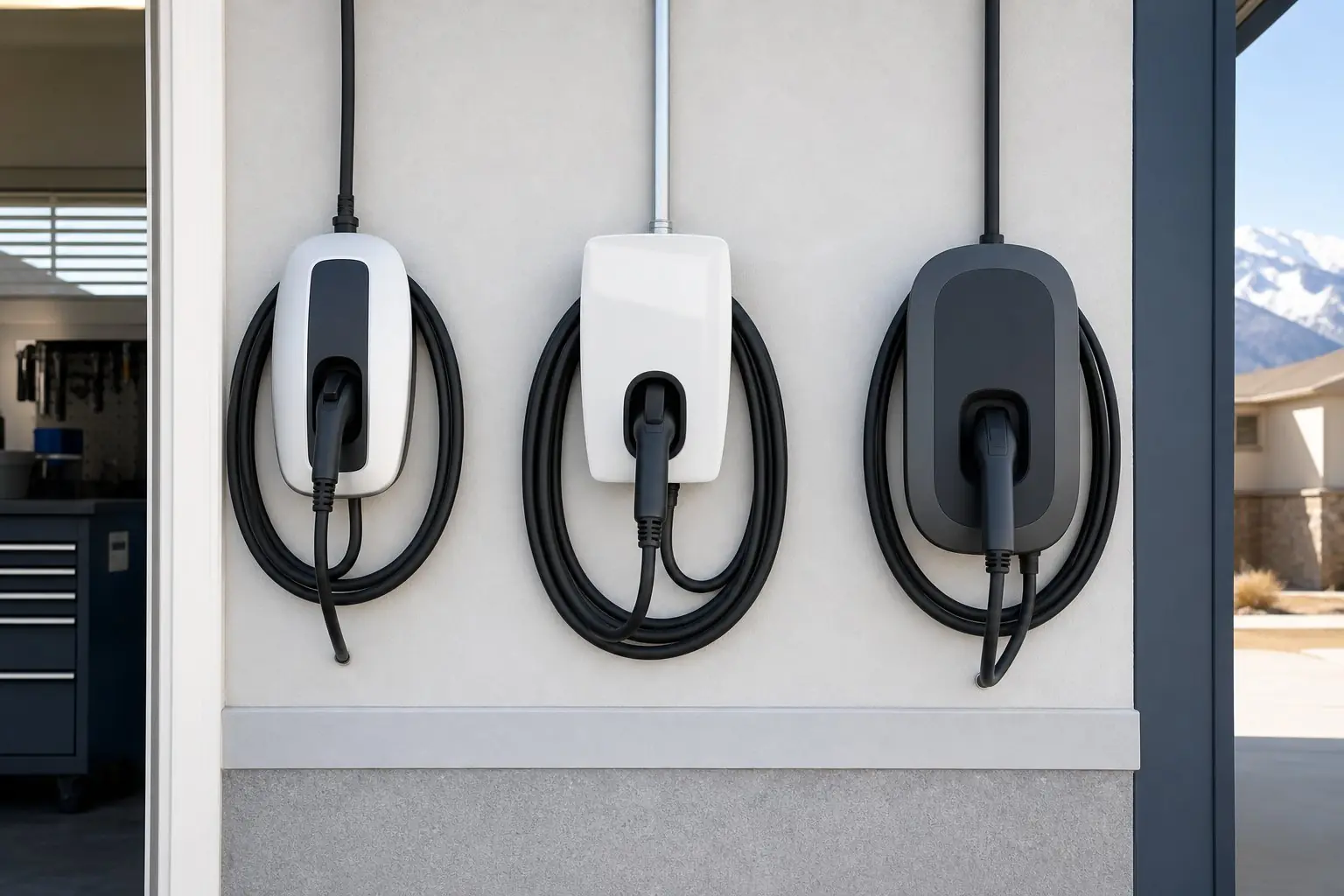
What is the difference between ChargePoint and Emporia?
On the hardware, not much: both are 240 volt chargers sold in J1772 or NACS versions, hardwired or plug-in, rated -22°F to 122°F, with three-year warranties. The real split is the panel. The Emporia Pro comes with an energy monitor that throttles charging to fit your service. The Home Flex reaches 50 amps and has a wider choice of plugs.
| Spec | ChargePoint Home Flex (CPH50) | Emporia Pro |
|---|---|---|
| Max output, hardwired | 50 A, 12 kW (70 or 80 A breaker) | 48 A, 11.5 kW (60 A breaker) |
| Plug-in versions | NEMA 14-50 or NEMA 6-50, 32 or 40 A | NEMA 14-50, 40 A |
| Settings | 16, 24, 32, 40, 48, 50 A | Nine steps, 12 to 48 A |
| Connector | J1772 or NACS | J1772 or NACS |
| Cable | 23 ft | 25 ft |
| Enclosure | Type 3R | Type 4 |
| Operating temperature | -22°F to 122°F | -22°F to 122°F |
| Wireless | 2.4 and 5 GHz Wi-Fi, plus Bluetooth | 2.4 GHz Wi-Fi |
| Whole-home load management | Check ChargePoint's documentation | PowerSmart, Vue 3 monitor included |
| Weight | 13.8 lb | Not stated in the documents we read |
| Warranty | 3 years parts | 3 years |
ChargePoint figures are from its April 2025 Home Flex datasheet and installation pages; Emporia figures from its Pro sell sheet, installation guide and March 2026 Classic vs Pro comparison. Prices are left out because they change often.
Emporia also sells the Classic, which leaves out the Vue monitor; PowerSmart is a paid upgrade for it. Full details are on our ChargePoint Home Flex and Emporia EV charger pages.
Which one charges faster?
For almost every car, they tie. Both deliver 48 amps on a 60 amp breaker and 40 amps on a 14-50. The Home Flex adds a 50 amp setting, but it needs a 70 or 80 amp breaker and only helps a car whose onboard charger accepts more than 48 amps.
Check your car's rating in our vehicle charging guides. If you are weighing the top two settings, see 40 amp vs 48 amp EV charger.
Which is better on a panel with little room to spare?
The Emporia Pro, on two counts. Its Vue 3 monitor lets PowerSmart slow charging whenever the whole house nears the service rating your electrician enters. And it accepts nine breaker sizes, including 45, 35 and 25 amps, so it can use a circuit that falls between the Home Flex's steps.
Emporia's guide asks the electrician for three numbers at setup: the service rating, the maximum charge rate from the breaker, and a guaranteed charge rate worked out "using load calculation methods in NEC Article 220." If the monitor goes offline, the charger falls back to that guaranteed rate. The 2023 NEC, adopted in Utah, recognizes this kind of system in 220.70. Installing the Vue means work inside the main panel, so it is part of the charger job.
The Home Flex fits a tight panel the simpler way: a lower setting on a smaller breaker. ChargePoint requires a new, dedicated two-pole breaker matched to the setting and warns a mismatch can trip mid-session. More options are on EV charger load management and panel upgrades for EV charging.
Which plug-in version fits your outlet?
If you already have a NEMA 6-50, only the Home Flex comes in that version. Both come in NEMA 14-50. The Home Flex plug-in is capped at 32 or 40 amps and has a 12 inch input cord, so the outlet must sit 20 to 26 inches above the floor. The Emporia plug version has a 28 inch cord and is capped at 40 amps.
In Utah, a receptacle installed for EV charging needs GFCI protection, and both makers warn a GFCI breaker can nuisance-trip on top of the charger's own protection. ChargePoint recommends "a hardwire installation" where code requires the GFCI, and Emporia recommends its hardwire version. Emporia offers two hardwired options, a 3 foot conduit whip or rear entry. See hardwired vs NEMA 14-50.
What about two EVs?
Emporia's Load Sharing, announced in October 2025, splits power between two or more Emporia chargers, on one shared circuit or separate ones, with at least 6 amps each. We did not find a matching feature for the Home Flex in the ChargePoint documents we read, so ask ChargePoint before planning on one.
Wi-Fi and outdoor mounting
The Home Flex supports 2.4 and 5 GHz Wi-Fi and lets the electrician set the amperage over Bluetooth without a network. The Emporia Pro uses 2.4 GHz, and PowerSmart needs the app and an internet connection; the Vue itself can use wired Ethernet when the garage is far from the router. Both are rated to -22°F for Ogden Valley winters. Emporia's Type 4 enclosure is the higher rating; the Home Flex is Type 3R, and ChargePoint says hardwiring "is recommended for outdoor use." See outdoor EV charger installation.
Pros and cons side by side
| Factor | ChargePoint Home Flex | Emporia Pro |
|---|---|---|
| Top output | 50 A, on a 70 or 80 A breaker | 48 A, on a 60 A breaker |
| Plug options | NEMA 14-50 or 6-50 | NEMA 14-50 only |
| Tight panel | Six fixed settings | Nine settings plus PowerSmart |
| Extra panel work | None beyond the circuit | Vue 3 monitor installed in the panel |
| Wi-Fi | 2.4 and 5 GHz | 2.4 GHz; Vue can use Ethernet |
| Cable | 23 ft | 25 ft |
Choose a ChargePoint Home Flex if
- You have a NEMA 6-50 outlet already, or want a plug-in unit at 32 or 40 amps.
- Your car accepts more than 48 amps and your panel can spare a 70 or 80 amp circuit.
- You do not need whole-home load management and want nothing extra in the panel.
Choose an Emporia Pro if
- Your panel looks full and load management could avoid a service upgrade.
- A breaker size between the usual steps, such as 45 amps, is what your panel can spare.
- You may add a second Emporia charger and want them to share power.
ChargePoint vs Emporia questions
Is ChargePoint or Emporia faster?
Hardwired, the Home Flex reaches 50 amps (12 kW) on a 70 or 80 amp breaker and the Emporia Pro reaches 48 amps (11.5 kW) on a 60 amp breaker. On a NEMA 14-50, both stop at 40 amps. Unless your car's onboard charger accepts more than 48 amps, they charge at the same speed.
What is the difference between the Emporia Pro and Classic?
The Pro is bundled with the Vue 3 Energy Monitor, so PowerSmart load management works from day one, and it charges at up to 48 amps. On the Classic, PowerSmart is a paid upgrade and the Vue is bought separately. Emporia lists a 25 foot cable, NEMA 4 enclosure and three-year warranty for both.
Do I need a GFCI breaker for either charger?
Hardwired, no: ChargePoint says to use a non-GFCI breaker and Emporia says to always use a standard non-GFCI breaker, since both have ground-fault protection built in. A plug-in version on a NEMA 14-50 in Utah needs GFCI protection on the receptacle, and both makers recommend hardwiring where code requires that.
Which has the better warranty?
They match on length. ChargePoint's datasheet lists a three-year parts warranty for the Home Flex, and Emporia lists three years for its chargers. Read each company's current terms before buying.
Choosing between the two? Send your car model, your main breaker size and a photo of your panel.
Get a charger installation quote