
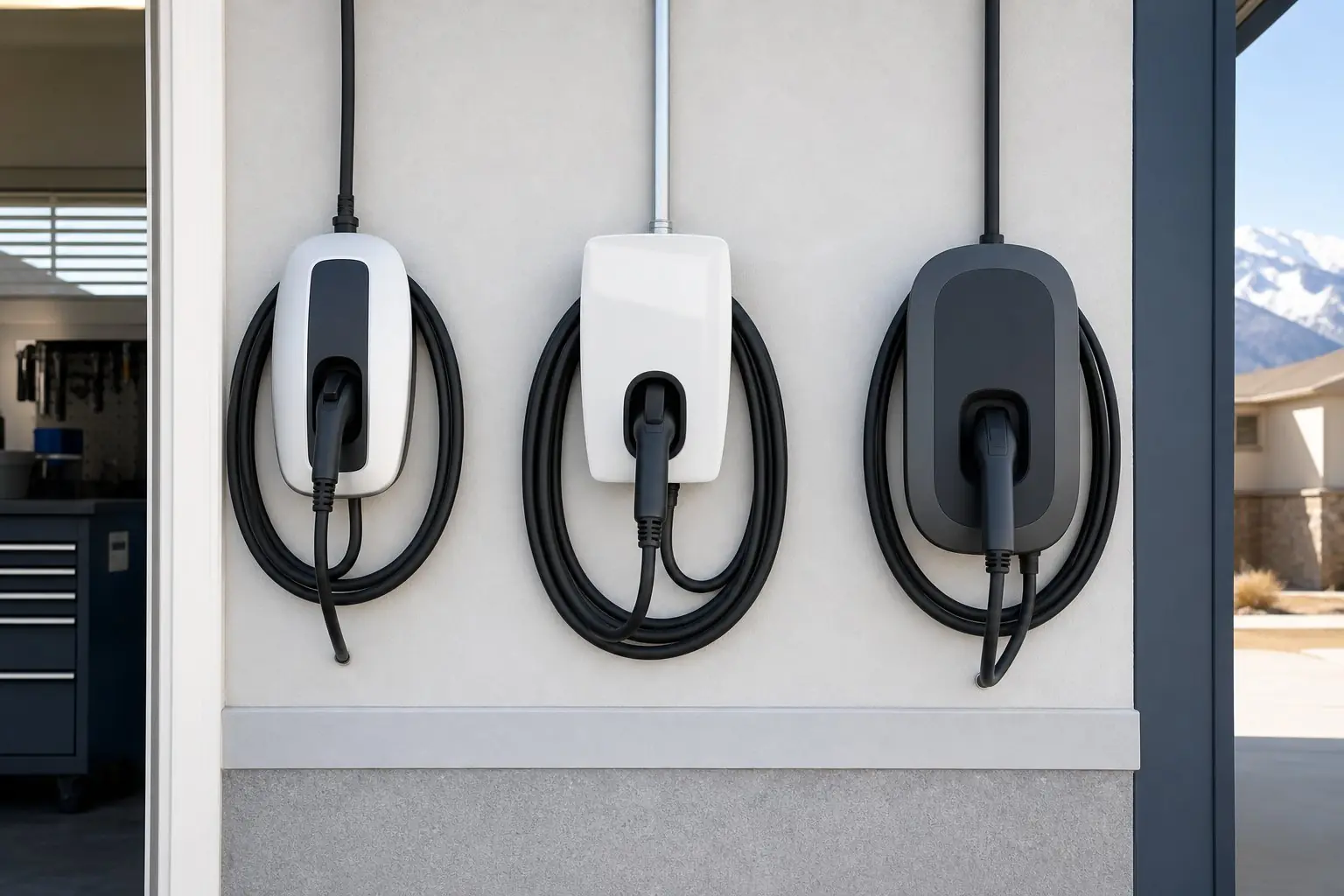
What is the difference between an OEM and a third-party charger?
An OEM charger is sold by your car's maker, such as Tesla, Rivian, GM Energy or Ford, and is set up for that brand's cars and app. A third-party charger comes from a charging company and is sold for any car with a matching plug. On the electrical side they are the same: a 48 amp unit needs a 60 amp circuit either way.
Will an OEM charger work with other brands of car?
Sometimes, and it depends on the plug. OEM units are built around their brand's charge port and model years. Tesla's own home charging page lists the standard Wall Connector for Tesla vehicles and the Universal Wall Connector for all EVs. Third-party brands usually sell both J1772 and NACS versions.
| OEM charger | Output | Connector and fit |
|---|---|---|
| Tesla Wall Connector (Gen 3) | 48 A, hardwired only | NACS; Tesla lists it for Tesla vehicles |
| Tesla Universal Wall Connector | 48 A, hardwired only | NACS plus a built-in J1772 adapter |
| Rivian Wall Charger | 48 A, hardwired | J1772 for 2022 to 2025 R1; NACS for 2026 and later |
| GM PowerUp 2 | 48 A, hardwired | J1772 or NACS versions |
| GM Energy PowerShift | 80 A | CCS1 connector; vehicle-to-home with GM's kit |
| Ford Charge Station Pro | 80 A | No longer sold, per Ford |
From each maker's manual, datasheet or product page, checked October 4, 2026. Ford's 48 amp Connected Charge Station appears in Ford's August 2025 comparison table; check whether Ford still sells it. More on our Ford Charge Station Pro page.
Adapters do not always bridge the gap. Rivian says its J1772 Wall Charger is "not compatible with a NACS port without a separate adapter." Ford says its NACS adapter is "not compatible with Level 1 or Level 2 AC chargers," so a CCS1-port Ford cannot use it on a NACS home charger. GM sells a NACS Level 2 adapter that lets its CCS1-port cars use NACS home chargers, and the PowerUp 2 manual warns against non-GM-approved adapters. Mixed garages are covered in Universal Wall Connector vs Wall Connector.
How do the apps and setup differ?
OEM chargers tend to live inside the car's own app. GM's PowerUp 2 connects through myChevrolet, myBuick, myGMC or myCadillac using your vehicle account, and Rivian's Wall Charger is added in the Rivian app. Third-party chargers use their own app, which works the same whatever car you drive.
Tesla commissions its Wall Connectors through Tesla One, its installer app, and owners manage vehicle access in the Tesla app. Rivian allows one Rivian account per charger. Grizzl-E also sells a Classic model with no internet connection at all. If you change car brands later, a third-party app follows you; an OEM app may not.
Which has better power sharing and extra features?
It depends on the feature. Tesla lets up to six Wall Connectors at one site share power. Wallbox and Emporia offer whole-home load management with their own meters. GM's PowerShift supports vehicle-to-home backup with GM's kit. Rivian's install guide describes no power sharing between units.
See EV charger load management. Ford's backup-power route through the Charge Station Pro has closed for new installs, since Ford no longer sells the unit. Lightning details are on the F-150 Lightning home charging page.
How do the warranties compare?
OEM warranties are not automatically longer. Tesla gives 48 months for personal use, Rivian 4 years on parts and labor, while most third-party brands give three years and Grizzl-E three or five. Several makers tie coverage to a proper installation.
| Charger | Warranty stated by the maker |
|---|---|
| Tesla Wall Connector | 48 months personal use; 12 months commercial use |
| Rivian Wall Charger | 4 years, parts and labor |
| GM PowerUp 2 | Check with the manufacturer |
| ChargePoint Home Flex | 3 years, parts |
| Wallbox Pulsar Plus | 3 years |
| Emporia Classic and Pro | 3 years |
| Grizzl-E | 3 or 5 years, by model |
| Autel MaxiCharger AC Elite Home | 36 months |
Rivian requires installation by a licensed electrician. GM's manual says the PowerUp 2 can only be installed by licensed contractors or electricians. ChargePoint says any licensed electrician can install its home chargers. Tesla requires trained, qualified personnel and excludes damage from improper installation.
Does the choice change installation cost?
Less than people expect. The circuit, breaker and wire are set by the charger's output, not its brand. The differences are hardwired versus plug-in, since the Tesla, Rivian and GM PowerUp 2 units are hardwired only, and any adapters a second car needs.
Several third-party chargers come in NEMA 14-50 plug-in versions capped at 40 amps; see hardwired vs NEMA 14-50. Cost factors are in EV charger installation cost.
Choose an OEM charger if
- Every car you will charge is that brand and uses its connector.
- You want setup inside the car's app, or a brand feature such as Tesla power sharing or GM vehicle-to-home.
Choose a third-party charger if
- You have two car brands, or expect to switch.
- You want a plug-in charger, whole-home load management, or no Wi-Fi at all.
Model-by-model specs are on our home EV chargers page.
OEM vs third-party charger questions
Does an automaker's charger charge my car faster?
Not because of the brand. Charging speed is the lowest of the charger's setting, the circuit and the car's onboard charger. The Tesla Wall Connector, Rivian Wall Charger and GM PowerUp 2 are all 48 amp units, and several third-party chargers reach 48 amps or more on the same 60 amp circuit.
Will a third-party charger void my car's warranty?
We found no automaker statement saying so in the documents we checked. Tesla's Wall Connector manual does warn that damage from incorrect installation is excluded from both the vehicle and charger warranties, which is a reason to have any charger installed and tested properly.
Which charger works best in a garage with two different EV brands?
A unit whose connector fits both cars, or one with two connectors. Tesla's Universal Wall Connector carries a NACS handle plus a built-in J1772 adapter, and most third-party brands sell J1772 and NACS versions. Check adapter ratings: Ford's NACS adapter is for DC fast charging only.
Do I need a certified installer for a Tesla Wall Connector?
Tesla's installation manuals require personnel who are trained and qualified to work on electrical systems, and they tell installers who are not Tesla Certified Installers to register as Unknown. We found no certified-installer requirement for the warranty in those manuals.
Choosing between brands? Start with your car model and a photo of your panel.
Get a charger installation quote